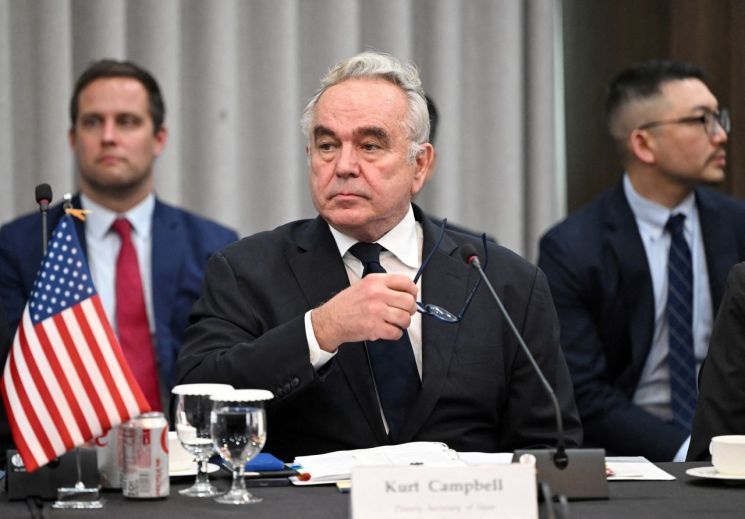
The U.S. administration under Joe Biden announced on the 19th (local time) that it plans to engage in high-level face-to-face diplomacy soon with the South Korean government led by Acting President and Prime Minister Han Duck-soo.
Kurt Campbell, U.S. Deputy Secretary of State, said at an Asia-Pacific regional press briefing held in Washington D.C. on the same day, "The United States plans to have high-level face-to-face engagement with the South Korean government under Acting President Han within the last weeks of the Biden administration's term."
Accordingly, attention is focused on the possibility of visits by the foreign ministers of South Korea and the U.S. or other high-level officials to each other's countries before the U.S. administration changes on January 20 next year. The U.S. government had postponed the Korea-U.S. Nuclear Consultative Group (NCG) meetings and tabletop exercises, as well as U.S. Secretary of Defense Lloyd Austin's visit to South Korea, following President Yoon Suk-yeol's declaration of martial law on the 3rd. This has raised growing concerns that diplomatic relations with the U.S. could face significant setbacks amid South Korea's martial law situation and the impeachment proceedings against President Yoon.
Deputy Secretary Campbell stated, "The United States has supported the constitutional measures taken by South Korea during this uncertain period and has expressed trust in South Korea's management of this difficult time." He also evaluated Acting President Han, saying, "He has decades of experience serving in the South Korean government and served as ambassador to the U.S. from 2009 to 2012, so we know him well." He added, "We fully support his role within South Korea," and said, "We will do our best to continue sending strong signals of deep engagement (between South Korea and the U.S.)."
Furthermore, he said, "We are keeping all communication channels open not only with the acting government but also with other actors involved in the crisis," implying that the U.S. Embassy in South Korea is communicating with both ruling and opposition political parties in South Korea.
In addition, when asked about the prospects for North Korea-U.S. diplomacy under the second Trump administration set to begin in January next year, Deputy Secretary Campbell responded, "I think he (President-elect Trump) remains very focused on North Korea and Kim Jong-un (Chairman of the State Affairs Commission of North Korea)." He went on to say that "the situation has changed compared to Trump's first term," pointing out that "the cooperation between North Korea and Russia has deepened, and some of the measures taken by North Korea are provocative and concerning." He also mentioned, "I cannot say whether the diplomatic approach pursued in Singapore and Vietnam (the venues of the 1st and 2nd North Korea-U.S. summits in 2018?19) was effective."
Previously, President-elect Trump met with Chairman Kim in Singapore in 2018, and in Vietnam and Panmunjom in 2019 during his first term. However, despite the successive summits, they failed to reach substantive agreements on the North Korean nuclear issue and peace on the Korean Peninsula.
© The Asia Business Daily(www.asiae.co.kr). All rights reserved.
![Clutching a Stolen Dior Bag, Saying "I Hate Being Poor but Real"... The Grotesque Con of a "Human Knockoff" [Slate]](https://cwcontent.asiae.co.kr/asiaresize/183/2026021902243444107_1771435474.jpg)
















