April 18th, 4 PM at Gwangalli Homers Hotel, 'Busan Future Aviation Cluster Council Forum' Held
Industry-Academia-Research Experts Discuss Aviation Composite Specialization, Supply Chain Securing, Opportunity Factors, Overcoming Limitations, and Systems
Busan City held the ‘Busan Future Aviation Cluster Forum’ to strengthen the cooperation system among government, industry, academia, and research institutes for the creation of the ‘Future Aviation Cooperation Complex (Cluster)’ within the Eco Delta City Phase 2 area on the west side of Gimhae Airport.
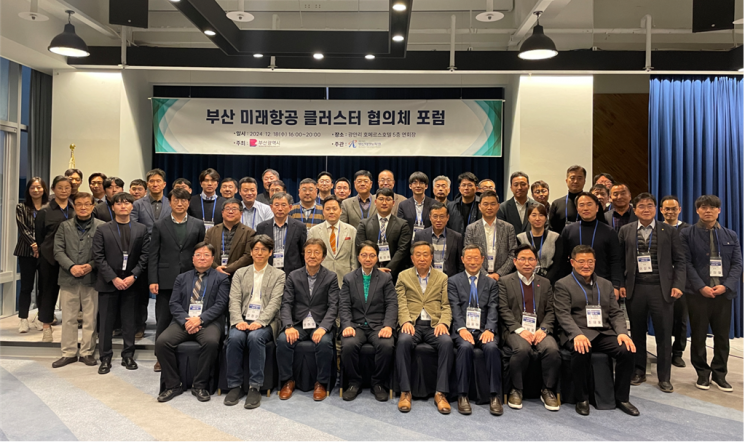 Participants of the 'Busan Future Aviation Cluster Council Forum' are taking a commemorative photo. Provided by Busan City
On the 18th at 4 p.m., about 90 participants including the Director of the Advanced Industry Bureau of the city, the Director of Busan Technopark, representatives from Korean Air Aerospace Business Division, the Korea Carbon Nano Industry Association, and aerospace material and parts companies gathered at the Homers Hotel in Gwangalli to share diverse opinions on promoting pilot projects for establishing the Busan Future Aviation Cooperation Complex (Cluster).
The forum proceeded in the order of ▲ progress on policies for establishing the Busan Future Aviation Cooperation Complex (Cluster) ▲ current status of aerospace material and parts R&D based on the global supply chain ▲ presentation on technology development plans for aircraft parts assembly processes based on AI autonomous manufacturing ▲ and panel discussion.
The city expects the future aviation industry to act as a trigger to revitalize the local manufacturing sector, which has been stagnant, and is focusing on building related infrastructure.
The aerospace industry is a sector with rapidly increasing demand in the global market and is undergoing swift supply chain restructuring. It is regarded as a high value-added market with intense competition.
The future aviation industry is a new industry concept encompassing new types of aircraft such as unmanned aerial vehicles and Advanced Air Mobility (AAM) within the next-generation commercial aircraft sector, where new model development and supply chain restructuring are underway.
With the possibility of cooperation with the existing aerospace cooperation cluster, the plan is to focus on developing aerospace composite parts as a differentiated strategy to respond to the global supply chain.
In March, the city signed a memorandum of understanding in Stade, Germany, with Airbus ‘CTC’, Korean Air, and Busan Technopark, and in October, Mayor Park Hyung-jun and the ‘CTC’ representative agreed to open the Asia’s first ‘CTC Korea Office’ within Busan Technopark.
Based on this, infrastructure is being established to support full-cycle R&D and demonstration from raw materials to production for the localization of domestic aerospace composite parts.
In particular, in October, Busan became the only city nationwide to attract the ‘AI Autonomous Manufacturing Leading Project’ as a strategic industry for the aerospace sector and is accelerating pilot projects for building the future aviation cooperation complex (cluster), including the establishment of an advanced manufacturing demonstration support center.
At the forum, various opinions were presented by leading domestic experts from industry, academia, and research institutes on building a ‘Sustainable Busan Future Aviation Cooperation Complex (Cluster).’
Topics discussed included the necessity and opportunities for a composite material specialized cluster in the domestic aerospace industry, Busan’s advantages and coexistence plans with existing aerospace clusters, overcoming limitations in industry development, and policy proposals for attracting small and medium-sized enterprises.
The city plans to officially launch the ‘Busan Future Aviation Cluster Council’ next year based on this forum and establish a comprehensive plan (master plan) covering R&D, infrastructure, and systems necessary for cluster development through the operation of a working group.
The council’s goals are ▲ to establish a foundation for acquiring ‘Super Tier-1’ status in the global supply chain ▲ to build a mobility lightweight composite specialized complex centered on the aerospace industry ▲ and to create a sustainable cooperation complex (cluster) through strengthened collaboration with global OEM companies.
Additionally, continuous exchanges and cooperative R&D with Airbus ‘CTC’ will be promoted, and support will be provided to enable broad participation of aerospace parts and materials companies.
Park Dong-seok, Director of the Advanced Industry Bureau, stated, “We will actively promote key policies such as talent supply, benefit provision, and R&D support to maximize Busan’s city advantages and make the future aviation cooperation complex a hub for the Asian supply chain in the global aircraft parts market.”
© The Asia Business Daily(www.asiae.co.kr). All rights reserved.
![User Who Sold Erroneously Deposited Bitcoins to Repay Debt and Fund Entertainment... What Did the Supreme Court Decide in 2021? [Legal Issue Check]](https://cwcontent.asiae.co.kr/asiaresize/183/2026020910431234020_1770601391.png)















