Choi Sang-mok, Deputy Prime Minister for Economy and Minister of Strategy and Finance, forecasted that the decision by the United States to cut interest rates could increase uncertainty in the domestic financial and foreign exchange markets. He also expressed the intention to implement additional market stabilization measures if market volatility becomes excessive.
On the 19th, Deputy Prime Minister Choi held a macroeconomic and financial meeting at the Korea Federation of Banks building in Jung-gu, Seoul, stating, “While major global currencies are showing significant weakness, our financial and foreign exchange markets are also expected to experience increased volatility in the short term.”
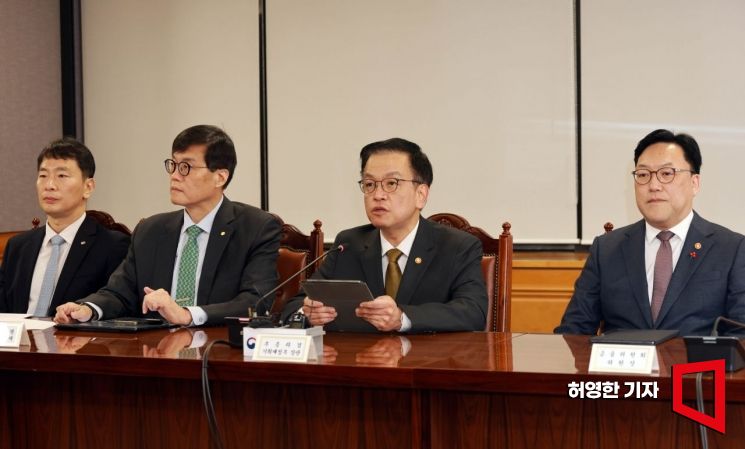 On the 19th, before the Macroeconomic Financial Meeting held at the Bankers Hall in Myeongdong, Seoul, Choi Sang-mok, Deputy Prime Minister for Economic Affairs and Minister of Strategy and Finance, is delivering opening remarks. From the left are Lee Bok-hyun, Governor of the Financial Supervisory Service; Lee Chang-yong, Governor of the Bank of Korea; Deputy Prime Minister Choi; and Kim Byung-hwan, Chairman of the Financial Services Commission.
The meeting was convened to assess the weakening of major global currencies following the Federal Open Market Committee (FOMC)’s interest rate cut decision, global financial market trends, and the domestic impact. The U.S. Federal Reserve (Fed) lowered its benchmark interest rate by 0.25 percentage points to 4.25?4.5% on the 18th (local time), marking the third consecutive cut. However, Fed Chair Jerome Powell indicated an intention to slow the pace of rate cuts.
Deputy Prime Minister Choi explained, “Chairman Powell mentioned in the press conference that he might be cautious about further cuts, suggesting the possibility of adjusting the pace of monetary easing. Despite the rate cut, the global financial markets reacted to the meeting’s results as tightening, causing U.S. Treasury yields and the dollar’s value to rise sharply early this morning.”
He continued, “Excessive one-sided market movements can lead to significant counter-reactions in the opposite direction later. The government and the Bank of Korea will maintain a high level of vigilance by operating a 24-hour monitoring system for the financial and foreign exchange markets, and if volatility becomes excessive, we will boldly and swiftly implement additional market stabilization measures,” he emphasized.
Deputy Prime Minister Choi also announced, “To stabilize the foreign exchange market and secure foreign currency liquidity, we will include measures to improve foreign exchange supply and demand, activate foreign exchange trading during extended hours, and enhance trading infrastructure related to the World Government Bond Index (WGBI) in next year’s economic policy directions.” He added that they will also prepare measures such as deferring the introduction of stress buffer capital regulations, strengthening the financial capacity of financial companies, alleviating financial burdens on small business owners through cooperation with the banking sector, and supporting low-income financial services.
© The Asia Business Daily(www.asiae.co.kr). All rights reserved.

















