'Perovskite-Crystalline Silicon Tandem Cell'
Produces 15% More Power in the Same Area
"Leading the Global Solar Market with Technological Competitiveness"
Hanwha Solutions Q CELLS Division (Hanwha Q CELLS) has recorded the world's highest power conversion efficiency with the next-generation solar cell known as the 'Perovskite-Crystalline Silicon Tandem Cell' (tandem cell). This achievement is seen as a significant step closer to the goal of commercializing next-generation solar cells for the first time.
Hanwha Q CELLS announced on the 19th that its M10 size tandem cell, developed and manufactured in-house, achieved a power conversion efficiency of 28.6%, earning certification from the internationally recognized German Fraunhofer Institute for Solar Energy Systems (Fraunhofer ISE).
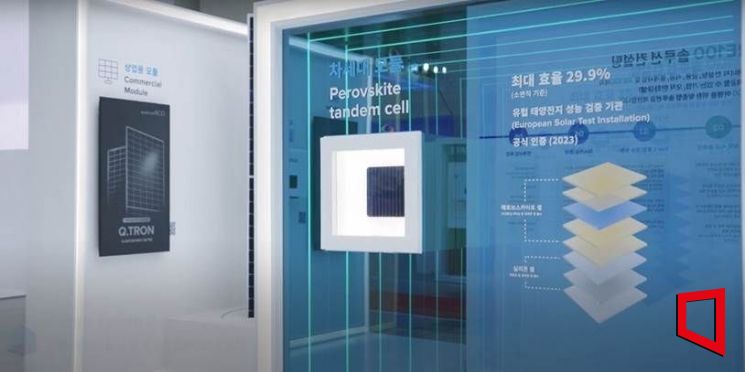
This is the world's first time that a large-area M10 (330.56㎠) cell, suitable for application in commercially available modules rather than small research-scale cells, has been produced and certified by a third-party institution.
The tandem cell stacks silicon cells and perovskite cells, which absorb light in different spectral regions, to maximize power generation efficiency, making it a leading candidate for next-generation solar cells. According to academia, the theoretical efficiency limit of tandem cells reaches 44%, which is about 50% higher than the 29% theoretical limit of conventional silicon cells.
Commercialization of high-efficiency tandem cells is expected to significantly accelerate the transition to renewable energy and improve economic feasibility. Installing tandem modules with power conversion efficiencies of around 26-27% instead of conventional silicon modules with efficiencies of 23-24% can produce approximately 15% more electricity.
Additionally, perovskite exhibits less variation in output due to temperature and solar irradiance changes, so tandem cells can reliably generate more power than single silicon cells even in hot climates or cloudy weather. Producing more power from the same area lowers the LCOE (Levelized Cost of Electricity) of solar power generation and enhances economic viability.
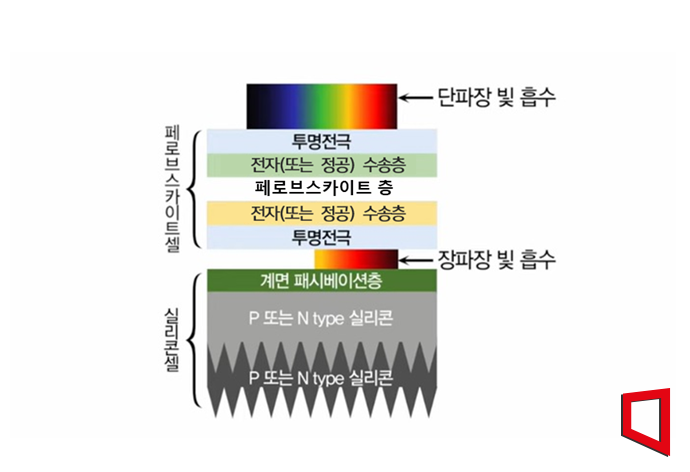
Hanwha Q CELLS has focused on developing manufacturing technologies applicable to mass production and module processes to accelerate the early commercialization of tandem cells. As a result, they created a bottom silicon cell using Hanwha Q CELLS’ proprietary Q.ANTUM technology and a top cell formed with their independently developed large-area perovskite thin-film formation technology. The bottom cell is made from commercial wafers, which is expected to facilitate future application in module processes.
Hanwha Q CELLS plans to conduct research and development to improve the performance and long-term reliability of tandem cells and modules. They aim to realize leading commercialization based on organic collaboration among the Jincheon factory in Korea, which operates the tandem cell pilot production line, the Thalheim R&D center in Germany, and the Pangyo R&D center.
The Hanwha Q CELLS Equipment Development Center, which is conducting R&D on next-generation solar cell manufacturing equipment, has produced key process equipment for mass production and plans to continue advancing research to complete the internalization of process equipment.
Hong Jeong-kwon, CEO of Hanwha Q CELLS, stated, "Once the high-efficiency tandem cell, known as a 'game changer' in the solar market, is commercialized, the efficiency and economic feasibility of solar energy will improve dramatically. We will continue to devote ourselves to research and development to succeed in mass-producing tandem cells for the first time in the world and lead the global solar market based on our technological competitiveness."
© The Asia Business Daily(www.asiae.co.kr). All rights reserved.
![User Who Sold Erroneously Deposited Bitcoins to Repay Debt and Fund Entertainment... What Did the Supreme Court Decide in 2021? [Legal Issue Check]](https://cwcontent.asiae.co.kr/asiaresize/183/2026020910431234020_1770601391.png)
















