Claims of Inability to Proceed with Constitutional Court Justice Appointment Procedure for Second Day
"If Prosecutor-like National Assembly Elects Judge-like Constitutional Court Justices, Fairness Is Undermined"
Constitutional Law Scholars: "National Assembly Appointment of Constitutional Court Justices Is According to the Constitution"
Kwon Seong-dong, the acting leader of the People Power Party and floor leader, who has raised issues regarding the appointment of constitutional court justices allocated to the National Assembly, argued that there is a procedural problem in proceeding with the selection of constitutional court justices while the National Assembly has passed the impeachment motion against the president. This follows Han Deok-soo, the acting president and prime minister, asserting the impossibility of appointing constitutional court justices. However, opposition parties and the legal academia rebut this by stating that the National Assembly’s appointment of constitutional court justices follows the constitution and is "completely baseless."
At the People Power Party’s members’ meeting held at the National Assembly on the 18th, Acting Leader Kwon said, "Since the presidential impeachment motion has passed the plenary session of the National Assembly and is pending at the Constitutional Court, the National Assembly has now become the accuser." He added, "After the National Assembly becomes the accuser, deciding on the constitutional court justices, who are the subjects of the impeachment motion, damages legal fairness." In the situation where the National Assembly assumes a kind of 'prosecutor' role regarding President Yoon Seok-yeol’s impeachment, intervening in the appointment of constitutional court justices, who correspond to 'judges,' poses procedural problems.
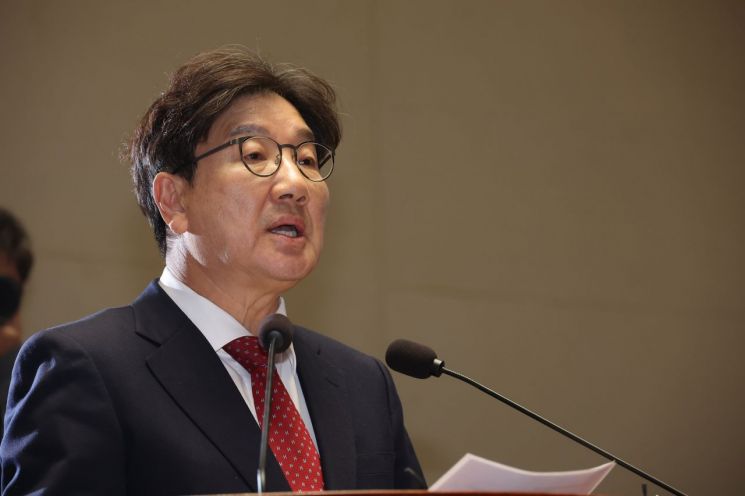
He referred to a past case where, during President Yoon Seok-yeol’s tenure as Prosecutor General, the Minister of Justice appointed disciplinary committee members to fill vacancies during a disciplinary cancellation lawsuit, which was ruled a procedural violation. He argued, "If the National Assembly, which passed the impeachment motion, recommends constitutional court justices, it violates the constitutional principles of fair trial and due process." He continued, "Whether to impeach the president is a matter of national importance, and constitutional spirit and procedural completeness must take precedence over partisan interests."
Kim Han, the Democratic Party’s secretary of the special committee on personnel hearings, countered Acting Leader Kwon’s claim that proceeding with the constitutional court justice appointment procedure at this time is a procedural defect by stating, "(The National Assembly proceeding with the constitutional court justice selection procedure) is all stipulated in the constitution."
Professor Lim Ji-bong of Sogang University Law School, former president of the Korean Constitutional Law Association, said, "Although the National Assembly has the right to impeach and thus corresponds to the plaintiff, constitutional court justices are appointed by the National Assembly, the Supreme Court, and the president, each nominating three justices according to Article 111 of the Constitution under the principle of separation of powers." He added, "All of this is done according to the constitution." Professor Lim also said, "The analogy that the National Assembly is like a prosecutor is correct, but the National Assembly following the related procedures is all done according to the constitution."
The previous day, Acting Leader Kwon also challenged the authority of Acting President Han, who holds the power to appoint constitutional court justices. He argued, "While the acting president can appoint constitutional court justices in the event of a presidential vacancy, they should not be able to do so during a suspension of presidential duties." This means that in a vacancy situation where the president cannot return to office, the acting president may exercise the appointment power, but in a suspension situation where the president can return to office, the use of appointment power should be restricted.
According to the logic Kwon has asserted over two days, the National Assembly should not proceed with the constitutional court justice selection procedure, which has already formed a personnel hearing committee, and even if Acting President Han appoints justices, the appointment procedure should not be followed.
The opposition views Kwon’s series of claims as a delaying tactic to postpone President Yoon’s impeachment trial. Park Chan-dae, the Democratic Party floor leader, demanded at the previous day’s floor strategy meeting, "The People Power Party should give up their petty procedural delay tactics."
© The Asia Business Daily(www.asiae.co.kr). All rights reserved.
![Clutching a Stolen Dior Bag, Saying "I Hate Being Poor but Real"... The Grotesque Con of a "Human Knockoff" [Slate]](https://cwcontent.asiae.co.kr/asiaresize/183/2026021902243444107_1771435474.jpg)
















