The National Academy of Engineering Holds Presentation on 'Semiconductor Special Committee Research Results'
"Urgent Need for Policies to Protect Manufacturing, Including Easing the 52-Hour Workweek"
Academia has raised the 'Seven Major Crisis Theory' that Korean semiconductors are falling behind overseas companies in technology, investment, and design capabilities. They advised strengthening the system (non-memory) ecosystem, accelerating research and development (R&D) activation, and speeding up policies for talent attraction. There was also an opinion that regulatory relaxation related to the 52-hour workweek system is necessary.
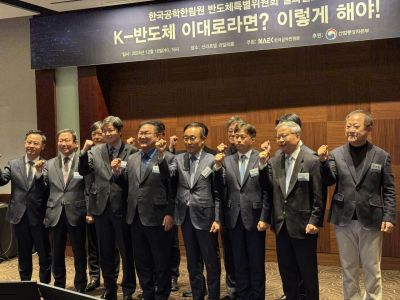 On the afternoon of the 18th, attendees of the Korean Academy of Engineering's 'Semiconductor Special Committee Research Results Presentation' held at the Shilla Hotel in Jung-gu, Seoul, are taking a commemorative photo. From the fourth person on the left: Kim Tae-nyeon, member of the Democratic Party of Korea; Kim Ki-nam, president of the Academy; Kwak No-jung, president of SK Hynix. Photo by Yonhap News.
The National Academy of Engineering of Korea announced on the afternoon of the 18th that it held the 'Semiconductor Special Committee Research Results Presentation' at the Shilla Hotel in Jung-gu, Seoul. This was a presentation of the research results of the 'Semiconductor Special Committee,' which has been studying the diagnosis of the K-semiconductor industry crisis and deriving solutions. Earlier, the Academy had launched the Semiconductor Special Committee in February.
The committee analyzed the current ecosystem of the domestic semiconductor industry and policies and systems amid the semiconductor technology inflection point such as the rapid rise of artificial intelligence (AI) semiconductors, and researched strategies to strengthen technological competitiveness and lead the industry from February to this month. Kwak No-jung, CEO of SK Hynix, and Lee Hyuk-jae, professor of the Department of Electrical and Computer Engineering at Seoul National University, served as co-chairs. The committee members include Kwon Seok-jun, professor of Polymer Engineering at Sungkyunkwan University, Ahn Hyun, President of Development at SK Hynix, Park Jae-hong, CEO of Boss Semiconductor, and Cho Myung-hyun, CEO of SemiFive, totaling eight members.
In his keynote speech that day, Professor Lee Hyuk-jae warned, "If we do not properly respond to the signs of crisis, K-semiconductors will fall behind in the global technology hegemony competition, and furthermore, it will leave irreversible damage to the entire Korean industry."
He then listed seven signs of crisis. The seven crises are ▲narrowing technology gap with overseas companies in memory semiconductors ▲weakening leading investment competitiveness ▲vulnerable materials, parts, equipment, fabless (design companies), and packaging industries ▲brain drain overseas ▲difficulty in establishing essential infrastructure such as power and water ▲unnecessary regulations ▲weakening diligent corporate and work culture.
In the subsequent topic presentation, four measures to overcome the crisis were proposed. The four measures are protecting manufacturing, strengthening the system (non-memory) semiconductor ecosystem, promoting research and development (R&D), and implementing policies to attract and bring in talent.
In particular, as a specific measure in the manufacturing protection presentation, relaxation of the 52-hour workweek system was raised. The National Academy of Engineering of Korea stated, "Semiconductors are a speed competition, so it is necessary to organize the causes that delay speed," and "redundant and unnecessary regulations must be eliminated, and we must break free from the shackles of the 52-hour workweek."
Additionally, alternatives proposed included timely support of power and water for the Yongin semiconductor cluster, providing incentives when domestic materials, parts, and equipment companies sell products to demand companies (such as Samsung and SK), and establishing a large-scale public research institute for advanced packaging development, manufacturing, verification, and certification evaluation.
Kim Ki-nam, chairman of the National Academy of Engineering of Korea, said, "Although the current political situation is severe, protecting semiconductors, which are the core of the Korean economy, is also very important," and added, "To this end, we have gathered experts' opinions over a year to announce ways to overcome the crisis of K-semiconductors, which are the core of our economy."
© The Asia Business Daily(www.asiae.co.kr). All rights reserved.
!["The Woman Who Threw Herself into the Water Clutching a Stolen Dior Bag"...A Grotesque Success Story That Shakes the Korean Psyche [Slate]](https://cwcontent.asiae.co.kr/asiaresize/183/2026021902243444107_1771435474.jpg)
















