Three candidates composed of one ruling party and two opposition party recommendations
In response to concerns about 'whether the National Assembly will appoint recommended judges'
Johan Chang: "Appointment aligns with the constitutional intent"
On the 18th, the National Assembly unilaterally launched a special committee to select Constitutional Court (Constitutional Court) justices. This was to fill the three vacancies for justices recommended by the National Assembly, which had been vacant for nearly three months. However, the People Power Party is not engaging in negotiations, citing the president's suspension from duty as the reason.
On the same day in the morning, the National Assembly held the 'Special Committee on Personnel Hearings for the Selection of Constitutional Court Justices (Personnel Hearing Special Committee).' The People Power Party and the Democratic Party of Korea had been disputing over the composition of the three candidates but announced last month that they would hold personnel hearings for two candidates recommended by the Democratic Party (Ma Eun-hyeok and Jeong Gye-seon) and one candidate recommended by the People Power Party (Jo Han-chang). The Constitutional Court is composed of nine justices, with three recommended each by the president, the National Assembly, and the Chief Justice of the Supreme Court.
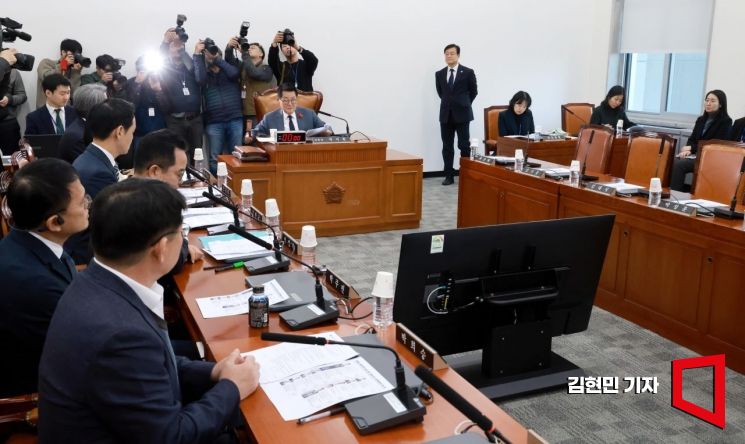 On the 18th, at the special committee for the confirmation hearing of Constitutional Court justices held at the National Assembly, Chairman Park Ji-won is striking the gavel. Members of the People Power Party were absent from this meeting. Photo by Kim Hyun-min
However, after the emergency martial law incident on December 3rd and the passage of the impeachment motion against President Yoon Seok-yeol in the National Assembly on the 14th, the People Power Party changed its stance. Their reason is that even if the three National Assembly-recommended candidates pass the personnel hearings, the acting president and Prime Minister Han Duck-soo cannot exercise the appointment authority for the three justices while the president is suspended from duty.
However, according to the written responses received from the three candidates by the Personnel Hearing Special Committee, all of them answered in the sense that "the acting president must appoint candidates elected by the National Assembly." Candidate Jo, recommended by the People Power Party, stated in his response, "If the National Assembly elects a specific person as a Constitutional Court justice, it is in line with the constitutional provisions that the president or acting president appoint that person as a Constitutional Court justice."
Park Ju-min, a member of the Personnel Hearing Special Committee, pointed out, "It is an ironic situation where even the candidate recommended by their own party says the procedure is appropriate, but Kwon Seong-dong, the floor leader of the People Power Party, says it is not." Regarding the question, "If the appointment is not made, can it be considered unconstitutional behavior?" Candidate Jo replied, "There has never been a case where the president did not appoint a person elected by the National Assembly as a Constitutional Court justice," adding, "It is not appropriate to express a specific opinion on hypothetical situations."
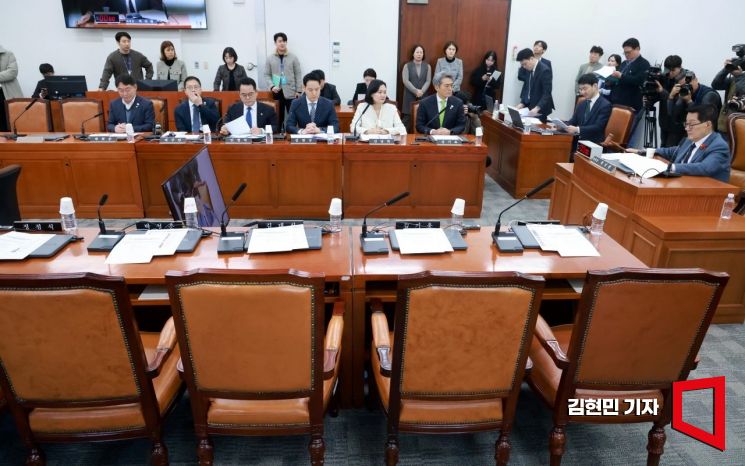 On the 18th, Park Ji-won, the chairman, struck the gavel at the Special Committee on the Constitutional Court Justices' Personnel Hearing held at the National Assembly. Ruling party lawmakers were absent from this meeting. Photo by Kim Hyun-min
Candidate Jeong, recommended by the Democratic Party, mentioned both sides' views. Jeong said, "There is also an opinion that even if the president or acting president does not appoint a justice elected by the National Assembly, the president's appointment authority is an inherent right and does not violate the constitution." However, he also expressed concern, "However, the substantial appointment authority lies with the National Assembly. If a vacancy arises due to the president's arbitrary non-exercise of appointment authority, it would cause serious problems not only in terms of protecting the subjective rights of individual citizens but also regarding the objective nature of constitutional adjudication."
Candidate Ma, based on the composition of the Constitutional Court justices (3·3·3), conveyed his opinion: "If the National Assembly elects a person through a lawful procedure, it is in line with the intent of the constitutional provisions mentioned above for the president or acting president to appoint that person as a justice."
© The Asia Business Daily(www.asiae.co.kr). All rights reserved.
![Clutching a Stolen Dior Bag, Saying "I Hate Being Poor but Real"... The Grotesque Con of a "Human Knockoff" [Slate]](https://cwcontent.asiae.co.kr/asiaresize/183/2026021902243444107_1771435474.jpg)

















