KCCI Hosts Meeting with Heads of Economic Research Institutes from 8 Companies
"The government and the National Assembly must continuously convey to overseas parties the trust that our economic system is functioning normally."
Amid unstable domestic and international situations, heads of corporate research institutes in Korea urged the government and the National Assembly to thoroughly manage macroeconomic indicators and restore national credibility. They also stated that the control tower should be unified to respond to the reduction of U.S. subsidies raised with the launch of the second Trump administration.
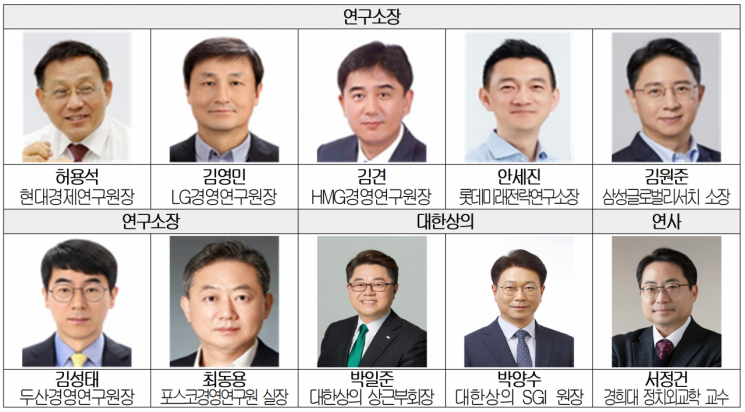
The Korea Chamber of Commerce and Industry (KCCI) announced on the 19th that it held a roundtable meeting on overcoming the Korean economic crisis by inviting heads of management and economic research institutes from eight companies, including Samsung Global Research and Hyundai Research Institute, at the KCCI Hall in Jung-gu, Seoul.
The corporate research institute heads identified the rise in the exchange rate as the biggest domestic risk. They said, "If the Korean won weakens, import prices will rise, freezing private consumption and increasing corporate production costs," adding, "This leads to contraction in investment and employment, making the domestic economy more sluggish." They continued, "If export competitiveness weakens due to an unfavorable external environment, the momentum for our economy's rebound will be delayed for years to come."
Reflecting on past cases, the corporate research institute heads said, "In 2016, when the impeachment motion against former President Park Geun-hye was passed, the external environment was relatively favorable," and "During that period, the improvement in exports due to won depreciation offset the burden of rising raw material import prices." However, they noted, "In the recent sharp rise in the exchange rate, the volume expansion effect from export price declines has diminished compared to the past, raising concerns about worsening corporate profitability."
Recently, the won-dollar exchange rate rose to the 1,400 won level, similar to the levels seen during the past foreign exchange crisis and the global financial crisis. The KCCI explained, "It is interpreted that structural deterioration of economic fundamentals, such as the strong dollar driven by Trump and the intensification of U.S.-China conflicts, accumulated while domestic and international political situations acted as catalysts."
The corporate research institute heads stated, "If trust that the Korean economic system is operating normally is not established, stabilizing the financial and foreign exchange markets will be practically difficult," and urged, "The government and the National Assembly should strive for stable governance, manage macroeconomic indicators, and restore credibility." They also said, "Scheduled economic policies should be implemented without wavering, and active measures such as early fiscal spending for economic stimulus should be taken, while new or strengthened regulations that burden companies should be avoided for the time being."
Professor Seo Jeong-geon of Kyung Hee University, a U.S. political expert, said in a presentation on "Policy Changes in the Second Trump Administration" that "The Trump administration will pursue the imposition of universal tariffs through executive orders," and pointed out, "Looking at the case during President Nixon's era, universal tariffs are likely to be implemented as planned. They can be used as a negotiation card to resolve trade deficits later."
Regarding the repeal of subsidy policies such as the Inflation Reduction Act (IRA) and the CHIPS Act, he said, "Considering the legislative process, the IRA is more likely to be repealed than the CHIPS Act," explaining, "The CHIPS Act, subject to filibuster, is practically difficult to repeal, but the IRA can be passed by simple majority through budget reconciliation procedures." However, he predicted, "The Trump administration prioritizes extending the Tax Cuts and Jobs Act (TCJA), which focuses on corporate tax cuts and deregulation, so discussions on repealing the IRA will likely be postponed until after 2026 due to U.S. congressional procedural rules."
The corporate research institute heads mentioned, "To appropriately respond to the reduction or abolition of subsidies for producers' manufacturing facilities related to the electric vehicle industry, a joint response system should be established to monitor policy changes and understand the needs of related companies, unifying the control tower."
A KCCI official said, "Last year, Korea emerged as the largest investor in the U.S., which contributed significantly to U.S. economic growth through production expansion and job creation," emphasizing, "It is time to strengthen diplomatic communication with the U.S. by actively conveying to the Trump administration that Korea and the U.S. have a strategic economic cooperation relationship beyond simple economic exchanges."
Park Il-jun, Executive Vice Chairman of the KCCI, urged, "To allow companies to focus on their core business activities, the government should implement scheduled economic policies steadily, refrain from burdening companies with new bills, and promptly pass uncontested economic bills. The National Assembly, government, and business community must unite to restore external trust."
© The Asia Business Daily(www.asiae.co.kr). All rights reserved.

















