Refused to Accept but Took It the Day Before Sentencing
The Court Made Sentencing Decision Unaware
"Intent to Deceive the Court by Abusing the System"

In a criminal trial, controversy is expected as a case has emerged where a victim who had expressed an intention not to accept the defendant's deposit unexpectedly 'ambushed and withdrew' the deposit the day before the verdict was announced. While the fact of the defendant's deposit is notified to the court, the victim's receipt of the deposit is not communicated to the court, exploiting a loophole in the system. Some judges point out the need for system improvement, stating that "the intention to deceive the court appears clear."
Defendant A, who was indicted and detained on charges of trespassing and theft, admitted to all crimes at the first trial date after failing to reach a settlement with the victim and proceeded with a criminal deposit to pay the amount of damages stated in the indictment to the victim. Subsequently, the victim submitted a petition for severe punishment and a consent form for withdrawal of the deposit (consenting to the defendant retrieving the deposit). The court sentenced the defendant to one year imprisonment, stating that "the victim is urging severe punishment by submitting the consent form for deposit withdrawal." The court also accepted the order for compensation for the full amount of damages stated in the indictment. Generally, when a consent form for deposit withdrawal is submitted, the court interprets it as the victim's intention not to receive the deposit. However, it was revealed that the victim withdrew the entire deposit the day before the verdict was announced.
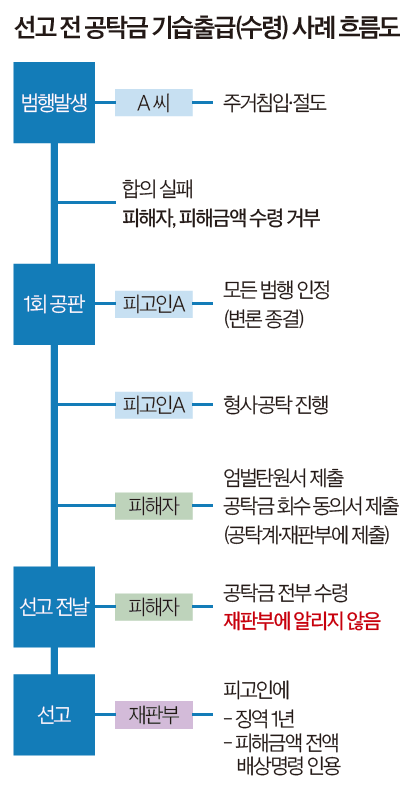
The problem is that the victim's receipt of the deposit was not notified to the court, so the court was unaware of this when deciding the sentence. Although the defendant can correct this through an appeal after the first trial verdict, if the victim 'ambushes and withdraws' the deposit the day before the appeal verdict, appeals based on unfair sentencing may be restricted, potentially resulting in the trial being finalized based on inaccurate facts.
This is the first known case of a victim abusing the deposit system by 'ambush withdrawal,' but it cannot be ruled out that similar situations frequently occur in practice. An official in charge of deposits at a court expressed puzzlement, saying, "It is often the case in practice that victims withdraw deposits just before or after the verdict even after submitting the consent form for withdrawal, which is hard to understand."
Until now, the main issues have been defendants abusing the deposit system through 'ambush deposits' (making deposits just before the verdict so that the court reflects it as a mitigating factor without separately confirming the victim's intention) and 'eat-and-run deposits' (defendants secretly retrieving deposits that victims refused to accept after receiving a reduced sentence through criminal deposits).
To address this, the Ministry of Justice prepared amendments to the Criminal Procedure Act in July this year, establishing a procedure requiring the court to mandatorily hear the victim's opinion during criminal deposits, and amendments to the Deposit Act restricting the withdrawal of criminal deposits in principle. These bills passed the National Assembly plenary session in September. However, even under these amendments, there is no provision requiring notification of deposit withdrawal, so if the victim intends to deceive the court, there is practically no way to prevent it.
Experts point out that while the victim's receipt of the deposit itself cannot be questioned, it appears to be an intention to deceive the court when a victim who submitted a petition for severe punishment and a consent form for deposit withdrawal reverses this and ambushes the deposit withdrawal the day before the verdict without the court's knowledge.
A judge at a district court emphasized, "This is an unacceptable act contrary to the principle of good faith," adding, "Even if it does not warrant criminal punishment, appropriate sanctions such as fines are necessary."
A judge at a high court said, "The fact that the court is not notified when the deposit is withdrawn and cannot inquire about it means that currently there is no way for the court to know that the victim has received the deposit," adding, "If there is a victim actively trying to deceive the court in this way, there may be no option other than holding them criminally responsible." He further suggested, "There is a problem that information verification and opinion exchange among criminal courts, deposit officers, and prosecutors (victims) are difficult. We could consider a system that automatically notifies the court of deposit withdrawals through an electronic system."
A lawyer in Seocho-dong said, "I knew it was theoretically possible, but I did not advise clients (victims) to do this because it ultimately deceives the court," adding, "If such behavior by victims is considered appropriate, I would have to consider advising clients to withdraw deposits just before the verdict after submitting consent forms for deposit withdrawal in future cases."
On the other hand, a lawyer who is a former chief judge said, "From the perspective of victim recovery and forgiveness, criminal deposits should be understood from the victim's viewpoint, and viewing it from the defendant's perspective is secondary," adding, "Ambush withdrawal is a very exceptional case, so it is more desirable to resolve it through appeals or separate procedures such as objections to compensation orders."
Jae-myung Ahn, Han-ju Cho, Legal Times reporters
※This article is based on content supplied by Law Times.
© The Asia Business Daily(www.asiae.co.kr). All rights reserved.













