Passenger numbers and flight operations fully recovered to pre-COVID-19 levels
Sales and operating profit up over 20%... Record-breaking performance expected next year
Improvement of Terminal 1 underway... Digital transformation 추진
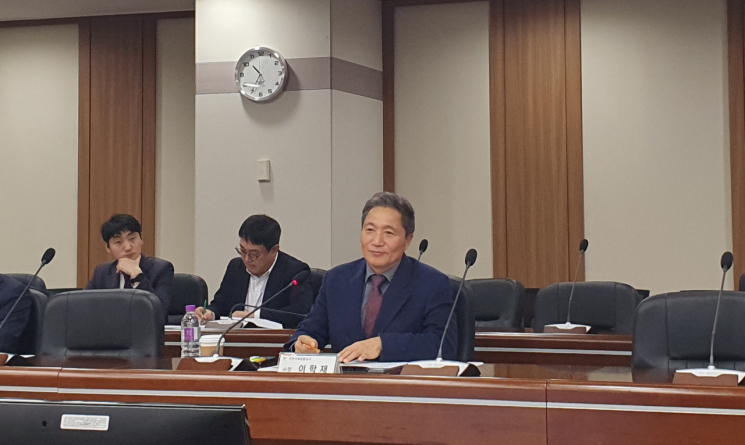 Lee Hak-jae, President of Incheon International Airport Corporation, is attending a meeting at the corporation's headquarters in Jung-gu, Incheon on the 18th, explaining management issues.
This year, both passenger and flight operations at Incheon International Airport Corporation have fully recovered from the impact of COVID-19, returning to 2019 levels. Establishing itself as a global mega-hub airport, it is expected to record the highest-ever passenger numbers and revenue next year. The over 20-year-old Terminal 1 is also set to undergo a complete renovation to provide top-notch facilities.
Completely Overcoming COVID-19 Impact... Laying the Foundation as a 'Mega-Hub'
On the 18th, Incheon International Airport Corporation held a press briefing on this year's achievements and next year's outlook. According to the corporation, Incheon Airport is projected to handle 71.23 million passengers and 413,448 flights this year. These figures represent increases of 26.9% and 22.6%, respectively, compared to the previous year. Both passenger numbers and flight operations have surpassed the pre-COVID-19 levels of 2019 (71.17 million passengers, 404,104 flights). This surge is mainly due to increased demand on medium- and short-haul routes such as Japan and Southeast Asia.
Accordingly, this year's revenue is expected to reach KRW 2.5549 trillion, with an operating profit of KRW 775.9 billion. These represent increases of 20% and 49%, respectively, compared to the previous year. Net profit is estimated to increase by 7% during the same period to KRW 528.1 billion. The recovery rates compared to the COVID-19 period are 92.6% for revenue, 60.3% for operating profit, and 61.0% for net profit.
Incheon Airport Corporation stated, "While revenue has nearly returned to 2019 levels due to increased passenger demand, the recovery of operating profit and net profit has been somewhat delayed due to rising labor costs and interest rate hikes. However, with the recovery of air travel demand, we expect continuous improvement in financial performance, including a return to profitability in 2023 and maintaining profits this year."
Notably, with the expansion and opening of Terminal 2 this year, the airport can now accommodate 106 million passengers annually, ranking third worldwide in scale, and plans to lead growth in various areas. The corporation also achieved record overseas performance by securing the development and operation project of the Philippines' largest gateway airport, with cumulative revenue expected to approach KRW 37 trillion over 25 years. Other key achievements include the commencement of the aircraft Maintenance, Repair, and Overhaul (MRO) business complex, expansion of digital transformation and renewable energy facilities, and winning the world's first 5-stage customer certification three consecutive times.
Steady Outlook for Next Year... Initiating Terminal 1 Renovation
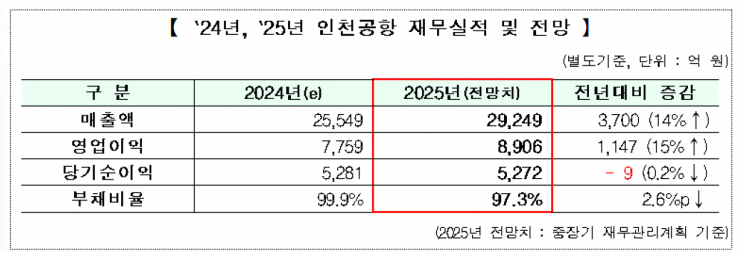
The corporation expects solid performance next year as well. Passenger demand is forecasted to increase by 2.5% from this year to 73.03 million, about 3% higher than in 2019. Demand on routes to Japan and Southeast Asia remains strong, and the number of foreigners entering Korea is expected to rise due to China's visa-free entry policy.
Accordingly, revenue is projected to reach a record high of KRW 2.9249 trillion. Operating profit is expected to increase by 15% from this year to KRW 890.6 billion. However, net profit is anticipated to decrease slightly by 0.2% to KRW 527.2 billion due to rising costs from exchange rates, inflation, and depreciation related to the Terminal 2 expansion area.
With the completion of the merger between Korean Air and Asiana Airlines, the allocation of airlines at Terminal 2 will proceed in earnest, expected to be finalized by the end of next year.
At the same time, a full-scale renovation of Terminal 1 will begin. The plan is to comprehensively upgrade the facilities that have been in use for over 20 years. The basic design is currently underway, with design completion scheduled by 2027 and construction planned through 2033. Digital transformation will be actively pursued across all areas, including an integrated immigration platform, introduction of multifunctional robots, establishment of an AI integrated platform, and an integrated facility management system.
The corporation will also strengthen new overseas airport operation projects and actively develop the domestic aircraft Maintenance, Repair, and Overhaul (MRO) industrial complex. The plan is to attract global companies to meet the demand of the integrated Korean Air and integrated low-cost carriers (LCCs).
Lee Hak-jae, President of Incheon International Airport Corporation, said, "This year marked the first step toward becoming a world-changing airport through recovery from COVID-19 and establishing a long-term vision for the 4th phase opening of Incheon Airport. In the new year, we will steadily realize this year's plans, including digital transformation and building the best infrastructure, to achieve innovation in airport operations."
© The Asia Business Daily(www.asiae.co.kr). All rights reserved.


















