Passed Judiciary Committee of Elementary and Secondary Education Act the Day Before
Crisis Ahead of March Application Next Year
Special Grant Cut Bill Discussed in Education Committee
The Ministry of Education's AI digital textbook, scheduled for field application next year, is facing the risk of being derailed. A bill defining it as 'educational material' rather than a textbook has passed the National Assembly's Legislation and Judiciary Committee, and a bill to cut special grants previously used for teacher training is also set to be discussed in the Education Committee subcommittee.
According to the National Assembly and the Ministry of Education on the 18th, the Legislation and Judiciary Committee approved an amendment to the Elementary and Secondary Education Act the day before, which defines AI digital textbooks as educational materials rather than textbooks for school use. Unlike 'textbooks,' which must be used in schools, educational materials can be voluntarily selected by each school. The Ministry of Education expressed concerns that downgrading AI digital textbooks to educational materials could deepen educational disparities and shift costs onto students, but the bill was passed led by opposition party lawmakers.
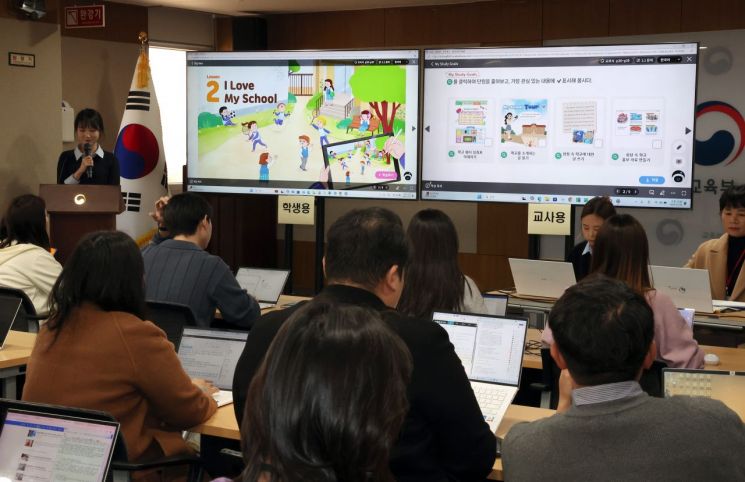
As the bill moves to the plenary session, the opposition party, holding the majority of seats, is increasingly likely to pass it unilaterally. If the bill passes, the unified rollout of AI digital textbooks for 3rd and 4th graders, 7th graders, and 10th graders scheduled for March next year may become difficult. The Ministry of Education expressed regret upon the bill's passage through the Legislation and Judiciary Committee, stating, "We consider this regrettable" and "We will do our best to communicate and persuade the National Assembly before the plenary session."
Amid this situation, a bill to cut special grants related to AI digital textbooks is also entering National Assembly discussions. The 'Local Education Finance Grants Act amendment,' which would revert the special grant portion increased from 3.0% to 3.8% under the name of 'digital-based educational innovation' back to its original level by cutting 0.8%, is being discussed in the Education Committee subcommittee today. This '0.8%' portion was used this year for AI digital textbook teacher training and other purposes. Kang Kyung-sook, a lawmaker from the Innovation Party who proposed the bill, emphasized that the government's increase of special grants for specific projects is a step backward for the times.
On the other hand, the Ministry of Education and the ruling party argue that the budget is necessary for classroom innovation. Lee Ju-ho, Deputy Prime Minister and Minister of Education, said at the full meeting of the Legislation and Judiciary Committee the day before, "(The special grants) were spent on teacher training, and the teachers who received the training responded positively," adding, "Since this budget was spent for innovation, it is a necessary budget at this time."
An opposition party official from the Education Committee said, "Since this is a bill with disagreements between the ruling and opposition parties, it seems difficult to proceed to a vote immediately today. We need to discuss it first," but added, "If the opposition decides to pass it unilaterally, it could go to the agenda coordination committee." The agenda coordination committee is a body for discussing bills that require reconciliation of differences, and if a reconciliation proposal is approved, it is considered passed through the standing committee subcommittee. Previously, the amendment to the Elementary and Secondary Education Act also passed the Education Committee agenda coordination committee on the 27th of last month before going through the plenary session and passing the Legislation and Judiciary Committee.
© The Asia Business Daily(www.asiae.co.kr). All rights reserved.
![Clutching a Stolen Dior Bag, Saying "I Hate Being Poor but Real"... The Grotesque Con of a "Human Knockoff" [Slate]](https://cwcontent.asiae.co.kr/asiaresize/183/2026021902243444107_1771435474.jpg)
















