November Retail Sales Up 0.7% MoM
Increase in 7 of 13 Categories
Steady US Economy Confirmed... Monetary Easing Expected to Slow Next Year
U.S. retail sales exceeded market expectations last month. As signals confirming the U.S. economy's steady growth continue to emerge, it is anticipated that the Federal Reserve (Fed) may slow the pace of interest rate cuts as previously indicated by the monetary authorities.
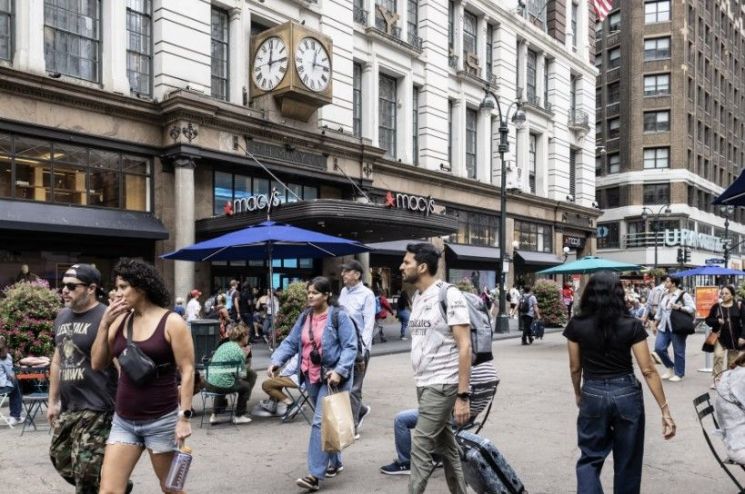
According to the U.S. Department of Commerce on the 17th (local time), November retail sales totaled $724.6 billion, up 0.7% from the previous month.
Initially, the market had forecast a 0.6% increase in retail sales last month, so the actual figure surpassed expectations. In October, retail sales rose by 0.5%.
Among the 13 retail categories, 7 showed growth. Consumption increased in automobile and parts dealers (2.6%), online retailers (1.8%), and sporting goods and bookstores (0.8%). Conversely, spending decreased in variety stores (-3.5%), restaurants and bars (-0.4%), grocery stores (-0.2%), and clothing stores (-0.2%).
The strength in retail sales, a core pillar supporting two-thirds of the U.S. economy, is interpreted as a sign that the economy continues to maintain solid growth. Accordingly, the view that the Fed may slow the pace of rate cuts as previously signaled gains more weight. The market has largely priced in the possibility that the Fed will implement a 'small cut' (a 0.25 percentage point rate reduction) the following day. According to the Chicago Mercantile Exchange (CME) FedWatch tool, federal funds futures on that day reflected a 97.1% probability that the Fed will cut rates by 0.25 percentage points at this month's FOMC meeting. The probability of a rate hold is 2.9%.
The key issue is next year. If the U.S. economy remains more resilient than expected, even if the Fed cuts rates this month, it is likely to be a 'hawkish cut' (favoring monetary tightening) before pausing rate reductions in January next year. Chris Larkin, Investment Managing Director at Morgan Stanley eTrade, assessed, "Stronger economic indicators like retail sales could support the argument that the Fed should stop cutting rates in January next year."
Market forecasts suggest that the Fed will reduce the expected number of rate cuts next year from the previous four times (100 basis points; 1bp = 0.01 percentage points) to fewer than three through the dot plot reflecting rate cut expectations the following day. Tom Essay, President of Sevens Report, analyzed, "Whether the Fed's decision the next day is positive, negative, or neutral for stocks and bonds will likely depend on the FOMC's stance on rate cuts in 2025 rather than the actual rate cut."
With the reaffirmation of the U.S. economy's robustness, expectations for rate cuts next year have diminished, and Treasury yields are rising. The 10-year U.S. Treasury yield, a global bond yield benchmark, rose 2 basis points from the previous trading day to 4.42%, while the 2-year U.S. Treasury yield increased by 1 basis point to 4.26%.
© The Asia Business Daily(www.asiae.co.kr). All rights reserved.
![Clutching a Stolen Dior Bag, Saying "I Hate Being Poor but Real"... The Grotesque Con of a "Human Knockoff" [Slate]](https://cwcontent.asiae.co.kr/asiaresize/183/2026021902243444107_1771435474.jpg)
















