Ministry of Industry Confirms '5th Energy Technology Development Plan'
Support for Technology Development Including SMR and Next-Generation Tandem Batteries
Promotion of HVDC Large-Capacity Expansion to Ease Transmission Constraints
The government has decided to strengthen competitiveness by securing core technologies for next-generation nuclear power and clean hydrogen, key zero-carbon energy sources, by 2033. Through this, it plans to raise the self-reliance rate of zero-carbon energy technologies, currently at around 80%, to 90%.

On the 18th, the Ministry of Trade, Industry and Energy announced that it finalized the "5th Energy Technology Development Plan," which includes a mid- to long-term energy research and development (R&D) investment strategy, at the National Science and Technology Advisory Council's steering committee meeting.
The Energy Technology Development Plan is a statutory plan established every five years and on a ten-year basis under the Energy Act to realize an efficient and environmentally friendly energy supply and demand structure.
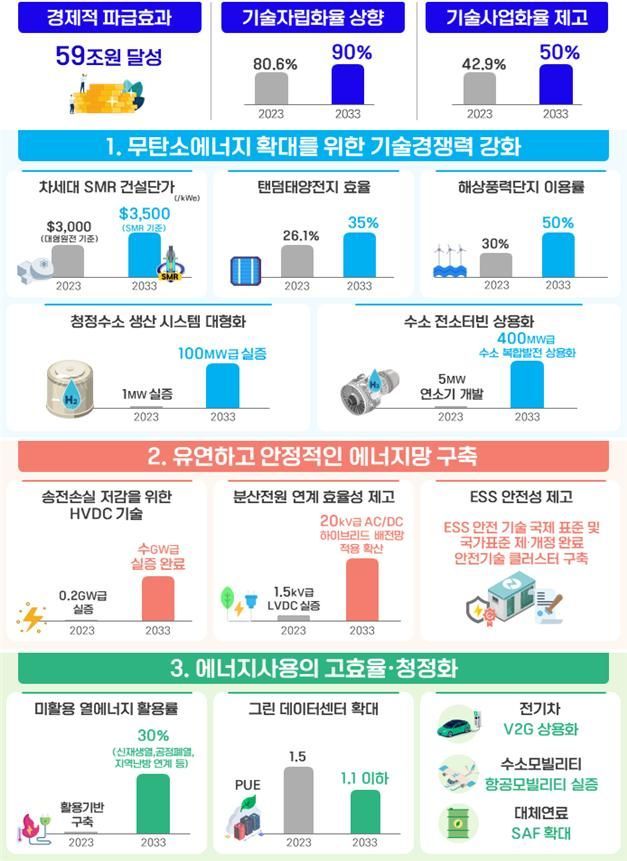
This plan contains strategies and tasks focused on full-cycle technology development and the creation of an R&D ecosystem across the energy 'supply-delivery-demand' sectors. First, to achieve a rational energy transition, it will promote securing core technologies for major zero-carbon energies such as next-generation nuclear power, renewable energy, and clean hydrogen. By supporting technology development for small modular reactors (SMR) and next-generation tandem batteries, it aims to increase the utilization of nuclear power plants and systematically expand renewable energy, thereby driving the export momentum of the domestic new energy industry.
Efforts will also be made to secure a flexible and stable energy grid in response to the increased electricity usage. To address the surge in electricity demand due to climate change and electrification, the plan includes developing gigawatt-class high-voltage direct current transmission technology (HVDC) to ease transmission constraints, as well as advancing power system monitoring and analysis technologies, diversifying AC/DC hybrid distribution networks and energy storage systems to enhance the robustness and flexibility of the grid.
To achieve carbon neutrality, the plan promotes ultra-high efficiency in energy use by linking the development of efficiency improvement technologies such as next-generation electric motors with the dissemination of high-efficiency products. Additionally, it will develop technologies for designing and optimizing heat energy supply, circulation, and recovery systems tailored to the characteristics of industries and buildings, and develop high-efficiency electric heat pumps to optimize heat use. For carbon neutrality in the transportation sector, it will pursue the development of economic production technologies for alternative fuels such as hydrogen-utilizing next-generation mobility systems, biofuels, and renewable synthetic fuels.
The government aims to secure global competitiveness in the domestic energy industry through this plan, targeting an economic ripple effect of 59 trillion won. It also expects to increase the self-reliance rate of zero-carbon energy systems from 80.6% in 2023 to 90% in 2033, a 10 percentage point rise, and raise the technology commercialization rate from 42.9% to 50%.
Choi Yeon-woo, Director of Energy Policy at the Ministry of Trade, Industry and Energy, said, "To ensure the smooth implementation of the 5th Energy Technology Development Plan, we will establish and execute annual action plans and actively reflect them in future energy R&D investment directions, accelerating the achievement of carbon neutrality and energy security through energy technologies."
© The Asia Business Daily(www.asiae.co.kr). All rights reserved.


















