Establishing a Corporation in Singapore and a Production Subsidiary in China
US Also Considered but China Advantageous in Cost
All Local Sales... Existing Chinese Volume Shifted to US and Europe
Samyang Foods is building its first overseas factory in its 63-year history, riding the global 'Buldak Bokkeum Myun' (Hot Chicken Flavor Ramen) syndrome. The location is China, its largest export market. Samyang Foods plans to establish a production base in China, where financing is more favorable than in the United States, targeting the local population of 1.4 billion. Meanwhile, it will focus domestic export volumes on the U.S. and Europe to continue the 'Buldak era.'
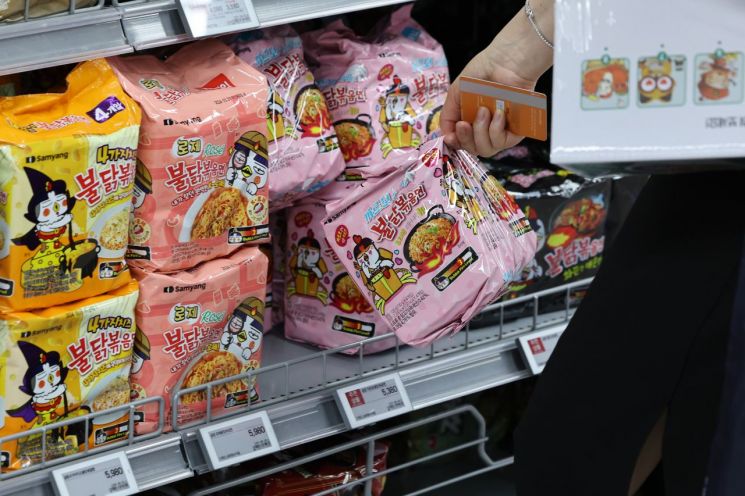
According to the Financial Supervisory Service's electronic disclosure system on the 17th, Samyang Foods announced the day before that it will invest 64.7 billion KRW to establish 'Samyang Singapore Limited (tentative name).' Samyang Foods plans to set up a production corporation in China through this company, in which it holds a 90% stake. Samyang Foods explained, "The investment is intended to serve as a base for overseas market entry and to establish a Chinese production corporation."
Samyang Foods' establishment of an overseas factory was already anticipated. As Buldak Bokkeum Myun gained explosive popularity through SNS platforms such as YouTube, Instagram, and TikTok, the world has experienced a 'Buldak sold-out crisis.' The number of export countries continues to increase. This year alone, Buldak Bokkeum Myun successfully entered markets including Somalia and Morocco in Africa, Lebanon in the Middle East, Tajikistan in Central Asia, and Hungary in Europe. Although the company is building the Milyang Plant 2, scheduled for completion in the first half of next year, it has been insufficient to meet the demand from countries worldwide.

In the early discussions about the overseas factory site, Samyang Foods reportedly weighed options between China and the United States, where Buldak Bokkeum Myun could be produced and sold entirely locally.
The reasons for choosing China are multifaceted. First, China accounts for 25% of Samyang Foods' total exports and is the largest export market for Buldak Bokkeum Myun. In China, Buldak Bokkeum Myun is known as 'Huojimen' (火鷄麵) and enjoys high popularity. Building a factory in China offers the advantage of quickly targeting the market to meet the tastes and demand of 1.4 billion people. A Samyang Foods official explained, "The Chinese factory will produce products for sale within the Chinese domestic market, not for export."
Moreover, from the perspective of factory construction costs, China was judged to be more advantageous than the U.S. A Samyang Foods representative said, "Considering factory establishment costs, labor costs after operation, and maintenance expenses, China is more favorable, and the local sales organization is well established, which led to this decision."
The Chinese factory is expected to begin operations in the first quarter of 2027. Once completed, Samyang Foods plans to supply the volumes previously produced at Milyang Plant 1 and shipped to China to the U.S. and Europe, continuing the popularity of Buldak.
Meanwhile, Samyang Foods recently became the first in the food industry to receive the '700 Million Dollar Export Tower' award. From July last year to June this year, Samyang Foods' export performance reached 700 million USD (approximately 991.1 billion KRW). Centered on the Buldak brand, Samyang Foods has been increasing exports and setting record-breaking results every year. Annual export revenue grew about ninefold from 93 billion KRW in 2016 to 809.3 billion KRW last year. During the same period, the proportion of exports in total sales rose from 26% to 68%.
© The Asia Business Daily(www.asiae.co.kr). All rights reserved.

![Clutching a Stolen Dior Bag, Saying "I Hate Being Poor but Real"... The Grotesque Con of a "Human Knockoff" [Slate]](https://cwcontent.asiae.co.kr/asiaresize/183/2026021902243444107_1771435474.jpg)
















