Ministry of Economy and Finance Confirms Next Year's Budget Allocation
75% of Budget Concentrated in First Half of Year
Allocation Ratio Hits Record High for Third Consecutive Year
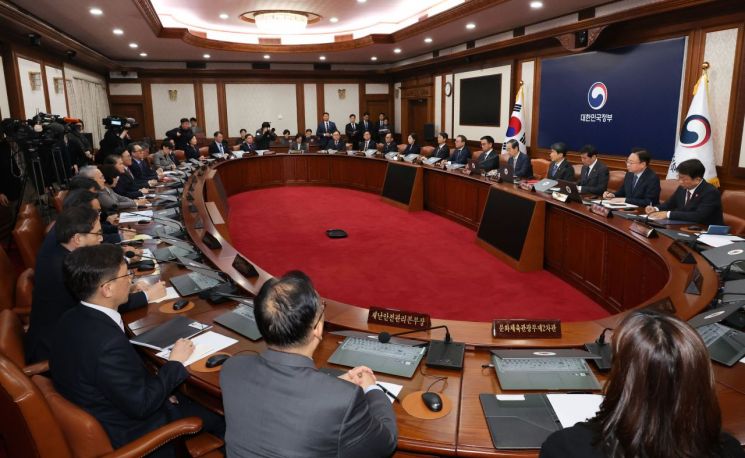
The government has decided to swiftly disburse 431 trillion won, equivalent to 75% of next year's budget, in the first half of the year. Amid a prolonged political crisis involving martial law and impeachment, domestic demand is weakening, and even exports?which have served as the engine of the economy?are showing concerns of a peak-out (reaching a peak and entering a decline phase). The government aims to overcome the economic downturn through early fiscal spending.
On the 17th, the Ministry of Economy and Finance announced at the Cabinet meeting that it had finalized the "2025 Budget Allocation Plan" with these details. Budget allocation grants each ministry the right to use the budget, which will then be executed through subsequent fund allocation procedures.
Excluding funds, the government plans to allocate 431.1 trillion won, which is 75% of the total general and special account expenditure budget of 574.8 trillion won, in the first half of next year. The 75% budget allocation rate for the first half of next year marks the third consecutive year at a record high.
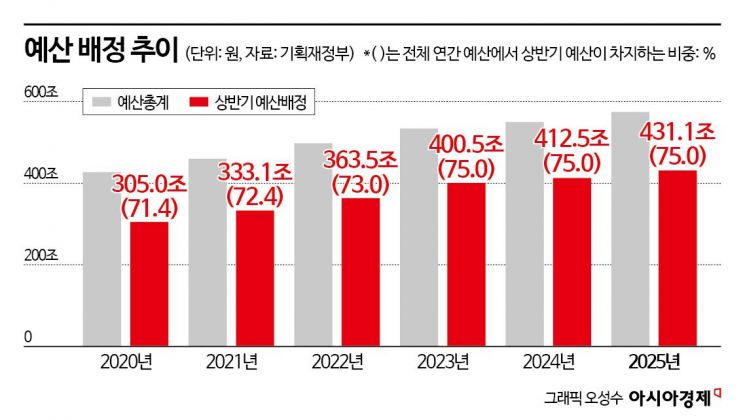
The government's decision to allocate the largest-ever budget in the first half of next year reflects considerations of prolonged political uncertainty due to the impeachment crisis amid simultaneous sluggishness in domestic demand and exports. According to the National Statistical Office's National Statistical Portal (KOSIS) and others, retail sales, which indicate goods consumption, have been declining for 10 consecutive quarters since the second quarter of 2022 (-0.2%). This is the longest continuous decline since related statistics began in 1995.
While the contraction of private consumption, which accounts for half of the Gross Domestic Product (GDP), is problematic, the weakness in exports is an even bigger issue. The Korean economy, which has been driven by exports, has entered a structural low-growth phase, with last month's export growth rate falling to a low single-digit figure of 1.4% year-on-year. Considering external risk factors such as upcoming U.S.-China trade frictions following the launch of Donald Trump's second term next month and the slowdown in exports to China, the export slowdown trend next year is inevitable.
The government has not specified the budget allocation rates by sector for the first half but is expected to focus on allocating budgets for social overhead capital (SOC), research and development (R&D), small and medium enterprises, and livelihood-related expenses, which have strong economic stimulus effects. Support for job creation, vulnerable groups, and small business owners will also be executed early.
The Ministry of Economy and Finance explained, "We allocated 75.0% of the total expenditure budget in the first half to invigorate the economy and support the swift execution of the budget. We focused on early allocation for needs requiring prompt execution, such as easing the livelihood burdens of ordinary citizens, supporting vulnerable groups, tailored support for small business owners, and fostering advanced industries to spread economic vitality."
The business community is urging the prompt passage of economic-related bills such as the Semiconductor Special Act, the Artificial Intelligence (AI) Basic Act, and the National Power Grid Expansion Special Act within this year to prevent weakening of industrial growth momentum amid unstable political conditions.
To reduce economic turmoil caused by the impeachment crisis, the government has requested cooperation from the business sector. The day before, the heads of six major economic organizations who met with Choi Sang-mok, Deputy Prime Minister and Minister of Economy and Finance, emphasized that "minimizing the government vacancy and maintaining policy stability and continuity are important," and requested active promotion of economic stabilization measures so that companies can focus on investment and management. Park Il-jun, Executive Vice President of the Korea Chamber of Commerce and Industry, said, "It is necessary to prepare active policy responses according to different economic scenarios," and urged, "The enactment of major economic bills, including the delayed Semiconductor Special Act, within this year is also necessary."
© The Asia Business Daily(www.asiae.co.kr). All rights reserved.


















