Climate Solution Evaluation Results Released
Far Below International Standards
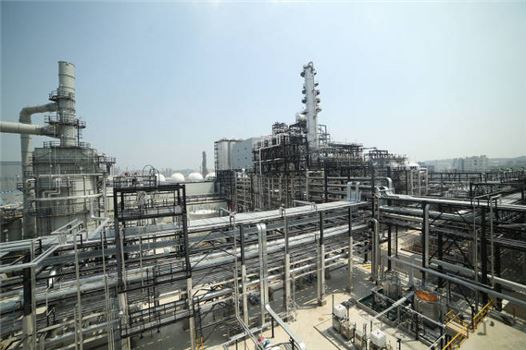 ▲A view of the Nexlene plant within SK Innovation's Ulsan Complex, the largest oil refining company in Korea
As a result of evaluating the greenhouse gas reduction plans of the top five domestic petrochemical and refining companies, SK Innovation received the highest score. S-Oil recorded the lowest score. However, overall, domestic companies' greenhouse gas reduction plans were found to fall far short of international standards.
On the 16th, Climate Solutions released the evaluation results of greenhouse gas reduction plans of domestic petrochemical and refining companies in the report titled "Stalled Carbon Neutrality: The Lost Promises of Korean Petrochemical Companies."
Among the top five petrochemical and refining companies?LG Chem, SK Innovation, Lotte Chemical, GS Caltex, and S-Oil?SK Innovation received the highest score, followed by LG Chem, Lotte Chemical, GS Caltex, and S-Oil. However, the report analyzed that even SK Innovation, which ranked first, falls far short of international standards.
The greenhouse gas emissions from plastic production amount to approximately 2.24 gigatons (Gt CO2e) annually, accounting for 5.3% of global greenhouse gas emissions. South Korea is a petrochemical powerhouse ranked fourth worldwide in ethylene production capacity, the basic material for plastic products, playing a key role in the plastic supply chain.
According to the report, as of 2023, the greenhouse gas emissions from the domestic petrochemical and refining industries reached about 68.2 million tons (CO2e). Emissions from the petrochemical industry were 52 million tons (CO2e), and those from the refining industry were 16.2 million tons (CO2e), accounting for about 10% of South Korea's total greenhouse gas emissions (based on 2022). South Korea's total greenhouse gas emissions in 2022 were 654.5 million tons (CO2e).
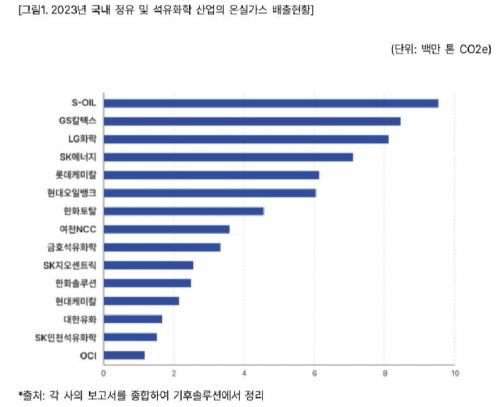
Looking at individual companies, based on the 2023 greenhouse gas emissions statements, S-Oil recorded the highest emissions at approximately 9.5 million tons, followed by GS Caltex and LG Chem at about 8.5 million tons and 8 million tons, respectively.
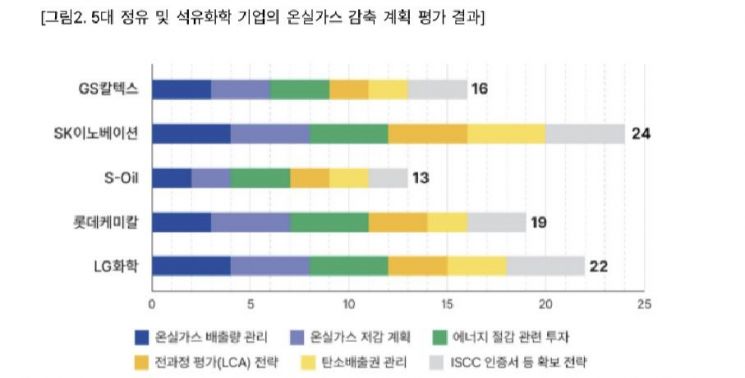
Domestic refining and petrochemical companies announce their greenhouse gas reduction targets and management plans through sustainability and ESG reports. Accordingly, Climate Solutions evaluated the five domestic companies based on six international criteria: greenhouse gas emissions management, greenhouse gas reduction plans, investments related to energy transition, life cycle assessment (LCA) strategies, carbon credit acquisition strategies, and ISCC (International Sustainability & Carbon Certification) certification acquisition strategies.
As a result, SK Innovation ranked first with 24 points, followed by LG Chem (22 points), Lotte Chemical (19 points), GS Caltex (16 points), and S-Oil (13 points). However, despite the maximum score per category being 5 points and the total maximum score being 30 points, none of the top five companies achieved a perfect score in any evaluation criterion.
According to the report, SK Innovation, which received the highest score, was relatively highly rated in carbon credit acquisition and greenhouse gas emissions management, specifically Scope 3 emissions management, but its overall execution and response strategies for greenhouse gas reduction were insufficient.
LG Chem, which ranked second, also scored high in Scope 3 emissions management and ISCC certification acquisition strategies but lacked specific management strategies for life cycle assessment (LCA) and the overall supply chain.
Although Lotte Chemical and GS Caltex have greenhouse gas management systems in place, they lacked investments in energy transition and Scope 3 management strategies. S-Oil's reduction plan was very limited, and it lacked Scope 3 calculation and life cycle assessment strategies.
In particular, the report pointed out that the high ratio of free allocation of emission allowances relative to emissions acts as a factor hindering reductions. According to the report, SK Energy, LG Chem, and Lotte Chemical have free allocations exceeding their actual emissions, with allocation-to-emission ratios of 101%, 111%, and 112%, respectively. GS Caltex and S-Oil also recorded free allocation ratios above 90%.
The report emphasized that domestic petrochemical and refining companies must establish concrete reduction targets and phased roadmaps to secure international competitiveness. It stated that expanding investments in innovative technologies such as electric cracker technology and renewable energy transition, and preparing practical reduction measures through pilot projects are necessary. Additionally, companies should adopt Scope 1-3 emissions disclosures aligned with global standards and management strategies based on life cycle assessment (LCA).
Jinseon Noh, a researcher at Climate Solutions and the author of the report, said, "The reduction strategies of domestic petrochemical and refining companies must move beyond declarative levels to have concrete execution capabilities. Voluntary efforts by companies, along with institutional support from the government, must be realized together, as this is an essential task for responding to the climate crisis and the long-term development of the national economy."
© The Asia Business Daily(www.asiae.co.kr). All rights reserved.













