Weekend Presidential Impeachment Approval Expected to Ease Won-Dollar Exchange Rate Volatility
Gradual Stabilization Anticipated if No Major Variables
America First Policy and Domestic Economic Slump Limit Downside Potential
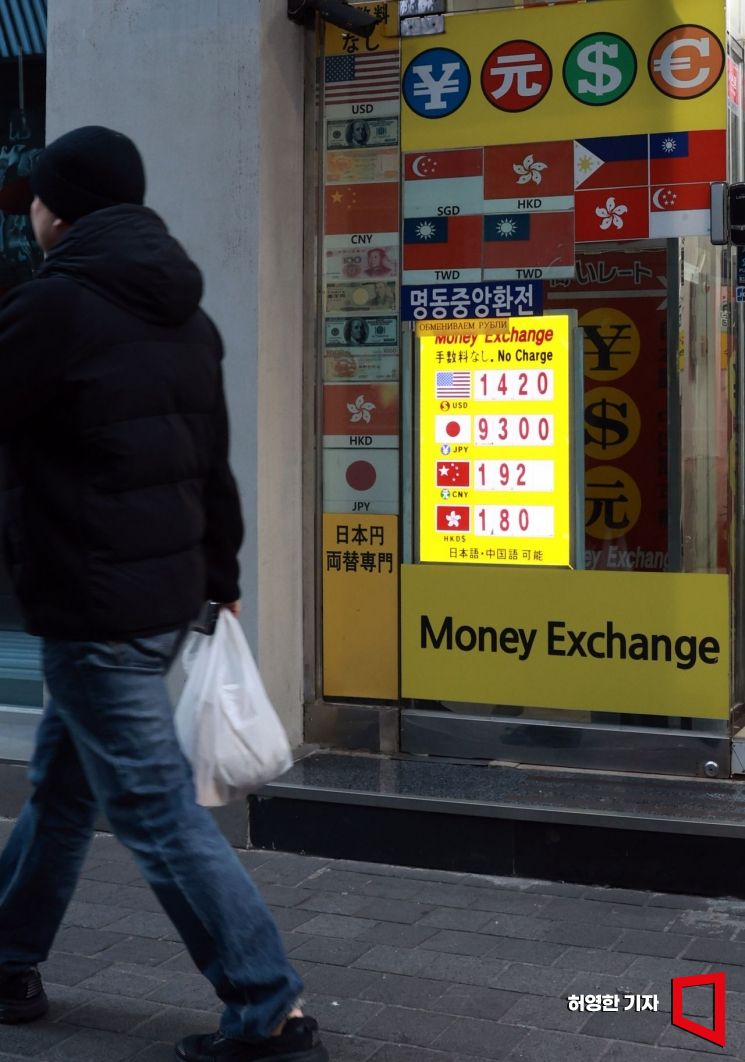 Amid rising exchange rates such as the won-dollar rate following the martial law situation, the won-dollar buying rate at a private exchange office in Myeongdong, Seoul, was displayed as 1,420 won on the 10th. Photo by Heo Young-han
With the impeachment motion against President Yoon Suk-yeol passed, market expectations have grown that the volatility of the won-dollar exchange rate will decrease and stabilize downward for the time being. However, due to the global strong dollar trend driven by the Trump administration's America First policy and concerns over domestic economic sluggishness, it is expected to take time for the exchange rate to fall back to pre-martial law levels.
On the 16th, in the Seoul foreign exchange market, the won-dollar exchange rate opened at 1,431.0 won, down 2.0 won from the previous trading day. The won-dollar exchange rate surged to 1,442 won on the day of the martial law incident on the 3rd but fell to the low 1,430 won range due to active market stabilization measures by the government and the Bank of Korea and the passage of the presidential impeachment motion.
Experts expect that the political uncertainty has somewhat eased with this impeachment, leading to a downward stabilization of the exchange rate for the time being. Lee Min-hyuk, an economist at KB Kookmin Bank, said, "With the passage of the impeachment motion, political turmoil has partially eased, and the possibility of a second emergency martial law has significantly decreased due to the president’s suspension of duties, which we judge has partially resolved market uncertainty. We expect the recent rapid rise in the exchange rate to also calm down somewhat."
Min Kyung-won, an economist at Woori Bank, also said, "With the passage of the presidential impeachment motion in the National Assembly last Saturday, immediate political uncertainty has been resolved. Although the Constitutional Court’s decision remains, there is relief in having overcome the major hurdle of the National Assembly’s approval, which could improve foreign investor sentiment."
However, since political uncertainty has not been completely resolved and due to the strong dollar trend from the Trump administration’s America First policy and concerns over domestic economic slowdown, the prevailing view is that it will take time for the exchange rate to fall below the 1,400 won level, which was the level before the martial law incident.
Jeon Gyu-yeon, an economist at Hana Securities, observed, "Even if the won-dollar exchange rate stabilizes in the low 1,400 won range following the passage of the impeachment motion, the continuation of American exceptionalism and trade disputes under the Trump second-term administration make it highly likely that the strong dollar trend will persist, so the exchange rate is expected to remain in the 1,400 won range until the first half of next year."
Im Hye-yoon, an economist at Hanwha Investment & Securities, emphasized, "I believe the political uncertainty reflected in the foreign exchange market due to the passage of the impeachment motion has peaked. However, for the exchange rate to settle at pre-martial law levels, not only political uncertainty must ease, but signals of economic rebound such as improved export growth rates and supplementary budgets must also be confirmed."
The U.S. Federal Reserve (Fed) holding the Federal Open Market Committee (FOMC) meeting from the 17th to 18th to decide the final benchmark interest rate of the year is also a factor that could increase exchange rate volatility. Even if the Fed cuts the benchmark interest rate this time, there is a possibility it may send hawkish signals limiting further cuts considering recent inflation increases, which is a factor for a strong dollar. Park Sang-hyun, a specialist at iM Securities, predicted, "The National Assembly’s impeachment decision has partially eased political uncertainty, which is a downward pressure factor on the won-dollar exchange rate, but depending on the FOMC meeting results, there is ample room for exchange rate volatility to expand."
© The Asia Business Daily(www.asiae.co.kr). All rights reserved.
![Clutching a Stolen Dior Bag, Saying "I Hate Being Poor but Real"... The Grotesque Con of a "Human Knockoff" [Slate]](https://cwcontent.asiae.co.kr/asiaresize/183/2026021902243444107_1771435474.jpg)
















