Analysis of Major Domestic Industry Outlook for Next Year
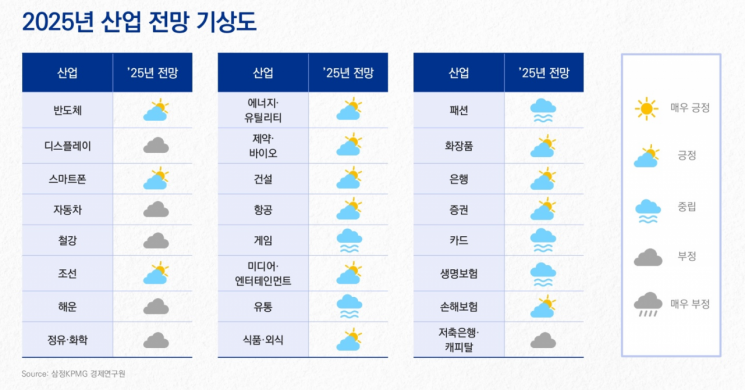
Next year, with the strengthening of U.S. protectionism and geopolitical risks, major domestic industries with high export impact are expected to contract, while some sectors such as semiconductors, smartphones, and shipbuilding are anticipated to continue growing based on technological innovation, demand recovery, and overseas expansion.
Samjong KPMG presented corporate response strategies by industry in its report "2025 Domestic Major Industry Outlook," which includes observations on the domestic economy and 24 key industries. In particular, it forecasted that in 13 major sectors including semiconductors, smartphones, energy·utilities, pharmaceuticals·and bio, demand creation and profitability improvement will be possible through new technology development and portfolio expansion.
The semiconductor market is expected to grow centered on IC (integrated circuit) product groups. Memory semiconductors are projected to continue their growth trend next year following an 81% increase compared to the previous year. Securing advanced packaging technologies such as AI semiconductors, power efficiency, and heat management is identified as a key task.
The smartphone market is expected to continue its growth for the second consecutive year as AI utilization accelerates with the launch of on-device AI smartphones. AI technology is emerging as an innovation factor for major manufacturers, and strategies to expand user benefits based on on-device AI for flagship smartphones to generate new smartphone replacement demand are required.
Next year, the energy and utility industries are expected to show a moderate recovery with a 1.3% increase compared to the previous year. As domestic power consumption rises due to data center expansion, gas power generation will increase, and strengthening energy transition infrastructure centered on LNG (liquefied natural gas) and nuclear power, along with policies to expand renewable energy, are presented as major growth factors.
The pharmaceutical and bio markets are expected to grow based on the strength of metabolic disease (obesity and diabetes treatments) and anticancer drug sectors in the global pharmaceutical market. In particular, as the share of biopharmaceuticals expands, the CDMO (contract development and manufacturing organization) market is growing alongside, benefiting domestic pharmaceutical and bio companies. Not only existing CDMO companies such as Samsung Biologics but also traditional pharmaceutical companies are expanding their entry into the CDMO business. Accordingly, establishing global market-tailored strategies by drug type is essential.
The construction industry is projected to reach a contract amount of KRW 210.4 trillion next year, a 2.2% increase from the previous year. Although public orders will decrease due to cuts in social overhead capital (SOC) budgets, private orders are expected to lead growth due to interest rate cuts and policies to revitalize private investment. Construction companies should prepare for external variables by expanding portfolios such as senior housing and modular homes and respond promptly to order situations in the Middle East region.
Air passenger demand is expected to show steady recovery. With Korean Air incorporating Asiana Airlines as a subsidiary, the low-cost carrier (LCC) market structure may change. Expansion of sustainable aviation fuel (SAF) is necessary for decarbonized management. The air cargo market is expected to grow moderately, and strategic responses to the U.S. administration's strengthened trade restrictions against China are also required.
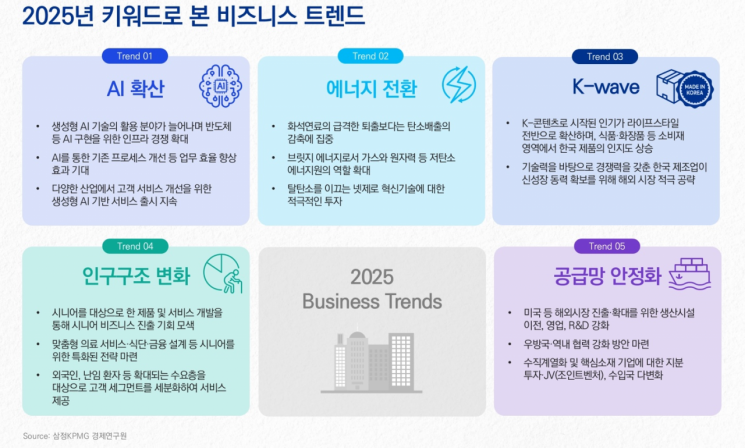
The report highlighted the following business trends to watch next year: ▲AI expansion ▲energy transition ▲K-wave (Hallyu) ▲demographic changes ▲supply chain stabilization.
Advancements in AI-related technologies and infrastructure competition will spread mainly in the semiconductor market, while fossil fuel reduction, expansion of low-carbon energy, and carbon capture technologies will emerge as key issues. Alongside the sustained global popularity of K-content, increases in exports of K-food and beauty products such as food and cosmetics are also expected.
Senior business and customer segmentation strategies responding to aging and low birth rates are required, and supply chain restructuring including relocation of production facilities and vertical integration is expected to actively proceed in response to U.S.-China conflicts and geopolitical risks.
Samjong KPMG Economic Research Institute stated, "It is an important time for companies to actively respond to various trend changes and establish mid- to long-term growth strategies," adding, "Despite various domestic and international uncertainties, companies must quickly respond to the reshaping business trends by preparing measures for AI expansion, energy transition, demographic changes, and supply chain stabilization to establish and execute preemptive strategies."
This report is available on the Samjong KPMG website. A related free online seminar will also be held on the 18th.
© The Asia Business Daily(www.asiae.co.kr). All rights reserved.


















