Democratic Party "Does Not Expect Veto to Be Exercised"
Han Does Not Give Clear Answer on Acting Authority's Veto Use
With the impeachment of President Yoon Suk-yeol, attention has turned to whether opposition-led livelihood bills, which had been blocked by the veto power, will pass through the National Assembly. Prime Minister Han Duck-soo, acting president, expressed his intention to closely cooperate and communicate with the National Assembly in future state affairs, leading to speculation that opposition-led bills could gain significant momentum.
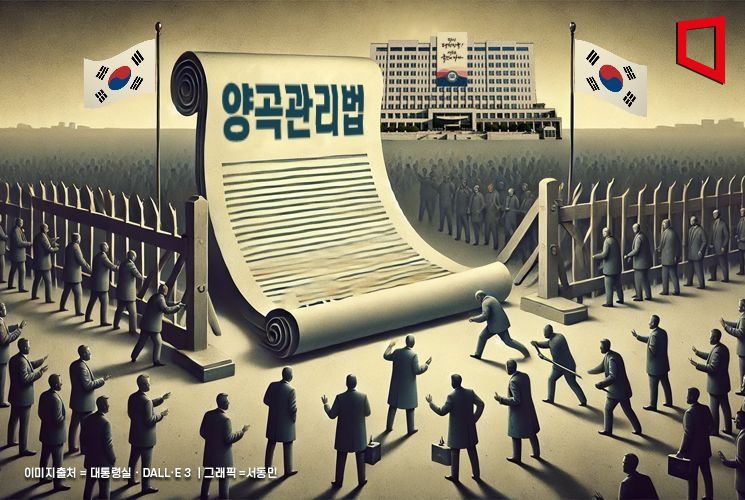
The reason opposition-led livelihood bills, previously blocked by veto power, have resurfaced is that on the 15th, Lee Jae-myung, leader of the Democratic Party of Korea, mentioned at a press conference that he had asked Acting President Han to conduct neutral state affairs. This statement is seen as an attempt by Lee to pressure Acting President Han not to exercise veto power on contentious bills from the ruling party's perspective.
The People Power Party had requested President Yoon to exercise veto power on six major opposition bills that passed the plenary session on the 28th of last month, just before the declaration of martial law. Specifically, these include the four agricultural laws such as the Grain Management Act, the Act on Distribution and Price Stabilization of Agricultural and Fishery Products, the Agricultural and Fishery Disaster Countermeasures Act, and the Agricultural and Fishery Disaster Insurance Act; the amendment to the National Assembly Act abolishing the automatic referral of the budget bill; and the amendment to the National Assembly Testimony and Inspection Act.
Political circles believe that Acting President Han, who inherited the veto power due to President Yoon's suspension, would face considerable political burden in exercising it. This is because investigations related to charges of rebellion against him are underway, and the opposition holds the power to impeach Acting President Han. Although the Democratic Party has stated that it will 'postpone' rather than 'consider' impeachment of Acting President Han, this implies that neutral state affairs are a prerequisite.
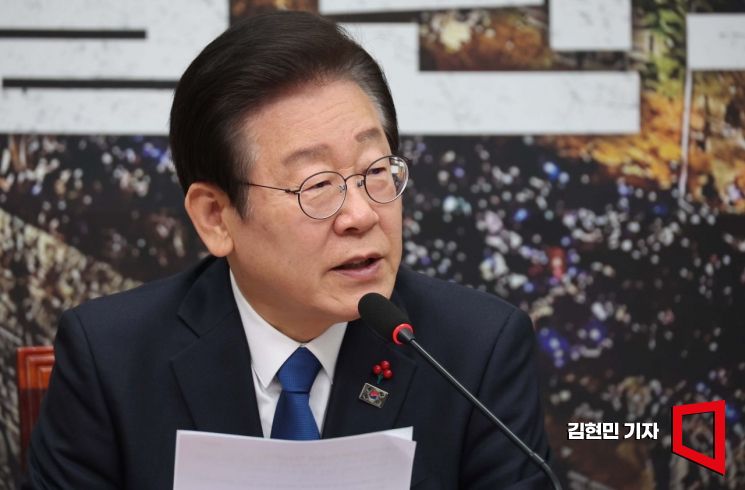 Lee Jae-myung, leader of the Democratic Party of Korea, is speaking at the Emergency Economic Inspection Meeting held at the National Assembly on the 11th. Photo by Kim Hyun-min
Within the Democratic Party, there is also a positive outlook on the possibility of passing major opposition-led policy bills. Hwang Jung-ah, spokesperson for the Democratic Party, said in a phone interview, "Acting President Han is maintaining the current situation and does not have the right to make bills pass or fail," adding, "The party predicts that Prime Minister Han will not exercise veto power."
Spokesperson Hwang also said that major bills promoted by Leader Lee, such as the Local Currency Act, will be reintroduced. He explained, "However, the timing has not been decided. I think related matters will be decided at today's party meeting or supreme council meeting," adding, "The direction for livelihood policies, including the reintroduction of the Local Currency Act, will be established."
However, it remains uncertain whether the People Power Party will accept opposition-led bills. Immediately after meeting with Presidential Chief of Staff Jeong Jin-seok on the same day, Acting President Han avoided giving a definitive answer to reporters, saying, "The issue of exercising veto power was not formally discussed." This leaves open the possibility that the People Power Party may request Acting President Han to exercise veto power on major opposition policies depending on the circumstances.
© The Asia Business Daily(www.asiae.co.kr). All rights reserved.













