First Economic Ministers' Meeting Held After Impeachment Approval
"One-Stop Foreign Investment Ombudsman Activated"
"Next Year's Economic Policy Including Livelihood Measures to Be Announced Within the Year"
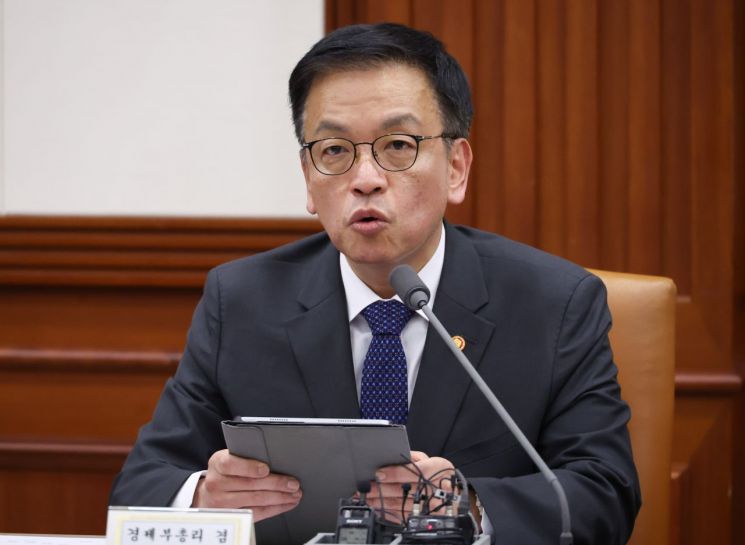
Choi Sang-mok, Deputy Prime Minister for Economy and Minister of Strategy and Finance, announced on the 15th that in response to changes in trade policy under the upcoming second Trump administration next month, the Foreign Relations Ministers' Meeting will be regularized, and the Industrial Competitiveness Enhancement Ministers' Meeting will be expanded into a public-private joint meeting. He also stated that the economic policy direction for next year, including measures to maintain external credibility and stabilize people’s livelihoods, will be announced within this year.
In his opening remarks at the Economic Relations Ministers' Meeting held at the Government Complex Seoul for the first time since the passage of the impeachment motion against President Yoon Seok-yeol, Deputy Prime Minister Choi said, "Domestic political situations and the inauguration of the new U.S. administration have increased internal and external uncertainties surrounding our economy."
He added, "Although the sharp volatility in the financial and foreign exchange markets has temporarily subsided, we cannot be complacent. There is concern that the economic sentiment of our citizens, domestic companies, and foreign-invested enterprises may shrink," and stated, "the economic team will unite all public and private capabilities to manage the economy as stably as possible."
To maintain external credibility, he said, "We will hold Korea Economic Briefings (IR) and dispatch ambassadors for international finance and international investment cooperation to actively explain our economic situation and response efforts to the international community." He also mentioned, "We will operate a government-wide Ombudsman Task Force that provides one-stop solutions for difficulties faced by foreign investors and will drastically strengthen incentives for foreign investment, which is key to enhancing external credibility."
In response to the increased volatility in financial and foreign exchange markets, the government has been holding an emergency daily 'Macroeconomic and Financial Issues Meeting (F4)' since the 4th, when the state of emergency was declared and lifted, to monitor market conditions in real time. The government plans to continue holding F4 meetings going forward.
To address uncertainties in the trade environment following the launch of the second Trump administration next month, he said, "We will regularize the Foreign Relations Ministers' Meeting, which includes economic and diplomatic ministries, to review economic cooperation, trade issues, and supply chain stability and respond immediately."
He continued, "We will establish a comprehensive response strategy covering all aspects of the external economy with national interests as the top priority, and to this end, we will maximize the participation of private-sector external cooperation capabilities."
To avoid being shaken by domestic and international conditions such as U.S.-origin protectionism, he said, "We will build a robust industrial structure," explaining, "We will expand and reorganize the Industrial Competitiveness Enhancement Ministers' Meeting into a public-private joint meeting to increase the execution power of industry-specific policies and response measures."
Deputy Prime Minister Choi added, "Following the semiconductor, aviation, and maritime logistics sectors, we will also prepare measures to enhance competitiveness in the petrochemical and construction sectors."
He also pledged to accelerate policy speed to stabilize people’s livelihoods. Deputy Prime Minister Choi said, "We will promptly complete the allocation of next year’s budget, including pre-allocation before the start of the fiscal year, so that the budget passed by the National Assembly can be executed immediately from the first day of the new year."
He added, "We will soon announce a rapid execution plan for the first half of next year, mobilizing all available resources such as finance, public institutions, and private investment, and will also devise additional support measures for vulnerable groups during the winter season."
Deputy Prime Minister Choi said, "We will jointly announce the ‘2025 Economic Policy Direction,’ which concretizes these four policy directions, within this year through cooperation among related ministries," and added, "Since this is a very critical time that will determine the direction of our economy, we will communicate more closely with the National Assembly."
The Ministry of Strategy and Finance initially planned to postpone the announcement of next year’s economic policy direction to early next year, but due to concerns about delayed responses to domestic demand sluggishness caused by the political uncertainty amplified during the impeachment rejection and passage process and the resulting impact on the real economy, it plans to bring forward the announcement.
Finally, he said, "We will explain the voices of the industrial sector to the National Assembly to ensure that bills that will determine the future fate of our industries, such as the ‘Special Act on Semiconductors,’ ‘Basic Act on AI,’ and ‘Special Act on Power Grids,’ are processed as much as possible within this year."
© The Asia Business Daily(www.asiae.co.kr). All rights reserved.
![Clutching a Stolen Dior Bag, Saying "I Hate Being Poor but Real"... The Grotesque Con of a "Human Knockoff" [Slate]](https://cwcontent.asiae.co.kr/asiaresize/183/2026021902243444107_1771435474.jpg)
















