New Turning Point After Martial Law Crisis, 'Emergency Response'
Prime Minister Han Deok-su Issues Urgent Orders → Temporary Cabinet Meeting... "Contingency Plan Activation If Necessary"
Deputy Prime Minister Choi Sang-mok Holds Emergency Economic Ministers Meeting and F4 Meeting on the 15th
Continued Strengthening of External Communication with Major Overseas Institutions, Embassies, and Foreign Media
Following the passage of the impeachment motion against President Yoon Suk-yeol in the National Assembly 11 days after the declaration of martial law, the movements of the heads of the economic and financial sectors are expected to accelerate at another turning point. Meetings chaired by Prime Minister Han Duck-soo, who will serve as acting president, as well as meetings led by Deputy Prime Minister and Minister of Economy and Finance Choi Sang-mok, are scheduled to be held consecutively.
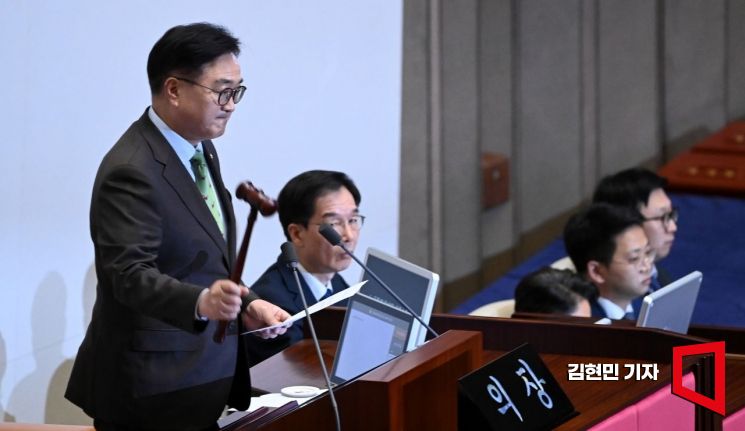 Speaker Woo Won-shik is announcing the passage of the impeachment motion against President Yoon Seok-yeol at the 4th plenary session of the 419th National Assembly (extraordinary session) held at the National Assembly on the 14th. Photo by Kim Hyun-min
On the 14th, immediately after the National Assembly's resolution on the presidential impeachment motion, Prime Minister Han issued urgent instructions to all ministries and public officials and held an interim Cabinet meeting at the Government Seoul Office Building as his first face-to-face schedule. To Deputy Prime Minister Choi, he urged, "The economic team should closely cooperate to minimize the negative impact of the political situation on the economy and maintain a 24-hour monitoring system," adding, "If necessary, activate contingency plans promptly and continue to seek ways to support our companies and the livelihood economy."
Following the acting president’s urgent instructions, Deputy Prime Minister Choi plans to hold an emergency meeting of economic-related ministers and a meeting of foreign affairs ministers in succession on the afternoon of the 15th. He also plans to chair the macroeconomic and financial issues briefing (F4) meetings, which have been held daily since the declaration of martial law.
The economic and financial authorities have faced unprecedented uncertainty in the financial markets since the declaration of martial law, and although some uncertainty has been alleviated by the passage of the impeachment motion, they appear to judge that there are still considerable risk factors.
A senior official from the financial authorities explained, "More detailed countermeasures following the passage of the impeachment motion will be discussed at the meeting chaired by the Deputy Prime Minister," adding, "Inspection meetings by the Financial Services Commission as well as the Financial Supervisory Service will continue to be held daily as before."
The heads of the economic and financial sectors also plan to continue external communications that have been ongoing to prevent damage to Korea’s credibility. Deputy Prime Minister Choi sent urgent letters to finance ministers of major countries such as the United States, Japan, and China, as well as heads of international organizations, global credit rating agencies, and financial institutions. He also met with Pierre-Olivier Gourinchas, Chief Economist of the International Monetary Fund (IMF), to exchange views on Korea’s economic and financial market situation.
On the 12th, Deputy Prime Minister Choi also held video conferences with senior officials from the three major global credit rating agencies?Standard & Poor’s (S&P), Moody’s, and Fitch. At this meeting, he emphasized that "although there were two previous impeachment crises, their impact on the overall economy was limited."
Financial Services Commission Chairman Kim Byung-hwan recently met with the British Ambassador to Korea and explained that, based on the experience of maintaining financial system stability during the political upheaval in 2016, the current market stabilization mechanisms are even more robust. Chairman Kim also held successive meetings with Hiromi Yamaji, CEO of the Japan Exchange Group (JPX).
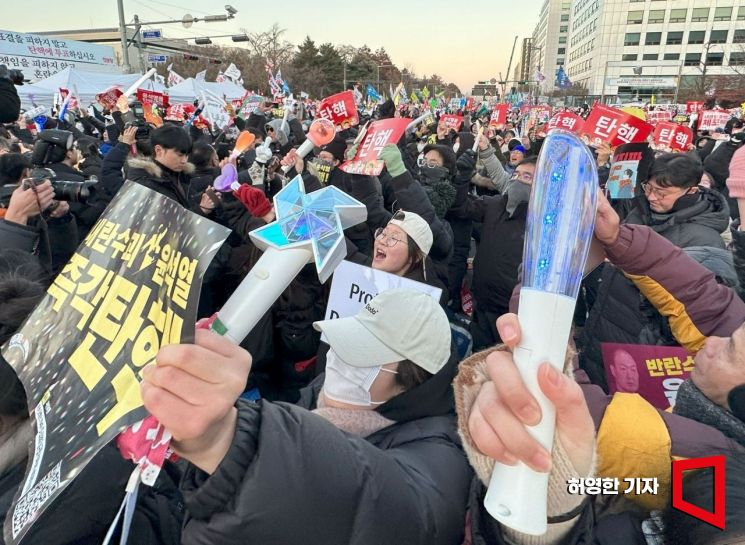 Participants gathered in front of the National Assembly building in Yeouido, Seoul, are cheering immediately after the impeachment motion against President Yoon Suk-yeol was passed in the second impeachment vote. Photo by Heo Young-han
Financial Supervisory Service Governor Lee Bok-hyun also met with the Japanese Ambassador to Korea and mentioned that, based on past cases, shocks from non-economic factors such as politics were temporary and limited. He emphasized that, from a long-term perspective, ongoing initiatives such as corporate governance improvement, value-up programs, foreign exchange market advancement, and inclusion in the WGBI will be consistently pursued to enhance market confidence.
Bank of Korea Governor Lee Chang-yong, who decided to supply unlimited liquidity through repurchase agreement (RP) purchases, is actively communicating with foreign media such as The Economist, Bloomberg TV, and the Financial Times (FT). In an interview with The Economist, he pointed out that "(the declaration of martial law) was unnecessary and an unimaginable mistake," but also stated that "the impact of political instability on the economy will be limited."
© The Asia Business Daily(www.asiae.co.kr). All rights reserved.


















