Impeachment Motion Against President Yoon Passed by National Assembly on 14th
Worst-Case Scenarios Like National Credit Rating Downgrade Avoided
"Uncertainty Partially Resolved by Impeachment Approval"
On the 14th, the National Assembly passed the impeachment motion against President Yoon Suk-yeol, which is being evaluated as having averted the worst economic situation. The political turmoil had impacted the economy and financial markets, raising concerns about a downgrade in the country's credit rating, but the uncertainty has now been partially resolved. The government is expected to focus on stabilization by monitoring domestic and international situations while increasing contact with credit rating agencies and investors.
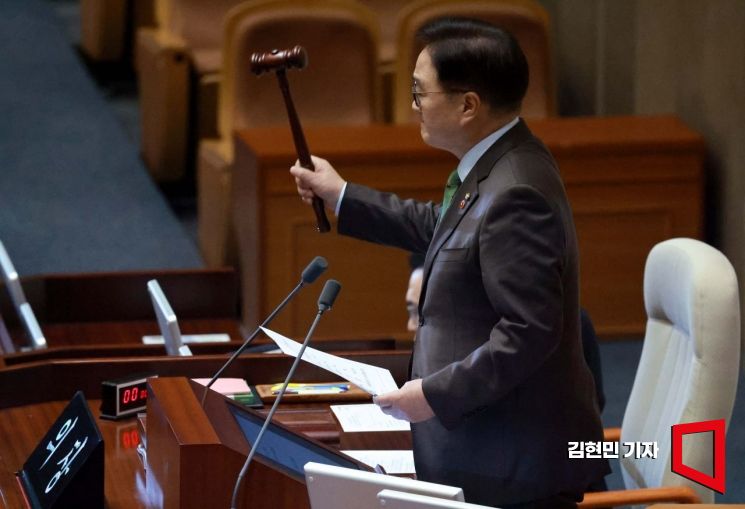 Speaker Woo Won-shik is announcing the passage of the impeachment motion against President Yoon Seok-yeol at the 4th plenary session of the 419th National Assembly (extraordinary session) held at the National Assembly on the 14th.
That afternoon, the National Assembly, during the 4th plenary session of the 419th National Assembly (extraordinary session), passed the second impeachment motion against President Yoon Suk-yeol. Out of 300 votes, 204 were in favor, 85 against, 3 abstentions, and 8 invalid votes. Although the first impeachment motion against President Yoon on the 7th did not come to a vote due to the ruling party's non-participation, the political situation rapidly changed, leading to impeachment within a week.
Speaker of the National Assembly Woo Won-shik, upon announcing the vote, said, "The National Assembly and the government will unite and cooperate to ensure that the people's livelihoods and daily lives stabilize quickly and that domestic and international anxieties and concerns in all areas, including diplomacy and national defense, do not increase." He added, "Government officials should carry out their duties without any wavering," and "The National Assembly will also do its best to restore external credibility and revive people's livelihoods."
With the impeachment motion passed in the National Assembly just 11 days after the December 3 emergency martial law incident, it is being evaluated that the worst economic situation was avoided. This is because the sudden political turmoil had hit the financial and foreign exchange markets, raising concerns about a downgrade in the national credit rating. Especially, as disagreements between the ruling and opposition parties continued over the impeachment motion and President Yoon directly confronted the impeachment push, concerns about side effects if the situation prolonged were ongoing.
An official from the economic department said, "Global credit rating agencies said that if the (Korean political) uncertainty and turmoil persist for a long time, it would not be good for the Korean economy, and if the impeachment motion had been rejected, the turmoil would have been greater," adding, "With the motion passed this time, some of the uncertainty has been resolved." He further said, "If the impeachment procedure proceeds according to the constitution, the market is expected to respond positively."
Kang Sung-jin, a professor of economics at Korea University, said, "(If it had been rejected,) it would have meant voting on impeachment every week, so this time it is relatively better." He also explained, "If the national credit rating were downgraded, the cost for Korean companies to raise funds would increase, and there was also a possibility that funds invested in the domestic stock market would flow out."
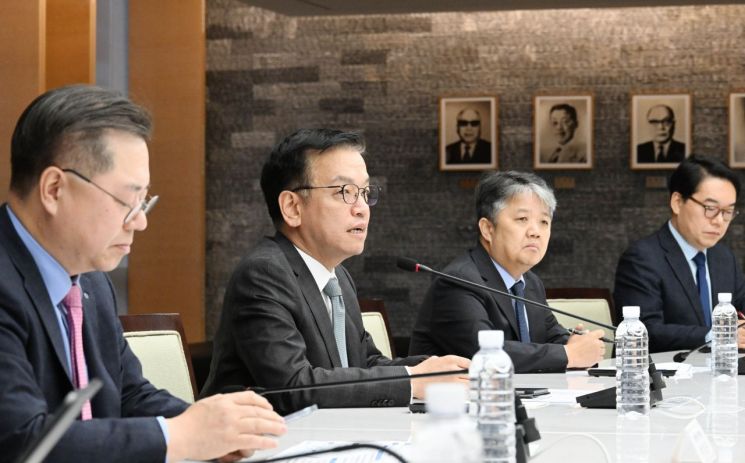 Choi Sang-mok, Deputy Prime Minister for Economic Affairs and Minister of Economy and Finance, speaks at a meeting with representatives of foreign-invested companies and related organizations on the 13th. Photo by Ministry of Economy and Finance
Earlier, the three major global credit rating agencies?Standard & Poor's (S&P), Moody's, and Fitch?said that the current situation would not immediately affect the national credit rating but all expressed concerns about the adverse effects of prolonged political uncertainty. Moody's evaluated that if political instability continues, the government's capacity to respond to crises could diminish, stating it would have a "Negative" impact on credit.
In fact, France, which has recently experienced political division, saw its national credit rating downgraded. According to foreign media such as AFP on the 14th (local time), Moody's lowered France's national credit rating from Aa2 to Aa3 by one notch. Moody's explained the downgrade by saying, "Political division has significantly weakened France's public finances and will limit the scope and scale of measures to reduce large deficits for the time being."
The government is expected to focus on stabilizing the situation by increasing contact with global credit rating agencies, overseas investors, and finance ministers of major countries while monitoring domestic and international situations. Professor Kang said, "Since Yongsan is in a situation where it is difficult to act as a control tower, the economic team will need to exert effort," adding, "The opposition party also does not want the economy to collapse, so cooperation is necessary to gain agreement on systems and budgets."
The government has been working to reduce economic risks while responding to financial and foreign exchange market instability. The Ministry of Economy and Finance held a meeting with representatives of foreign-invested companies and related organizations the day before, and on the 12th, held a video conference with senior officials from the three major global credit rating agencies. Choi Sang-mok, Deputy Prime Minister and Minister of Economy and Finance, emphasized, "Although there was turmoil during the two previous impeachments, the overall economic impact was limited."
Meanwhile, with the impeachment motion passed in the National Assembly that day, President Yoon's duties were suspended. Prime Minister Han Duck-soo will take over as acting president and lead the state affairs. The Constitutional Court will begin impeachment proceedings for up to 180 days. Based on past impeachment cases, it is expected that a conclusion could be reached within 60 to 90 days. Prime Minister Han stated, "I will devote all my efforts and energy solely to operating the government stably."
© The Asia Business Daily(www.asiae.co.kr). All rights reserved.













