Visit to Lotte Mart Store in Jakarta, Indonesia
Various Korean Agricultural Products on Sale Catch Attention
Signs and Menus Also Written in Hangul
Cumulative Export Amount Reached 2.2869 Billion USD
Local Manufacturers Also Selling Korean-style Ramen
Korean Government Supports Mandatory Halal Certification in Indonesia
The Korean Wave, which spread through K-dramas and K-pop, is now extending to K-food. As the number of global consumers seeking Korean products increases, the export value of agricultural and food products to Indonesia, the world's fourth most populous country, has surged by 45% over the past five years. In local supermarkets, it was easy to find young consumers looking for Korean ramen, snacks, and fruits. This is why the market is regarded as having high potential to expand the Korean agricultural and food industry’s offerings.
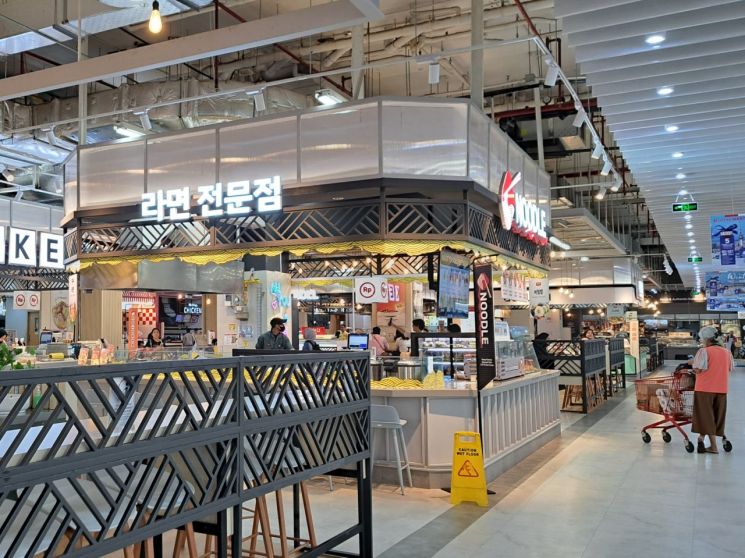 A view of the food court in front of Lotte Mart Gandaria City branch in North Jakarta, Indonesia. The Korean signboard stands out. Photo by Kim Pyeonghwa
On the afternoon of the 28th of last month, I visited the Lotte Mart Gandaria City branch in North Jakarta, Indonesia. Entering Gandaria City Mall and taking the escalator down from the first floor, a familiar scene soon unfolded.
At several food courts in front of the mart, various Korean dishes such as tteokbokki, gimbap, and bibimbap were being cooked and sold on the spot. The food menus displayed around were also written in Hangul. If there had been no Indonesian customers eating there, one might have mistaken it for a domestic Korean supermarket.
Inside the mart, various Korean agricultural and food products could also be found. At the entrance, Korean tomatoes, strawberries, and pears were neatly arranged. On one wall, there were tofu products marked with the Taegeuk symbol. In the middle of the mart, halal-certified Korean apple juice was available.
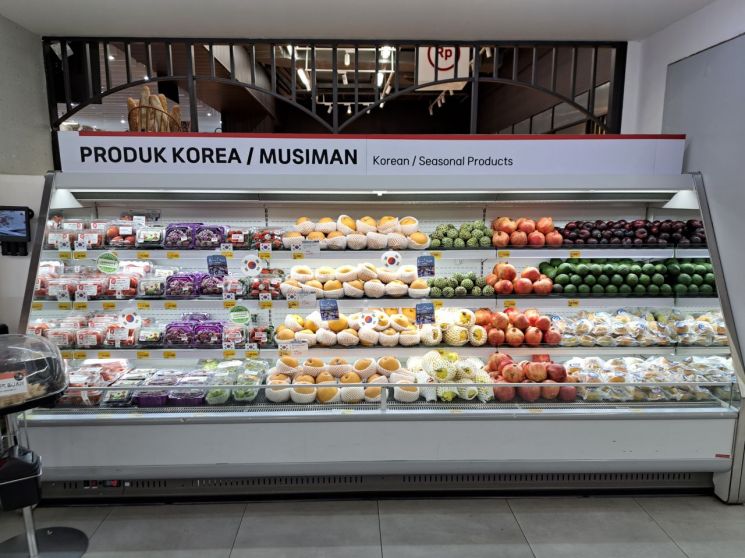 Several varieties of Korean fruits displayed at the entrance of Lotte Mart Gandaria City branch in North Jakarta, Indonesia. Photo by Kim Pyeonghwa
Halal is an Arabic word meaning "permitted" or "lawful," used in the Islamic scripture, the Quran. Products with halal certification mean they do not contain foods or ingredients forbidden to Muslims, such as pork.
Spinella, a 32-year-old local freelancer met at the mart that day, said, "I like Korean fruits such as peaches." She added, "My friends around me also like Korean food," and "I have even tried making gimbap myself."
Shahur, 21, who introduced himself as a barista, said, "I have a Korean friend who shows me Korean snacks every time we video call," and "I buy those snacks at the mart every time." He also said, "I sometimes buy Korean instant food and cook it to eat."
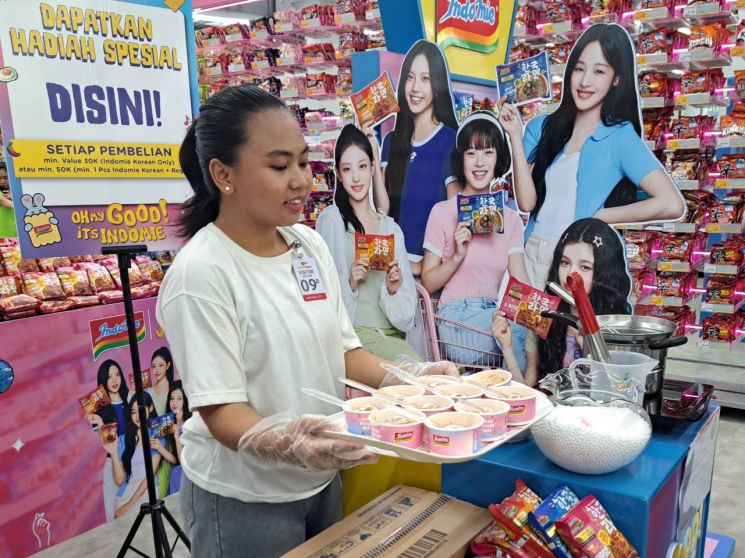 An employee at Lotte Mart Gandaria City in North Jakarta, Indonesia, is conducting a tasting event for Korean-style ramen products released by a local noodle manufacturer. The Korean idol group NewJeans, promoting the ramen, can also be seen. Photo by Kim Pyeonghwa
On one side, there was a noodle zone filled with various types of ramen products covering the wall, attracting attention. At this spot, a local Lotte Mart employee was conducting a ramen tasting event. Although the products were from a local ramen manufacturer, the name "Korean Ramen" was written in Hangul, which was interesting.
At the site, Seonggwang Cho, team leader of Lotte Mart Indonesia’s Global Sourcing team, explained, "Because Korean ramen is very popular here, Indomie, the largest ramen company in Indonesia, has released a product," adding, "(The Korean idol group) NewJeans is promoting the product."
Recently, Korean ramen companies have introduced several halal-certified ramen products locally, further boosting the popularity of Korean ramen. The export value of ramen to Indonesia from January to November this year reached $10,424,000, far surpassing last year’s total export value of $8,519,000.
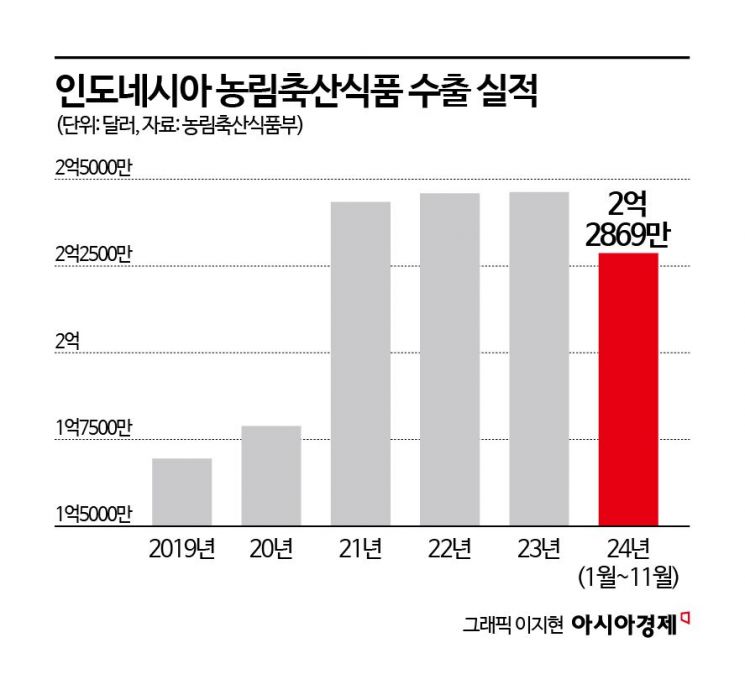
The total sales of agricultural, forestry, livestock, and food products exported to Indonesia are also on an upward trend. From $169.49 million in 2019, it rose to $246.3 million last year, a 45.32% increase over five years. The cumulative export value from January to November this year recorded $228.69 million.
Of course, it is difficult to have only rosy prospects for the Indonesian market. Since about 80% of the population is Muslim, halal certification is necessary to consider the majority of the population as potential consumers. The Indonesian government’s plan to mandate halal certification by 2026 is also a factor raising market barriers.
According to the Korea Agro-Fisheries & Food Trade Corporation (aT), as of last month, about 17.8% (252 out of 1,412) of major Korean agricultural and food products have received halal certification. There are concerns that smaller companies may find it difficult to obtain halal certification.
The Korean government plans to work to ensure that halal certifications obtained domestically are recognized in Indonesia as well. Lee Seunghoon, head of aT’s Jakarta office, who was met locally, said, "Last month, we signed a mutual recognition agreement with Indonesia to have certifications obtained domestically through organizations such as the Korea Halal Certification Institute recognized."
© The Asia Business Daily(www.asiae.co.kr). All rights reserved.
![Clutching a Stolen Dior Bag, Saying "I Hate Being Poor but Real"... The Grotesque Con of a "Human Knockoff" [Slate]](https://cwcontent.asiae.co.kr/asiaresize/183/2026021902243444107_1771435474.jpg)












