Various Experience Facilities, Exhibitions, Restaurants, Bookstores, Libraries, and Complex Cultural Space 'F1963' Outdoor Garden
Commemoration Ceremony at 10 AM on the 13th, Attended by Mayor Park Hyung-jun, Joo Jong-dae CEO of Goryeo Steel, and About 10 Others
Busan City has selected and registered 'F1963 Garden (located in Suyeong-gu)' as Busan's first private garden.
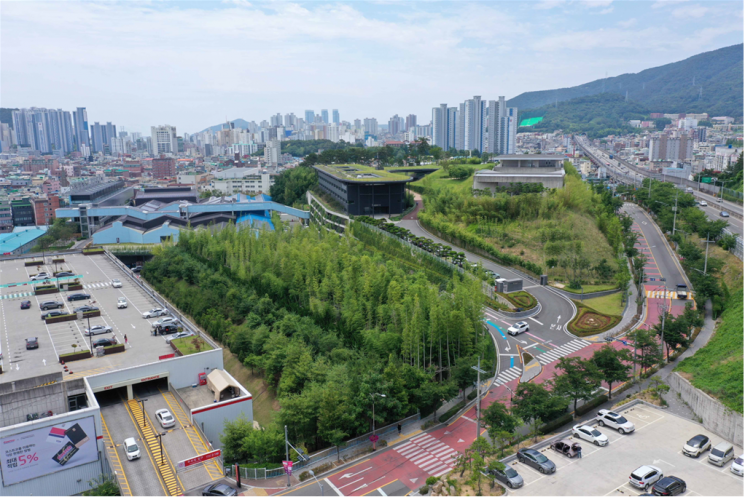
According to the 'Act on the Creation and Promotion of Arboretums and Gardens,' a garden refers to a space where plants, soil and stones, facilities, etc. are exhibited, arranged, cultivated, or maintained continuously. Among these, a 'private garden' is a garden created and operated by a corporation, organization, or individual.
Since COVID-19, healing has become a major social trend, and the demand for personal spaces is increasing. Gardens are gaining attention as their positive effects, such as fulfilling the desire for personal space and providing healing, are being re-evaluated.
The first registered private garden in the city, 'F1963 Garden,' is an outdoor garden of the complex cultural space 'F1963,' which was gradually created over about five years from 2016 to 2021.
'F1963' is a word combining the year '1963,' when the Goryeo Steel factory was first built, and 'F' for factory. Since 2008, the space used as a Goryeo Steel warehouse was utilized as a special exhibition hall for the Busan Biennale in 2016, attracting over 170,000 visitors, and has since become known as a complex cultural space.
Notably, when the building was renovated in 2016, the garden was planned together with the spatial layout, drawing attention. This is significant because it was not a conventional practice of introducing landscaping on the remaining site after construction, but rather a thoughtful and practical harmony between architecture and landscaping from the start.
In addition to the garden, this place is equipped with various cultural facilities such as exhibition spaces, restaurants, bookstores, libraries, and cafes. By operating diverse cultural programs and opening the garden free of charge to nearby residents, it reflects the local company's commitment to social contribution.
'F1963 Garden' is mainly composed of three themed gardens: ▲ 'Sorigil' Garden, a bamboo forest resembling wire ▲ 'Dalbit Garden,' which is better at night than during the day ▲ 'Danpung Garden,' with shade and breeze. Various garden plants, water features, and resting facilities harmonize to give each garden its unique character.
Walking from the parking lot of 'F1963' toward the entrance, you can see the bamboo forest 'Sorigil,' where green leaves stretch straight up to the sky. The bamboo forest path, resembling the straight and flexible properties of wire, fits well with 'F1963,' which has memories of a wire factory.
Passing the entrance and strolling outside the building, you can find 'Dalbit Garden,' transformed from a wastewater treatment plant into an ecological garden. The stone art installation placed in the space where the sky and a small lotus garden blend naturally seems as if it has been there for a long time.
'Danpung Garden,' where you can enjoy the shade of zelkova trees and maple leaves, exudes the deepening autumn atmosphere. Although a small space, it offers a sense of relaxation disconnected from the bustling city.
A ceremony to commemorate the designation of the city's first private garden will be held at 10 a.m. on the 13th at 'F1963 Garden.' About ten people, including Mayor Park Hyung-jun, Joo Jong-dae, CEO of Goryeo Steel, professors, and officials, will attend, with events such as certificate presentation and garden touring planned.
The city has designated lifestyle gardens created and operated by public institutions (Busan City's former official residence Domohun, Sosopung Garden) and is actively promoting the discovery (registration) of private gardens within the city to establish a garden culture led by citizens in daily life.
Private gardens are gardens created and maintained by the private sector rather than the government. Through the private garden system, the city expects to share garden spaces throughout the urban area and create opportunities to spread garden culture. It encourages interest in excellent private gardens and actively promotes registration.
Once designated as a private garden, it will be widely promoted through various media such as the city's website, and support will be provided for necessary matters related to garden operation and management, including plant preservation and propagation, as well as various projects linked with citizen gardeners.
Since private gardens are personal property, designation does not impose any financial disadvantages or restrictions regardless of whether the garden is open to the public.
Mayor Park Hyung-jun said, "'F1963' is widely known as a cultural space, but its value will be further enhanced as a beautiful and well-maintained garden, becoming a popular destination for many citizens." He added, "With the designation of Busan's first private garden, I hope garden culture that shares the beauty and utility of gardens already created in daily life will spread widely. We will also do our best to create high-quality public gardens by actively reflecting the opinions of experts and citizens."
© The Asia Business Daily(www.asiae.co.kr). All rights reserved.
![Clutching a Stolen Dior Bag, Saying "I Hate Being Poor but Real"... The Grotesque Con of a "Human Knockoff" [Slate]](https://cwcontent.asiae.co.kr/asiaresize/183/2026021902243444107_1771435474.jpg)











