Ministry of Agriculture, Food and Rural Affairs Announces 'Rice Industry Structural Reform Measures'
Aims to Resolve Oversupply and Stabilize Rice Prices through Area Adjustment and Crop Diversification
Promotes Quality Enhancement via High-Quality Rice Production Complexes and Reform of Grain Labeling System
Policy Funds Preferentially Provided to Companies Utilizing New Rice to Create New Demand
The government has decided to provide government support incentives such as public rice stockpurchasing only to farms that participate in reducing rice cultivation area next year. Considering this year's public rice stockpurchasing scale (450,000 tons), farms that do not reduce their rice cultivation area will mostly be excluded from the public rice stock target.
On the 12th, the Ministry of Agriculture, Food and Rural Affairs announced the "Rice Industry Structural Reform Measures (2025?2029)" containing these details.
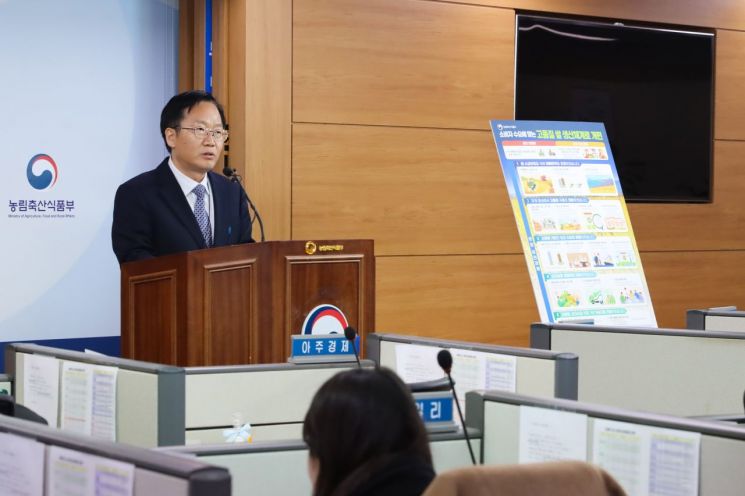 Choi Myung-chul, Director of Food Policy at the Ministry of Agriculture, Food and Rural Affairs, is announcing the 'Rice Industry Structural Reform Measures' at the Government Sejong Complex on the 12th.
Choi Myung-cheol, Director of Food Policy at the Ministry of Agriculture, Food and Rural Affairs, explained, "The rice industry is in a structurally oversupplied state where the rate of consumption decrease is greater than production," adding, "Despite 12 rounds of market isolation since 2005, rice price instability has repeated. Based on this judgment, this measure was prepared to resolve the structural oversupply of rice."
According to the Ministry, per capita rice consumption decreased by 7.5% from 61.0 kg in 2018 to 56.4 kg in 2023, but during the same period, the cultivation area only decreased by 4.1%, from 738,000 hectares to 708,000 hectares. This means the rice industry is structurally oversupplied with consumption decreasing faster than production.
◆ Implementation of 'Rice Cultivation Area Adjustment System' from next year = The Ministry plans to implement the rice cultivation area adjustment system starting in 2025, aiming to reduce rice cultivation area by 80,000 hectares. The reduction area will be allocated by city and province, and farmers will implement area reduction through various methods such as switching to other crops or converting to eco-friendly farming. Government support incentives, including public rice stockpurchasing, will be provided mainly to farms that comply with the reduction. The purchase price for public rice stock is 7?10% higher than the market price.
A Ministry official explained, "Next year, we will prioritize public rice stockpurchasing for farms participating in area reduction," adding, "We will review reduction plans by city and province, and if progress is poor, we will also consider reducing direct payments to farms that do not reduce their rice cultivation area."
Additionally, the government will expand the strategic crop direct payment system (from 186.5 billion KRW in 2024 to 244 billion KRW in 2025) to support farms switching from rice to other crops, and increase payment rates for summer forage and wheat. It will also support expanding the consumption base by linking with food companies for product development and promotion of strategic crops such as soybeans. Restrictions on general rice cultivation will be implemented on newly leased or contract-renewed reclaimed land (1,300 hectares in 2025).
◆ Transition to production and consumption structure centered on high-quality varieties = Along with reducing rice cultivation area, the Ministry will promote quality upgrading. First, it will designate and operate high-quality rice specialized production complexes (50?100 hectares). Producer groups will lead efforts to reduce fertilizer use and produce high-quality rice. One pilot site per city and province will be operated in 2025, expanding to two sites by 2029.
The government seed supply system will also be reorganized to focus on consumer-preferred varieties. Approximately 15 top varieties with excellent taste and aroma will be selected and intensively supplied as government seeds. To shift consumer perception from regional to variety-based, promotion highlighting characteristics such as single variety and certified rice (including eco-friendly) will be pursued.
Eco-friendly rice cultivation with good quality will be expanded to 68,000 hectares by 2029. To this end, eco-friendly rice will be preferentially purchased at increased prices when buying public rice stock, and up to 150,000 tons will be fully purchased as public rice stock when switching from general rice to eco-friendly rice. The direct payment rate for eco-friendly paddy fields will also be increased. The grain labeling system will be revised to spread high-quality rice production and distribution. Protein content labeling, currently optional and only about 10%, will become mandatory from 2027.
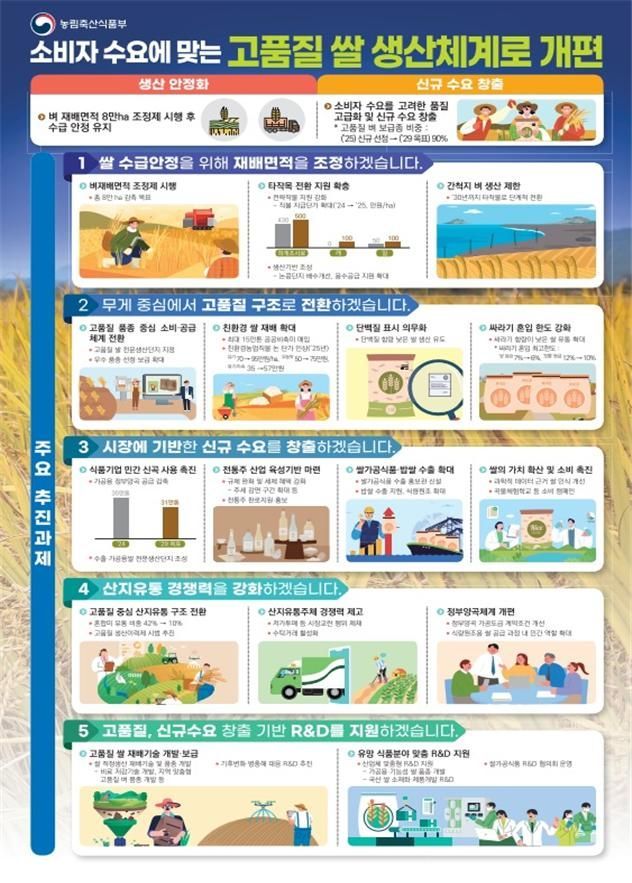
◆ Expansion of private new rice utilization and fostering traditional liquor to create new demand = The Ministry plans to improve systems to expand the use of private new rice by food companies. Food companies switching from government rice to private new rice will receive preferential treatment in food and dining policy funds. Pilot export and processing production complexes linked with food companies and rice processing complexes (RPC) will be established, and government rice supply for processed rice products will be gradually restricted.
Tax benefits and deregulation to foster the traditional liquor industry will also be pursued. To reduce manufacturers' burden, the liquor tax reduction range will be expanded from 2025 (introducing a 30% reduction bracket), and the main ingredient criteria for regional specialty liquors will be relaxed.
Expansion of rice processed food and rice exports will also be promoted. To increase rice processed food exports from 100,000 tons this year to 180,000 tons by 2029, local promotional centers for rice processed foods will be established in Singapore, China, and other countries, and sales channels such as online B2B marketplaces will be supported. Rice for cooked rice will gradually expand exports focusing on promising new markets such as Singapore. Additionally, cooperation with the United Nations World Food Programme (WFP) will increase food aid mainly to Africa and Asia from 110,000 tons in 2024 to 160,000 tons in 2025.
The Ministry aims to reduce the rice cultivation area from 698,000 hectares this year to about 600,000 hectares by 2029, and maintain per capita rice consumption at around 50 kg, down from about 53.3 kg this year.
Director Choi said, "Through the rice industry structural reform measures, we will resolve the structural oversupply of rice and strive to shift from conventional production systems to high-quality and eco-friendly systems desired by consumers," adding, "We will steadily implement policy tasks to make this an important turning point that enhances the competitiveness of the rice industry and contributes to rice price stability."
© The Asia Business Daily(www.asiae.co.kr). All rights reserved.

![Clutching a Stolen Dior Bag, Saying "I Hate Being Poor but Real"... The Grotesque Con of a "Human Knockoff" [Slate]](https://cwcontent.asiae.co.kr/asiaresize/183/2026021902243444107_1771435474.jpg)

















