The financial authorities have decided to build a platform that allows financial companies to easily calculate the carbon emissions of their investment and loan targets. They also announced that they have prepared green loan management guidelines applying the Korean-style green taxonomy (K-Taxonomy) to the credit sector, and are conducting climate stress tests to understand the impact of climate change on the financial sector.
On the 12th, the Financial Services Commission announced that it held the '6th Climate Finance Meeting' together with the Financial Supervisory Service, Bank of Korea, Korea Institute of Finance, Korea Federation of Banks, General Insurance Association of Korea, Korea Development Bank, Industrial Bank of Korea, Korea Insurance Research Institute, Deloitte, and others. At this final meeting of the year, they summarized and shared the outcomes of major policy tasks discussed so far, including ?expansion of climate finance supply ?enhancement of climate finance capabilities ?expansion of climate finance infrastructure. The Climate Finance TF is one of the three subcommittees (population, climate, technology) of the Future Response Finance TF, and has been discovering and discussing mid- to long-term climate finance policy tasks across the entire financial sector.
According to the 'Plan to Expand Financial Support for Climate Crisis Response' announced in March, the Financial Services Commission supplied 54 trillion KRW in policy finance to the climate sector by the end of October. This exceeded the first-year target of 48.6 trillion KRW. In addition, they completed raising 1.26 trillion KRW for the Future Energy Fund to support renewable energy facility investments, and are currently raising a 360 billion KRW Climate Technology Fund.
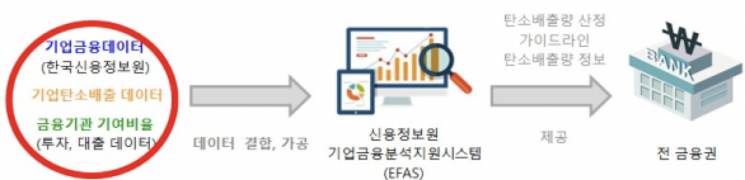
Furthermore, they decided to build a platform that can calculate financial sector carbon emissions. Financial emissions refer to the indirect contribution of financial companies to the carbon emissions of their transaction counterparts through financial activities such as investments and loans. Major global investors are demanding disclosures from domestic financial companies and investee companies regarding climate change-related risks, opportunities, and financial impacts.
In response, the Financial Services Commission, centered on the Climate Finance TF, launched the 'Financial Emissions Working Group' and is promoting the construction of a 'Financial Emissions Platform' utilizing the infrastructure of the Credit Information Center. Through this platform, standard financial emissions calculation guidelines and data necessary for calculating financial emissions will be provided to financial companies. The financial sector has faced difficulties due to excessive costs and time required to collect extensive information on the carbon emissions of investment and loan targets. Without a global standard financial emissions calculation formula, financial companies have calculated financial emissions based on different criteria.
Additionally, to apply the Korean-style green taxonomy to credit, the financial authorities and the Ministry of Environment established the 'Green Loan Management Guidelines.' The green taxonomy was enacted by the Ministry of Environment in 2021 to present standards for eco-friendly green economic activities. The financial authorities and the Ministry of Environment previously announced the 'Green Bond Guidelines' in 2022 to facilitate the application of the green taxonomy in the financial sector. This time, by establishing the 'Green Loan Management Guidelines' that provide criteria for financial companies to determine whether loans they handle are suitable for green economic activities, they aimed to create conditions for the activation of green finance.
To strengthen climate risk management in the financial sector, the financial authorities and the Bank of Korea are conducting climate stress tests together with 15 financial companies. This test measures the impact of climate change-related financial risks and the loss absorption capacity of financial companies, and analyzes the effect of climate risks on the soundness of the financial sector. The final results are scheduled to be announced in the first quarter of next year.
Next year, the Climate Finance TF plans to promote green finance suitable for Korea's economic structure by referring to 'transition finance' introduced by the European Union (EU) and Japan. In the short term, they will enhance the competitiveness of high-carbon industries, while in the long term, they will discuss 'Korean-style transition finance' to promote a flexible transition to a carbon-neutral economy. It is explained that since Korea has a high proportion of manufacturing and fossil energy, strictly pursuing green finance may rather cause limitations such as carbon lock-in.
There was also an opinion that it is necessary to expand education programs for financial personnel to increase the number of experts and evaluation institutions who can judge whether investment and loan targets are suitable for green economic activities. Additionally, participants suggested that after building the financial emissions platform, it is necessary to discuss various measures to enhance incentives for small and medium-sized enterprises to measure and reduce carbon emissions using the collected information.
Shin Jin-chang, Director of the Financial Policy Bureau at the Financial Services Commission, said, "We will form a joint working group (W/G) in the financial sector focusing on the tasks discussed in the TF, such as transition finance, expansion of green finance evaluation personnel and institutions, and activation of the financial emissions platform, and actively consult with related ministries such as the Ministry of Trade, Industry and Energy and the Ministry of Environment." He added, "Next year, we will actively promote supply and investment execution worth 51.7 trillion KRW according to the plan to expand climate finance, and actively pursue the development of various financial products such as green deposits and climate insurance, as well as the expansion of incentives to revitalize climate finance."
© The Asia Business Daily(www.asiae.co.kr). All rights reserved.
![Clutching a Stolen Dior Bag, Saying "I Hate Being Poor but Real"... The Grotesque Con of a "Human Knockoff" [Slate]](https://cwcontent.asiae.co.kr/asiaresize/183/2026021902243444107_1771435474.jpg)

















