Ministry of Health and Welfare's Budget for Next Year Confirmed at 125.49 Trillion Won
Support for Residents Reduced to 93.1 Billion Won, Nationwide Mind Investment Project to 7.5 Billion Won
As the budget bill, which the opposition party unilaterally cut, passed the National Assembly on the 10th, the Ministry of Health and Welfare's total expenditure for next year's budget and funds was finalized at 125.4909 trillion won. With a significant cut in the budget for improving the training environment and supporting training allowances for residents, the government's plan to strengthen regional and essential medical care through resident training has also been disrupted.
According to the Ministry of Health and Welfare on the 11th, the finalized budget for next year increased by 7.2% compared to this year (117.0445 trillion won), but it decreased by 16.55 billion won (-0.1%) compared to the original budget bill (125.6565 trillion won) submitted by the government to the National Assembly.
The largest cut was in the budget for the training and proper supply management of residents (interns and residents). Out of 392.242 billion won, 93.112 billion won was cut. The budget passed the plenary session with a reduction of 75.672 billion won in the 'Support for Innovation in Resident Training Environment' item and 17.44 billion won in the 'Resident Training Allowance Payment' budget. The government and ruling party claimed that this budget was essential to strengthen resident support, which the medical community had demanded, but the opposition party cut the budget, citing uncertainty about residents' return in the first half of next year.
Earlier, the Presidential Commission on Medical Reform announced various support measures to induce residents' return, including fee normalization and a national responsibility system for resident training, through the '1st Medical Reform Implementation Plan' in August. The plan was to invest a substantial budget in expanding allowances for essential specialty residents, improving training facilities, education expenses, and joint training innovation. Accordingly, the original government budget included support for education expenses for residents in pediatrics, internal medicine, surgery, obstetrics and gynecology, emergency medicine, thoracic surgery, neurology, and neurosurgery, and significantly expanded the number of recipients for the allowance of 1 million won per month for essential specialty residents.
However, due to budget cuts, these resident support plans inevitably faced setbacks. Although the government stated it would start supplementary budget preparation immediately after the execution of next year's budget to restore the cut livelihood budget, the possibility of restoring the resident-related budget seems low amid prolonged medical-government conflicts. Anna Choi, spokesperson for the Korean Medical Association, criticized, "The government hastily came up with resident training environment improvement measures without fully understanding the impact of increasing medical school quotas by 2,000, resulting in even the existing budget being cut. Even as the medical system collapses, they cannot identify where things went wrong or prepare countermeasures for the damage the public might suffer."
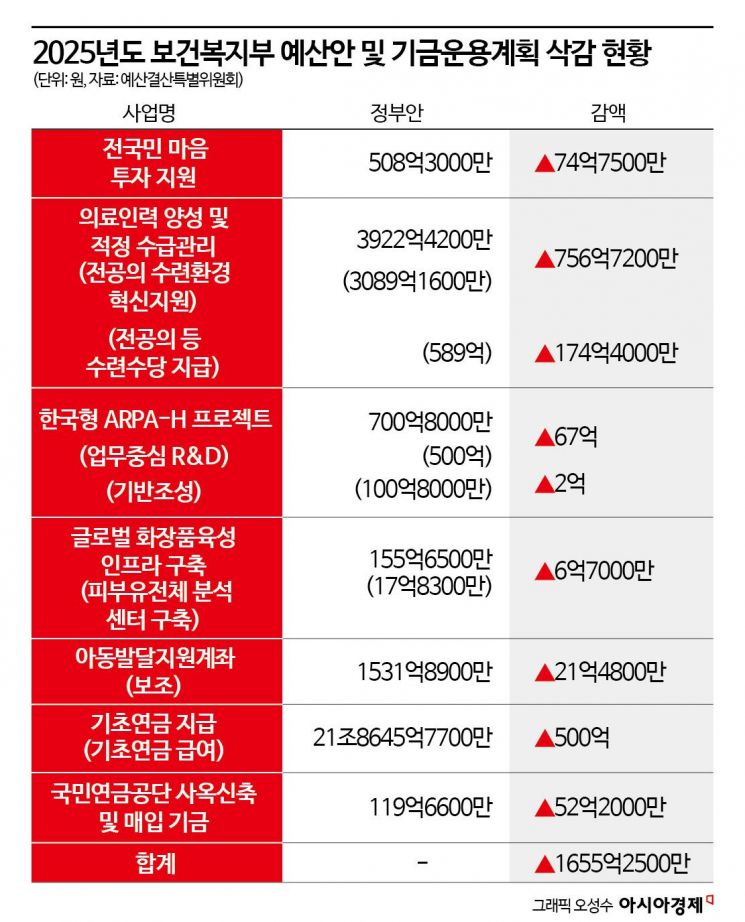
Meanwhile, among the Ministry of Health and Welfare's projects for next year, 7.5 billion won was cut from the nationwide mental investment support project, controversially known as the 'Kim Geon-hee budget,' and 6.9 billion won was cut from the Korean-style ARPA-H project mission-oriented research and development (R&D) budget, which sets the direction for national R&D. The budget for the Child Development Support Account, which supports initial costs such as tuition, employment, start-up, and housing for socially vulnerable children entering society, was reduced by 2.1 billion won, and the basic pension payment budget was cut by 50 billion won.
© The Asia Business Daily(www.asiae.co.kr). All rights reserved.
![Clutching a Stolen Dior Bag, Saying "I Hate Being Poor but Real"... The Grotesque Con of a "Human Knockoff" [Slate]](https://cwcontent.asiae.co.kr/asiaresize/183/2026021902243444107_1771435474.jpg)

















