11th Government Meeting on Strengthening Industrial Competitiveness
Korean Air-Asiana Corporate Merger Nears Completion
Antitrust Measures Announced for Emergence of Giant Airline
Southwest Asia and Europe Traffic Rights Increased and Allocated to LCCs
Alternative Airlines to Be Given Priority for National LCCs
As the corporate merger between Korean Air and Asiana Airlines nears completion, the government has introduced measures to prevent monopolies. Transport rights to South Asia and Europe will be allocated to low-cost carriers (LCCs), which face concerns over declining competitiveness, and support will be provided for national LCC operations on routes requiring alternative carriers. Additionally, the government plans to leverage the benefits of the merger to streamline overlapping routes, launch new routes, and expand consumer choice.
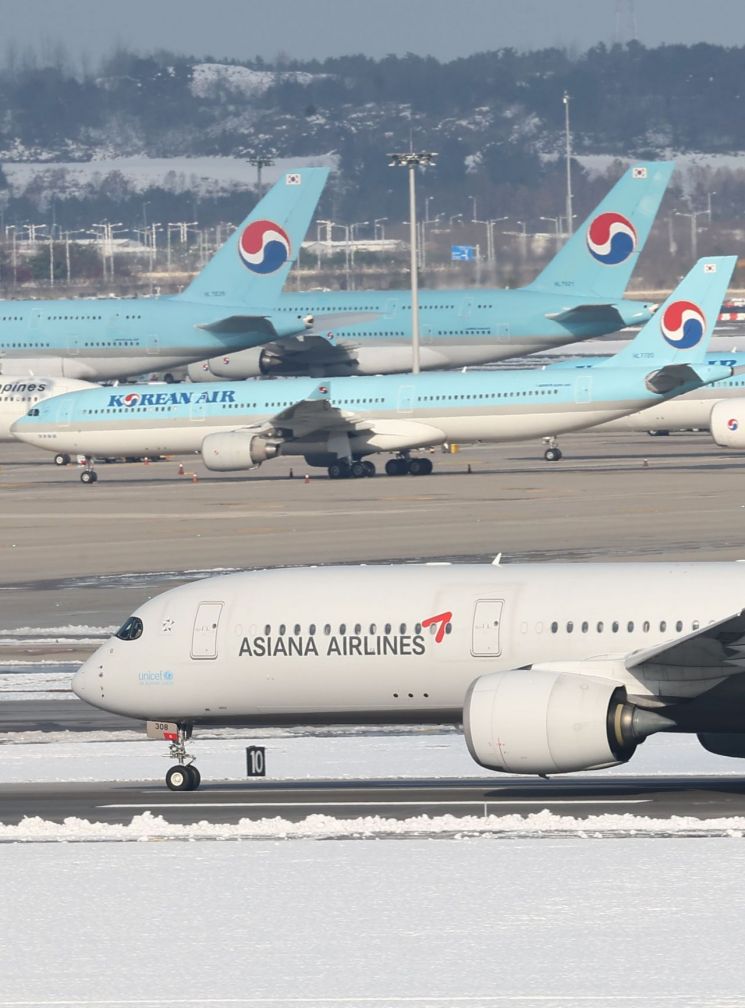
On the 11th, the Ministry of Economy and Finance and the Ministry of Land, Infrastructure and Transport held a meeting of ministers related to strengthening industrial competitiveness at Hanwha Ocean Siheung R&D Campus in Gyeonggi Province and announced the ‘Measures to Strengthen Competitiveness in Air Transport.’ The plan includes provisions to prevent monopolies in the aviation industry and provide more opportunities to LCCs.
The background for these measures is the corporate merger of Korean Air and Asiana Airlines. As of last month, the share of international passengers by airline was 27.1% for Korean Air affiliates and 20.6% for Asiana Airlines affiliates. Once the Fair Trade Commission completes its final discussions on the merger of the two companies soon, a giant airline with a combined 47.7% market share will be created. This has raised concerns within the industry that competition in the aviation sector could be significantly weakened.
The government plans to resolve the monopoly through competition with LCCs. First, the increased transport rights to South Asia and Europe, which are mainly dominated by major airlines, will be allocated primarily to LCCs to encourage fair competition. Also, if a giant airline monopolizes a specific route and alternative carriers enter, priority opportunities will be given to national LCCs. Currently, national LCC participation is expected on routes to China, Japan, and Southeast Asia, where alternative carrier entry is needed. Among the 68 overlapping international routes operated by Korean Air and Asiana Airlines, 38% will be subject to supervision including fare increase management, prohibition of mileage disadvantages, and maintenance of service quality.
Since the operating environment is expected to change rapidly due to the merger, a safety management system has also been established. The government emphasized that safety inspections will be conducted at the level of issuing a new Air Operator Certificate (AOC). A checklist benchmarking overseas airline merger cases in the US and Europe will also be created. For LCCs that operate long-haul flights more frequently, special safety inspections will be conducted, including pre-departure checks and emergency response capabilities.
Increasing High-Demand International Routes and Enhancing Competitiveness of Incheon and Regional Airports
On the other hand, the government will maximize the ‘economies of scale’ effect, which is an advantage of the merger. In the short term, overlapping routes between Korean Air and Asiana Airlines will be reduced, and new routes with confirmed potential demand, such as Dublin in Ireland and Copenhagen in Denmark, will be prioritized for launch. In the mid to long term, support will be provided for routes to emerging markets such as Dhaka in Bangladesh, Colombo in Sri Lanka, and Santiago in Chile. The departure times for the two companies’ Europe and US routes will also be adjusted. Currently, departure times are similar, but they will be staggered to expand consumer choice.
The government also unveiled other competitiveness enhancement measures aligned with market changes. Reflecting recent trends in international demand, transport rights and routes will be increased. Targets include India and Vietnam, where business demand has risen, as well as new vacation destinations and small-scale independent travel spots favored by Korean nationals. In particular, considering population growth and economic growth potential, transport rights to India and Bangladesh will be increased, and market exploration by airlines will be conducted through charter flights in under-served regions such as Africa and Latin America. At the same time, ‘air liberalization’ without transport rights restrictions will be promoted with the European Union (EU), Indonesia, and Australia.
Incheon International Airport, Korea’s main hub airport, aims to strengthen competitiveness through route diversification and attracting transfer passengers. Compared to Changi Airport, Incheon Airport is weak on South Asia routes, and compared to Narita and Haneda airports, it has lower connectivity to secondary European cities. The government plans to provide incentives such as awarding bonus points when allocating transport rights for popular routes to national carriers that operate routes without direct flights. Simultaneously, a new transfer model connecting Oceania-Korea-Central Asia will be expanded. Departure times will be adjusted to enable short transfer times, and the potential to attract transfer passengers will be considered when allocating transport rights.
For regional airports, subsidies will be provided to encourage new route launches. In addition to direct subsidies from local governments, reductions in landing, parking, and lighting fees per route will be offered through airport corporations. Based on regional demand, transport rights dedicated to regional airports will be expanded focusing on medium- to long-distance routes, and measures to foster hub airlines will be prepared, including prioritizing transport rights allocation to regional airports.
© The Asia Business Daily(www.asiae.co.kr). All rights reserved.

















