Explicit Provision of Extended Deterrence Commitment
Clause to Prevent Withdrawal or Reduction of USFK Will Not Be Revived
With the inauguration of Donald Trump as the President of the United States scheduled for January next year, the U.S. Congress has agreed on the Fiscal Year 2025 National Defense Authorization Act (NDAA), which specifies maintaining the size of the U.S. Forces Korea (USFK) and providing an extended deterrence commitment.
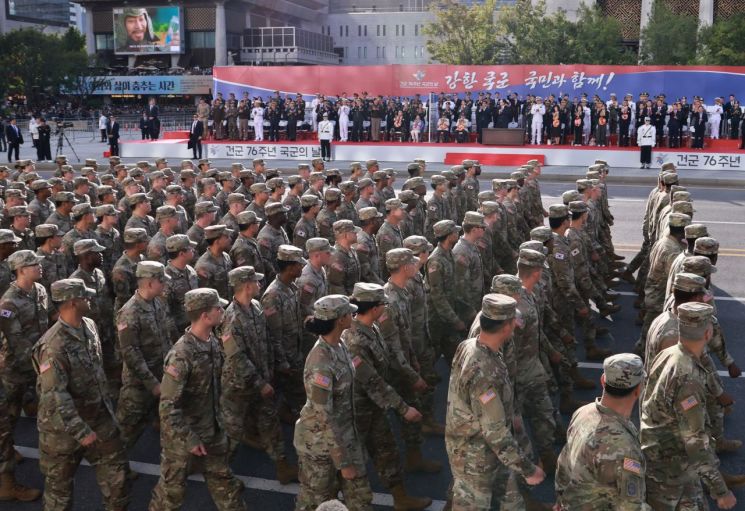
According to the single NDAA recently agreed upon by the Senate and the House on the 10th (local time), it states that cooperation with South Korea, Japan, and others must be strengthened to enhance the U.S.'s comparative advantage in strategic competition with China.
The bill states that approximately 28,500 U.S. troops stationed in South Korea will be maintained "to support the shared goal of a peaceful and stable Korean Peninsula." It also "reaffirms the extended deterrence commitment utilizing all U.S. military defense capabilities and strengthens the mutual defense foundation."
The content of maintaining the USFK at the current level of 28,500 troops and reaffirming the extended deterrence commitment has been included in the NDAA for several years. However, the provision restricting the reduction of USFK, which had been included in the NDAA since the Fiscal Year 2019 during Trump's first term to prevent withdrawal or reduction of USFK, was not revived this time. The Biden administration removed this provision, which was interpreted at the time as meaning there was no need for the wording because President Biden was unlikely to reduce USFK. However, with the second term of Trump approaching, the omission of the USFK reduction restriction clause has left uncertainty.
Regarding extended deterrence for South Korea, the NDAA requires the Department of Defense to submit a plan by March 1 next year to strengthen the U.S. extended deterrence commitment to South Korea. The U.S. Congress ordered the plan to include ▲ the nuclear consultation process between South Korea and the U.S. during emergencies and crises ▲ nuclear and strategic planning between South Korea and the U.S. ▲ integration of conventional and nuclear (capabilities) between South Korea and the U.S. ▲ security and intelligence sharing methods ▲ and the budget, personnel, and resources necessary to strengthen extended deterrence for South Korea between South Korea and the U.S.
Additionally, Congress also requested a separate report on ways to advance defense cooperation among the three countries: South Korea, the U.S., and Japan.
The defense budget for next year, set in the single bill by the Senate and the House, is $895.2 billion (approximately 1,285 trillion won). The NDAA is finalized through processes including approval by both the Senate and the House, drafting of a unified bill by the joint committee of both chambers, re-approval by both chambers, and the President's signature.
© The Asia Business Daily(www.asiae.co.kr). All rights reserved.
!["The Woman Who Threw Herself into the Water Clutching a Stolen Dior Bag"...A Grotesque Success Story That Shakes the Korean Psyche [Slate]](https://cwcontent.asiae.co.kr/asiaresize/183/2026021902243444107_1771435474.jpg)
















