6th Reduction Measure... Proven Effect in Reducing Ultrafine Dust
Ban on Grade 5 Emission Vehicles... Construction Site Monitoring
Verified Effect... "Expand Regulation and Support to Strengthen Capacity"
The Seoul Metropolitan Government will implement the 'Seasonal Fine Dust Management System' until March next year. This reduction measure has been promoted by Seoul since 2019 to manage high concentrations of fine dust during the winter season, and this year marks the sixth implementation. Since the reduction effects on high concentrations of ultrafine dust and nitrogen oxides (NOx) due to the implementation of the 'Seasonal Management System' have been proven, Seoul plans to establish more detailed countermeasures going forward.
According to Seoul on the 11th, the city will operate the '6th Seasonal Fine Dust Management System' from this month until March next year, which primarily prohibits the operation of grade 5 emission vehicles that have not undergone low-emission measures. This includes a fine dust monitoring plan for large construction sites, and department stores and hotels must comply with appropriate heating temperatures.
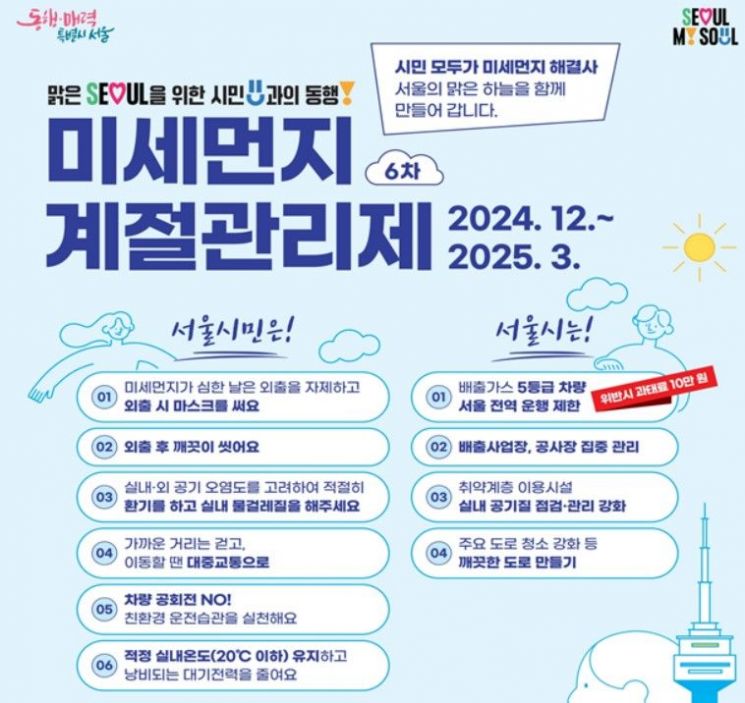 Promotional material for the fine dust seasonal management program. Provided by the Seoul Metropolitan Government.
Grade 5 Vehicles Without Low-Emission Measures... 100,000 KRW Fine for Operation During Restricted Hours
First, grade 5 emission vehicles without low-emission measures are prohibited from operating in Seoul on weekdays from 6 a.m. to 9 p.m. If caught operating, a fine of 100,000 KRW per day will be imposed. Seoul plans to use big data on areas with high operation of grade 4 and 5 vehicles to proactively enforce emission controls. These vehicles will also face disadvantages such as increased parking fees at city-operated parking lots and idling crackdowns.
Among air pollution emission facilities (a total of 2,389 sites), special inspections will be conducted on 717 workplaces. For large construction sites with a total floor area of 10,000㎡ or more, an IoT (Internet of Things) system will be applied to establish a continuous monitoring system to monitor fine dust in real time. The number of eco-friendly construction sites will also be expanded from the current 150 to 180 sites.
Measures to reduce fine dust in the heating (fuel combustion) sector have also been introduced. More than 80,000 eco-friendly boilers will be distributed for households, and heating temperature compliance (public 18℃, private 20℃ or below) will be checked for about 300 energy-intensive buildings such as hotels and department stores.
Measures to minimize citizens' exposure to fine dust will also be implemented. The length of fine dust intensive management roads will be increased from the existing 257.3 km to 259.1 km, and the number of road cleaning vehicles will be increased from 476 to 490. Additionally, management of multi-use facilities for vulnerable groups will be strengthened. Targets include daycare centers and elderly care facilities, where ventilation equipment will be provided and a central control system based on real-time air quality will be piloted.
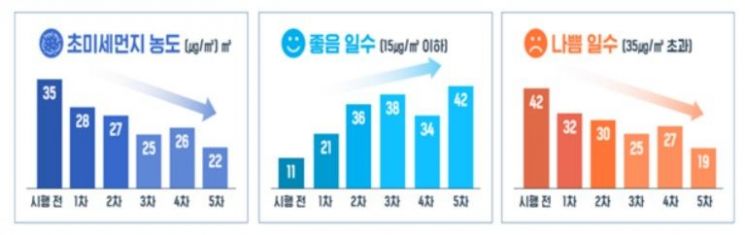
Proven Seoul 'Seasonal Management System'... Reduction Effects on Ultrafine Dust and Nitrogen Oxides
Seoul set a goal this year to reduce 144 tons of ultrafine dust and 3,041 tons of nitrogen oxides through the seasonal management system.
The effectiveness has already been confirmed. The restriction on grade 5 vehicle operation was introduced from the 2nd phase (December 2020 to March 2021), and the average daily number of vehicles caught, which was 1,424 during the 2nd phase, decreased to 46 by the 5th phase. Despite the strengthened detection system, the significant decrease in the number of violations can also be interpreted as a major change in drivers' awareness.
Harmful substance emissions have also significantly decreased. During the 5th phase (December 2023 to March 2024), focusing on quantifiable measures, the estimated reductions in air pollutants were an average of 183 tons of ultrafine dust, 4,157 tons of nitrogen oxides, and 468 tons of volatile organic compounds in Seoul.
Above all, Seoul is paying attention to the positive perception of citizens toward the 'Seasonal Management System.' In a survey conducted by the Seoul Institute targeting 1,000 Seoul citizens, 71% of respondents supported the annual implementation of the seasonal management system. Among related policies, the 'Climate Companion Card,' 'Citywide Restriction on Grade 5 Vehicle Operation,' and 'Management of Air Pollutant Emission Facilities' were highly evaluated, and 57.5% agreed with strengthening the restriction on grade 5 vehicle operation. A Seoul city official stated, "We will continue to strengthen reduction capabilities through regulations and support based on emission source priorities," adding, "We will also continue to consider customized management tailored to the characteristics of fine dust emissions by region."
© The Asia Business Daily(www.asiae.co.kr). All rights reserved.


















