Selected Business Operator in 2025, Completion by 2028
Utilizing Complex Data in Finance, Bio, IT, and Logistics
Attracting Overseas Big Tech Including MS and Nvidia
Incheon International Airport Corporation has presented a blueprint to develop the area near Incheon Airport into an artificial intelligence (AI) hub. The strategy involves building a large-scale data center and attracting domestic and international IT companies to transform the airport into a future airport city that integrates airport operations with AI technology.
On the 10th, Incheon International Airport Corporation announced this plan to establish an 'AI Innovation Hub' at the 3rd Incheon Airport Forum held at the Grand Hyatt Incheon.
The corporation emphasized that the AI Innovation Hub will be a long-term plan that fundamentally redefines the concept of an airport. The vision is to expand the Incheon Airport area to accommodate 100 million passengers annually and transform it into a future airport city that fuses airport functions with AI technology.
The Incheon Airport AI Innovation Hub will be established in the 156,000㎡ Second International Business Complex (IBC-II), located about a 5-minute drive from Terminal 2. Initially, an AI data center, an essential facility for the AI industry, will be constructed on approximately 17,611㎡ within IBC-II, with a power capacity of up to 40MW (megawatts). The schedule includes a call for business operators within this year, selection of the project implementer in the first half of next year, construction starting in 2026, and completion by 2028.
In addition to attracting major domestic and international big tech companies such as Amazon, Nvidia, Microsoft, and Intel, plans include creating an industry-academia-research ecosystem composed of R&D centers, prestigious universities, venture companies, and startups. Utilizing Incheon Airport as a testbed aims to foster a virtuous cycle of organic collaboration and investment among industry, academia, and research sectors.
To support this, stable power supply will be ensured through the second combined heat and power plant scheduled to begin operation in 2031. The policy is to allow hyperscale (over 100MW) AI data centers and various supporting facilities to be established on large-scale idle land around the airport.
Once the hyperscale AI data center is completed, it is expected to become a nationally representative multifunctional data center capable of handling abundant data from nearby industrial complexes such as finance in Cheongna, bio in Songdo, IT in Magok, and logistics data from Incheon Port. Furthermore, it will create an AI industry cluster where R&D centers in fields such as robotics, Internet of Things, AI, and autonomous driving can demonstrate advanced technologies.
Incheon Airport expects the AI Innovation Hub to generate an economic effect of approximately 6 trillion won during the investment phase. Over the next 10 years of operation, it anticipates a cumulative effect of about 96 trillion won and the creation of approximately 20,000 jobs.
Lee Hak-jae, President of Incheon International Airport Corporation, stated, "Based on the strengths of Incheon Airport, we will lead Korea's future competitiveness and become a key player driving global change through the realization of the AI Innovation Hub that can create maximum synergy effects. We will start a new challenge with the resilience that built the world's best airport."
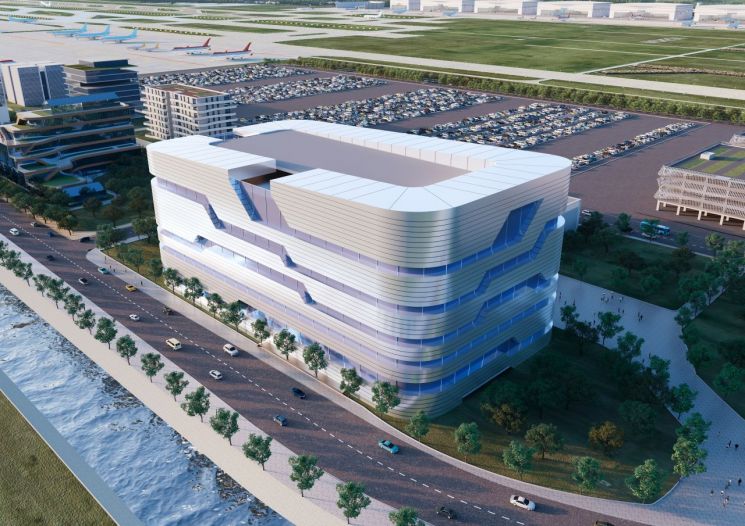 Incheon International Airport AI Innovation Hub bird's-eye view. Provided by Incheon International Airport Corporation
© The Asia Business Daily(www.asiae.co.kr). All rights reserved.

















