Sharp Decline in Won Value Continues After Martial Law Incident
Foreign Exchange Authorities Take Defensive Measures but Further Rise Expected
Possibility of Foreign Reserves Falling Below $400 Billion Also Raised
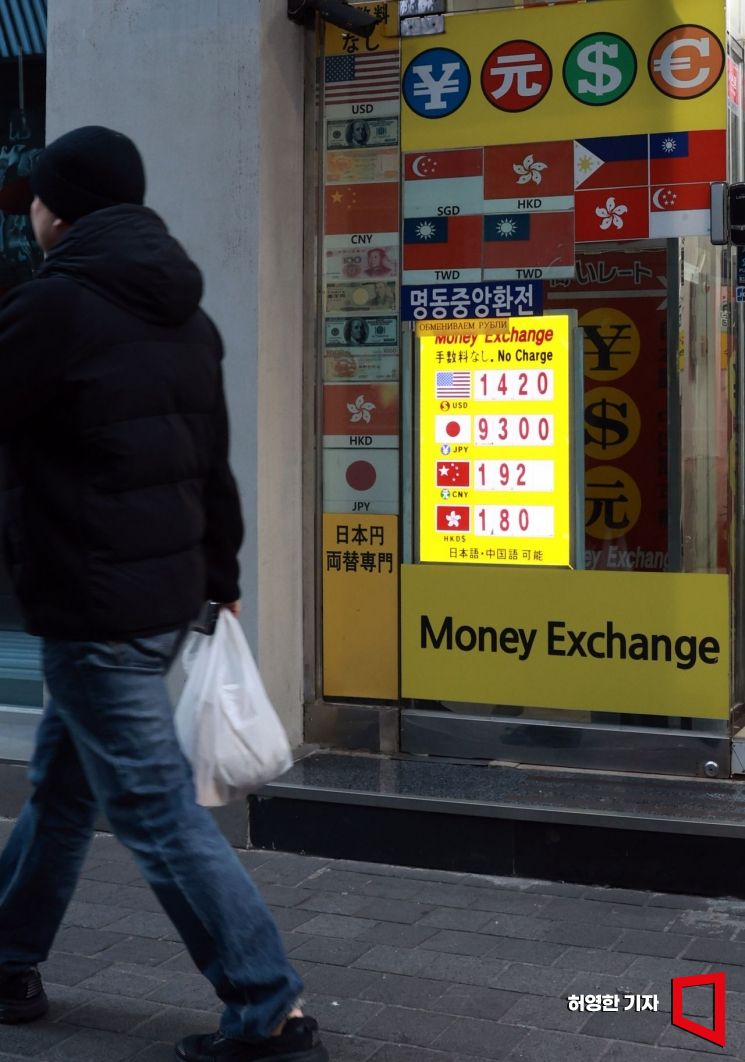 After the martial law situation, as exchange rates such as the won-dollar continue to rise, the won-dollar buying rate at a private exchange office in Myeongdong, Seoul, was displayed as 1,420 won on the 10th. Photo by Heo Young-han
As political instability continues with President Yoon Suk-yeol's emergency martial law situation and the failure of impeachment, the won-dollar exchange rate has sharply declined, once surpassing 1,440 won. With expectations that political instability will prolong, there is also speculation that the exchange rate could exceed 1,450 won. Although foreign exchange authorities have actively intervened to defend the exchange rate, concerns about a decrease in foreign exchange reserves have also emerged.
Exchange Rate Ceiling Should Be Set Up to 1,450 Won Amid Political Instability
On the 10th, in the Seoul foreign exchange market, the won-dollar exchange rate opened at 1,430.9 won, down 6.1 won from the previous trading day. Although the won-dollar exchange rate opened lower for the first time this month, it remains at the highest level of the year. At the beginning of this month, the won-dollar exchange rate was around 1,400 won, but after President Yoon's declaration of martial law on the night of the 3rd, it surged to 1,446 won during after-hours trading. As of 9:53 a.m. on the same day, the won-dollar exchange rate was trading at 1,428.4 won.
Experts evaluated that the longer the impeachment situation against President Yoon Suk-yeol prolongs, the harder it will be for the exchange rate to stabilize. Since the recent dollar value has been stabilizing downward, the reason why only the won is showing weakness is due to domestic political instability, so unless this issue is resolved, it will be difficult for the exchange rate to fall below the 1,400 won level.
If political instability continues, there is also a possibility that the exchange rate could rise above 1,450 won. Ahn Ah-min, a researcher at NH Investment & Securities, said, "The won value sharply declined after the emergency martial law situation, and comparing changes in other countries' currencies shows that the won's unique risk has expanded," adding, "In the short term, we are keeping the exchange rate ceiling open up to 1,450 won." Min Kyung-won, an economist at Woori Bank, also forecasted, "The ongoing political instability is expected to prolong the burden of won weakness," and "This series of events could lead to a drop in the won's value, potentially pushing the exchange rate up to 1,450 won in the short term."
Oh Jae-young, a researcher at KB Securities, said, "In the past, major political events lasted for 3 to 6 months, and with the weekend impeachment vote failing, concerns about the prolongation of the situation have increased," adding, "With news that impeachment will be pushed every Saturday, the possibility of further exchange rate increases has grown."
There is a more negative outlook that the decline in the won's value reflects Korea's economic instability and that it could rise to 1,500 won in the long term. Nomura Securities, a foreign investment bank (IB), predicted, "Following the inauguration of the Trump administration, there is a high possibility of rising U.S. interest rates and a strong dollar," and "The won is expected to remain relatively weak until the second quarter of next year, with the won-dollar exchange rate potentially rising to 1,500 won by the end of May next year."
Concerns Over Foreign Exchange Reserves Falling Below 400 Billion Dollars
After the martial law situation, although our foreign exchange authorities actively worked to reduce exchange rate volatility, there are also criticisms that there are limits. The market views that after the martial law situation, foreign exchange authorities directly intervened by supplying dollars to the market to reduce exchange rate volatility.
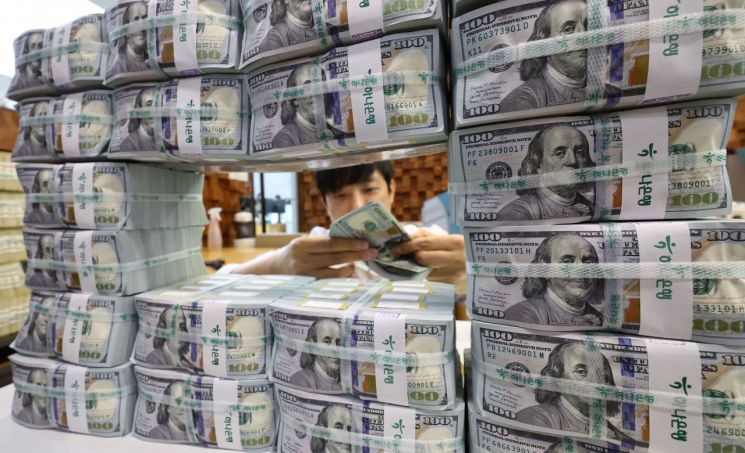
As foreign exchange authorities have used their dollar holdings to defend the exchange rate, concerns about a decrease in foreign exchange reserves have emerged. As of the end of last month, Korea's foreign exchange reserves stood at 415.4 billion dollars, continuously decreasing compared to over 460 billion dollars at the end of 2021, three years ago. There are concerns that as dollars are used to defend against sharp exchange rate rises, foreign exchange reserves could fall below 400 billion dollars by the end of this month.
Nomura Securities warned, "The Bank of Korea's foreign exchange reserve adequacy ratio is relatively low at an average of 93% based on the International Monetary Fund (IMF) model," adding, "As foreign exchange reserve capacity declines, won weakness may continue."
However, the government stated that there is sufficient capacity to respond to the foreign exchange market and that there is no need for concern. The Ministry of Economy and Finance and the Bank of Korea, among foreign exchange authorities, claimed at the macroeconomic meeting on the day, "We hold foreign exchange reserves of 415.4 billion dollars, ranking 9th in the world, and net external financial assets of 977.8 billion dollars, so the foreign exchange authorities have sufficient capacity to respond."
© The Asia Business Daily(www.asiae.co.kr). All rights reserved.


















