Macroeconomic and Financial Issues Meeting
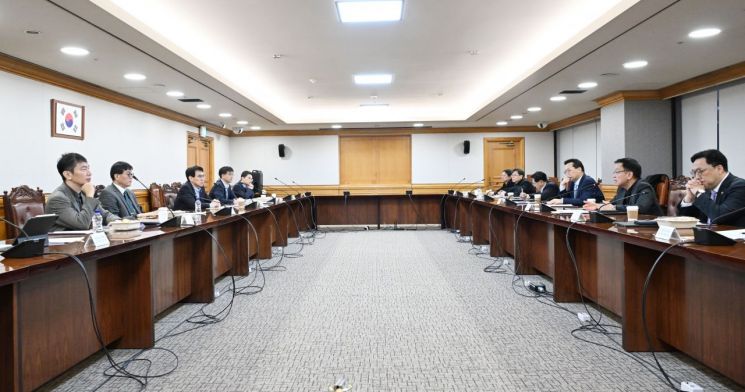 Choi Sang-mok, Deputy Prime Minister for Economic Affairs and Minister of Economy and Finance, is presiding over an emergency macroeconomic and financial issues meeting at the Korea Federation of Banks in Jung-gu, Seoul, on the 10th.
Choi Sang-mok, Deputy Prime Minister and Minister of Economy and Finance, stated on the 10th, "We will actively respond to excessive market volatility to the extent that market sentiment can be reversed."
On the same day, Deputy Prime Minister Choi held an 'Emergency Macroeconomic and Financial Issues Meeting (F4 Meeting)' at the Korea Federation of Banks building, saying, "The government and the Bank of Korea have sufficient capacity to respond to the market." Attendees included Lee Chang-yong, Governor of the Bank of Korea, Kim Byung-hwan, Chairman of the Financial Services Commission, and Lee Bok-hyun, Governor of the Financial Supervisory Service.
The economic leaders assessed, "Although volatility in the financial and foreign exchange markets has increased recently, it is somewhat excessive compared to the solid fundamentals of our economy and external soundness," and agreed to closely monitor market trends and mobilize all market stabilization measures.
Amid the impeachment standoff, domestic stock market volatility increased, with the KOSPI and KOSDAQ indices plunging 2.78% and 5.19%, respectively, the previous day. After the declaration and lifting of martial law on the 4th, the indices showed a decline of around 1% over three trading days, but the failure of the impeachment vote against President Yoon Seok-yeol raised concerns about increased political turmoil, leading to a wider drop. The won-dollar exchange rate soared to 1,437.0 won, the highest in 2 years and 1 month since October 2022.
Regarding the stock market, they noted, "Purchases by institutional investors continue, and there is also an inflow of bargain buying by foreigners," and agreed that "institutional investors such as pension funds should continue to play a responsible role, and individual investors need to maintain a calmer perspective when making decisions."
On the foreign exchange market, they emphasized, "Considering the foreign exchange reserves of $415.4 billion, ranked 9th globally, and net external financial assets of $997.8 billion (as of the end of September), the government and the Bank of Korea have sufficient capacity to respond to the market," and stated, "We plan to actively respond to excessive market volatility to the extent that market sentiment can be reversed."
The government is communicating the current economic situation and its commitment to market stabilization through meetings with the Japanese Ambassador to Korea, financial situation review meetings, and bank sector discussions. Going forward, they plan to hold a series of events including conference calls with the three major credit rating agencies, meetings with the Chinese Ambassador to Korea's charg? d'affaires, meetings with international finance officers of banks, meetings with domestic foreign banks, and meetings with global investment bank (IB) analysts to minimize the impact of political risks on external creditworthiness.
Deputy Prime Minister Choi reiterated, "Regardless of recent political situations, the economic sector will be managed as stably as possible with the economic team led by the Deputy Prime Minister at the center."
© The Asia Business Daily(www.asiae.co.kr). All rights reserved.
![From Bar Hostess to Organ Seller to High Society... The Grotesque Con of a "Human Counterfeit" [Slate]](https://cwcontent.asiae.co.kr/asiaresize/183/2026021902243444107_1771435474.jpg)
















