Economic Bills Approved at State Council Meeting
But Passage in National Assembly Uncertain Amid Martial Law Situation
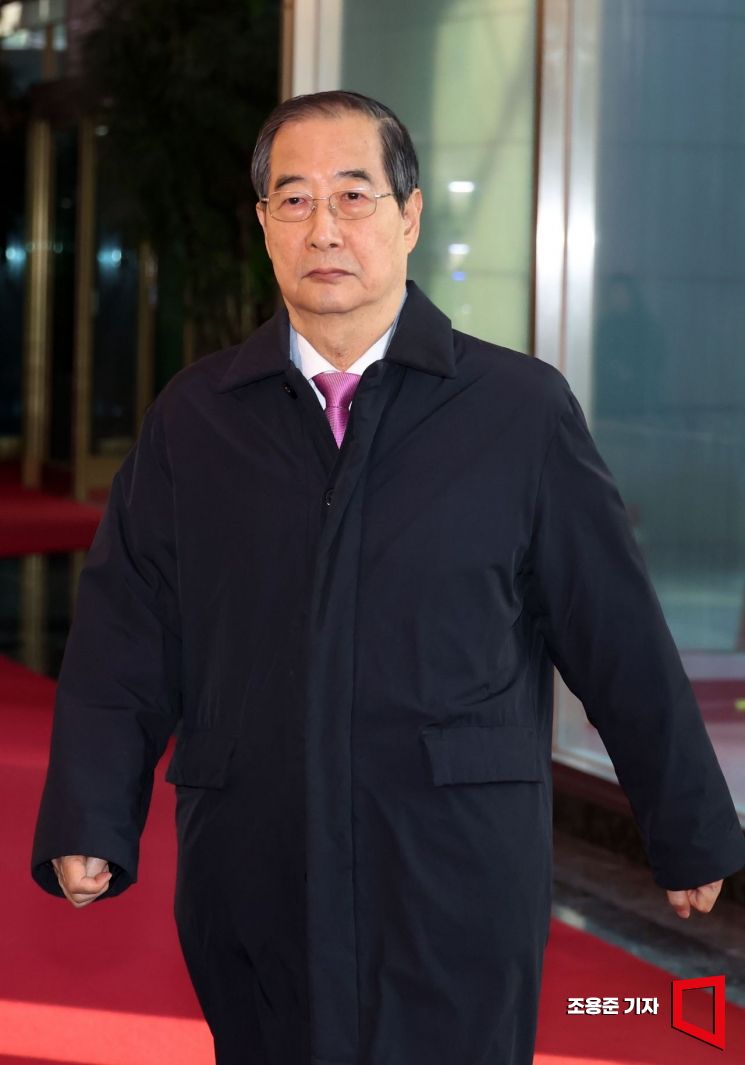 Prime Minister Han Duck-soo, named as an accomplice in the insurrection in the 'Permanent Special Prosecutor Investigation Request' passed by the National Assembly Judiciary Committee, is arriving at the Government Seoul Office in Jongno-gu, Seoul on the 10th. Photo by Jo Yong-jun
The government has reviewed and approved a revision bill at the Cabinet meeting to exempt the research and development (R&D) sector from undergoing preliminary feasibility studies. This appears to reflect the government's determination to proceed with economic policies despite the martial law situation. However, given the political turmoil, it is uncertain whether the bill will pass through the National Assembly as scheduled.
The Ministry of Economy and Finance approved amendments to the National Finance Act and the Framework Act on Science and Technology at the Cabinet meeting on the 10th to implement the abolition of preliminary feasibility studies in the R&D sector.
The revision bill primarily excludes national research and development projects and essential construction work for R&D execution from the preliminary feasibility study process. Until now, R&D projects have taken an average of over two years for feasibility studies, making prompt investment difficult. Moreover, due to the high uncertainty characteristic of R&D, it has been criticized that the feasibility study system is inadequate for proper evaluation. In response, the government announced plans to abolish the feasibility study system at the National Fiscal Strategy Meeting last May.
The Ministry of Science and ICT announced that it will introduce a tailored review system for the R&D sector by amending the Framework Act on Science and Technology. Simple equipment purchases or procurement projects without R&D elements will be reviewed in one go, while projects with a high risk of failure or that are challenging will be evaluated in stages according to the implementation plan. Lee Jung-soo, head of the R&D Feasibility Review Team at the Ministry of Science and ICT, explained, “Previously, only after passing the feasibility study could preliminary technology development proceed. We have rationalized the system so that reviews are conducted after a certain level of preliminary technology maturity is achieved.”
The Ministry of Economy and Finance and the Ministry of Science and ICT plan to submit the amendment bills to the National Assembly within this month. If the bills pass the National Assembly review by the first half of 2025, the new system is planned to be fully implemented in the second half of the following year.
However, it is unclear whether the revision bills will pass as scheduled due to the chaotic situation in the National Assembly following the emergency martial law declaration on the 3rd. The relevant committee, the National Assembly’s Science, Technology, Information and Broadcasting, and Communications Committee, is currently in a deadlock. Although it is known that there is consensus among ruling and opposition party members regarding the bills, fierce confrontations are ongoing between the Democratic Party and the People Power Party over President Yoon’s impeachment motion. On the 9th, there was a loud dispute over the impeachment motion against the Chairperson of the Korea Communications Standards Commission, and the ruling party members walked out, causing a breakdown in proceedings.
The government intends to proceed with economic policies regardless of the National Assembly situation. On the 5th, Choi Sang-mok, Deputy Prime Minister and Minister of Economy and Finance, presided over an economic ministers’ meeting at the Government Seoul Office, emphasizing, “Amid growing domestic and international uncertainties in our economy, there are numerous tasks the government must address,” and added, “We must take care of people’s livelihoods, amend laws for the public and businesses, and carry out necessary projects.” He also urged that various year-end events and existing duties proceed as originally scheduled.
Meanwhile, the Cabinet meeting that passed the two amendment bills was the first since the emergency martial law situation on the 3rd. President Yoon Seok-yeol convened the Cabinet meeting on the 3rd to declare martial law and presided over the Cabinet meeting on the 4th to lift the martial law. Subsequently, Prime Minister Han Duck-soo planned to hold a temporary Cabinet meeting at 2 p.m. on the 8th but suddenly changed the format to a closed “Cabinet members’ meeting.”
© The Asia Business Daily(www.asiae.co.kr). All rights reserved.

















