Small Business-Centered Service Industry Takes Hit
Department Stores, Marts, Hotels Worry Over Year-End Sales
Signs of Prolonged Political Instability... Concerns Over Lack of Control Tower
"The weekend business was completely ruined. Not only were existing reservations canceled, but there were no walk-in customers (customers who visit on the day without prior reservation) at all, so it was very quiet."
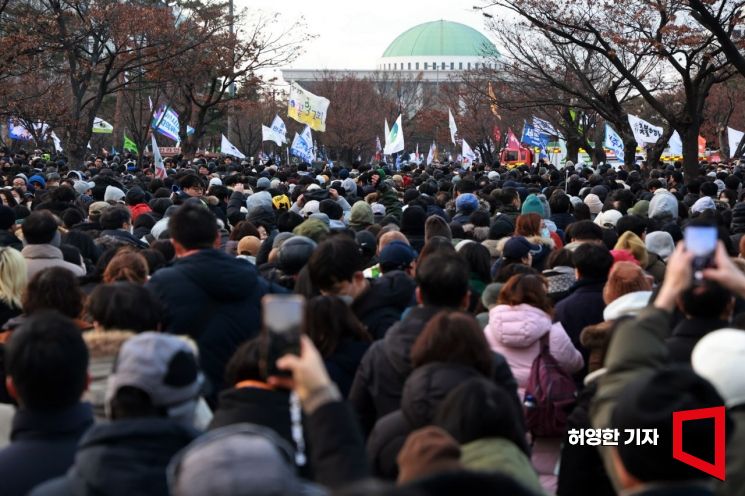 Citizens are gathering toward the National Assembly to participate in the rally urging the impeachment of President Yoon Seok-yeol, held on the 7th at Yeouido Park in Seoul, where the impeachment vote for President Yoon Seok-yeol took place. Photo by Heo Yeong-han
On the 9th, Mr. A, a man in his 40s who runs a beef specialty restaurant in Yongridan-gil, Yongsan-gu, which has emerged as a representative hot place in Seoul, explained the recent situation his store is facing. He expressed frustration, saying that the first weekend after the political turmoil caused by the emergency martial law and impeachment rallies on the 7th was practically a 'zero' sales day.
Mr. A's store is located near government institutions such as the Presidential Office, Ministry of National Defense, and Joint Chiefs of Staff, so it usually receives many reservations from political and government officials. It was difficult to find empty seats until the end of the year due to year-end parties, but the reservation demand centered around government offices has sharply declined like an ebb tide due to the recent situation. Mr. A said, "Reservations from nearby companies are still being maintained, but since the political circles have publicly declared that they will propose and vote on impeachment motions every week, we don't know how this will change," adding, "There is considerable anxiety among self-employed people who worry about a sudden drop in customers."
Such concerns are spreading beyond small business-centered service industries to the entire distribution sector. If large-scale rallies due to the political emergency continue for a long time, there is a high possibility that private consumer sentiment will freeze. Related industries such as department stores, large supermarkets, hotels, and beauty are closely monitoring sales trends toward the end of the year following the emergency martial law incident on the 3rd and 4th. A representative from the department store industry said, "As the cold wave started, outerwear sales increased and weekend sales slightly rebounded compared to the same period last year, so there is no significant impact yet," but added, "Since the political situation is unpredictable during the year-end season when gatherings and gift purchases are frequent, the atmosphere is cautious."
In fact, during the 2016 political scandal that led to the impeachment of former President Park Geun-hye, department stores experienced a temporary decline in year-end consumption due to political uncertainty. During the regular sale period from November 17 to December 4, ahead of the impeachment vote in the National Assembly on December 9 of that year, the department store industry recorded negative growth for the first time in six years. For example, Lotte Department Store's related sales decreased by 0.7% compared to the same period the previous year, and Hyundai Department Store's sales fell by 1.2%.
The Consumer Confidence Index (CCSI) announced by the Bank of Korea at that time also dropped from 102 in October, just before the political scandal broke out, to 95 in November and December, and further declined to 93.3 in January of the following year. The Consumer Confidence Index is an indicator that gauges consumers' perceptions of the economic situation; a value below 100 indicates negative consumer expectations about the overall economy. However, since the impeachment motion was passed in the National Assembly plenary session and the Constitutional Court upheld it over about three months, the temporarily weakened consumer sentiment recovered relatively quickly in a U-shaped pattern.
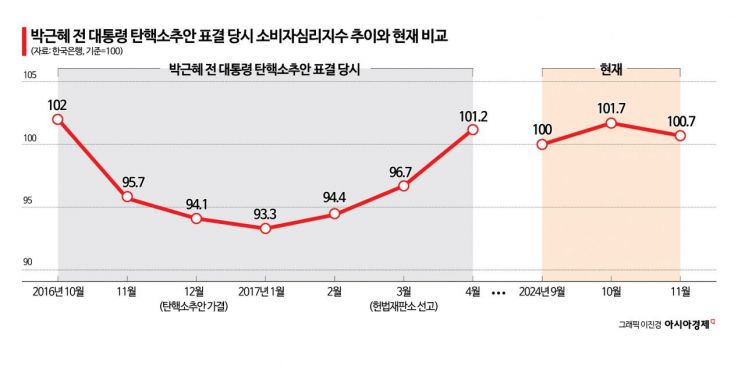
The distribution sector views private consumer sentiment amid the current emergency martial law situation as ultimately a race against time. A hotel industry official said, "In December, when Christmas and year-end events are concentrated, it is rare for guests to cancel reservations that were hard to secure, so there is no significant change at the moment," but added, "If political instability prolongs, group events for both domestic and foreign guests may be canceled, affecting lodging demand." A large supermarket official said, "If the exchange rate rises due to domestic political uncertainty, overseas sourcing, where goods are purchased abroad and payments are made in dollars, could become problematic," and predicted, "The impact will appear with a time lag depending on the payment timing."
There are also opinions that the domestic economic growth rate and external conditions are more challenging than before, making the current situation worse than during the previous administrations or the impeachment of former President Park Geun-hye. Professor Lee Young-ae of the Consumer Studies Department at Incheon National University said, "Although the distribution industry is not immediately affected in terms of sales after the current emergency martial law and impeachment situation, the domestic demand recession has already been ongoing, so the impact is not prominent," and forecasted, "If the uncertain political situation prolongs, consumers will reduce spending further and tend to seek cost-effectiveness (performance relative to price) mainly online." She added, "Manufacturers affected by exchange rates may raise product prices further citing raw material cost increases," and said, "Ultimately, a government operation focused on price stability is urgently needed, but it is difficult to gauge how the control tower role will be performed."
© The Asia Business Daily(www.asiae.co.kr). All rights reserved.


















