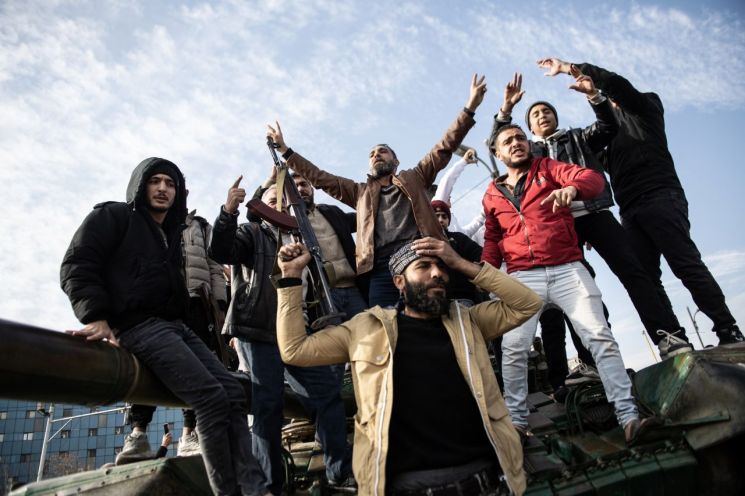
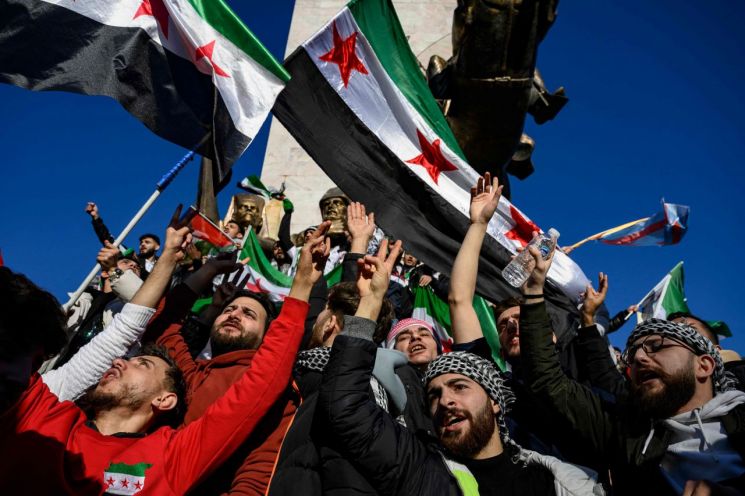
"Tears flowed spontaneously." "I realized that my father did not die for no reason." As the iron-fisted rule of the Bashar al-Assad dictatorship, which had lasted for 53 years through generations, collapsed with the victory of the Syrian rebels, the Syrian people poured into the streets cheering. Western major countries, including the United States, also welcomed the event in unison. However, concerns about future uncertainties, such as the expansion of Islamic extremist forces taking advantage of the chaos in Syria, are also pouring in.
Syrian People Cheer Rebel Victory... "Al-Assad Arrives in Moscow"
The Guardian reported on the 8th (local time) from Damascus, the capital of Syria, that hundreds of people gathered in the square to celebrate the collapse of the al-Assad regime and conveyed the local atmosphere. A woman who visited the square said, "Tears flowed spontaneously," and added, "My father, my brothers, so many people died under the dictatorship." Her daughter added, "Now we know that our father did not die for no reason."
The Guardian reported that the road to Damascus was filled with abandoned military uniforms, and the Syrian government tanks mobilized to block the rebels were empty. Mr. Mohamed smiled as he drove toward Damascus, saying, "There are no more checkpoints or bribes." Ms. Fatime said, "It feels like being in a dream." The media added, "Even the rebels did not expect to capture Damascus so quickly."
CNN also reported, "At the border area, Syrian people are gathering to celebrate al-Assad's ousting, sharing food, waving flags, and cheering," adding, "They are shouting 'Allahu Akbar' (God is the greatest)." Scenes of people rushing into the streets to cheer the collapse of the dictatorship have been confirmed not only in Syria but also around the world.
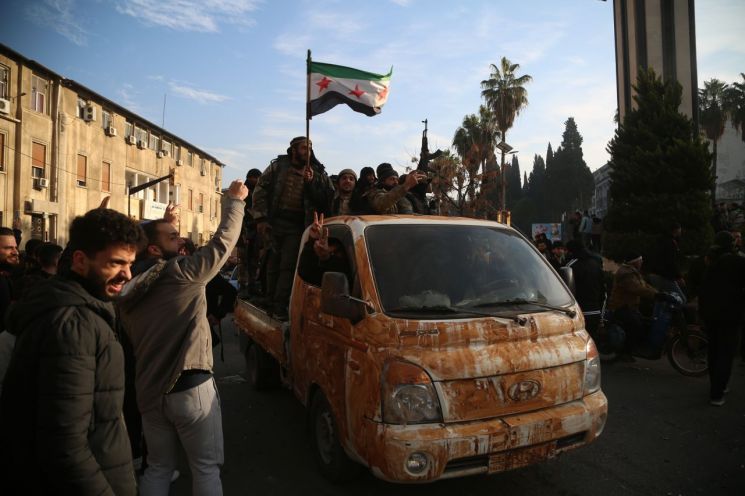
President al-Assad, who is known to have left Damascus just before the rebels captured the capital, is currently believed to have fled to Moscow, Russia. TASS and Sputnik news agencies cited Kremlin sources on the day, reporting that President al-Assad and his family are in Russia. The source said, "Al-Assad and his family have arrived in Moscow," and "Russia granted their asylum for humanitarian reasons." Russia, along with Iran, has been a representative country supporting the al-Assad regime.
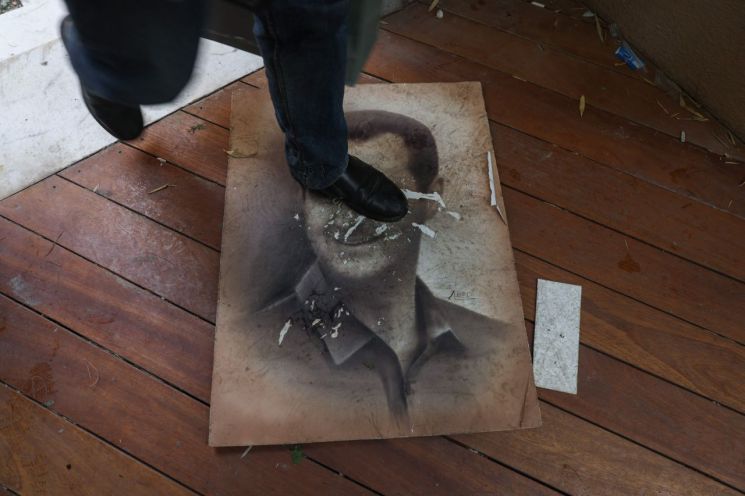
President al-Assad inherited power from his father, Hafez al-Assad, who seized power through a coup and ruled for a long term from 1971 to 2000. The iron-fisted dictatorship of the al-Assad father and son lasted for a staggering 53 years. In particular, President al-Assad is accused of indiscriminately massacring civilians using chemical weapons after the outbreak of the civil war. Major foreign media reported that more than 500,000 Syrians died in the Syrian civil war, of which 200,000 were civilians. Millions of Syrians have fled abroad as refugees and asylum seekers.
Background of the Sudden Collapse of Half a Century of Iron-Fisted Rule: 'Ukraine and Lebanon Wars'?
One of the reasons behind the sudden collapse of the al-Assad regime, which survived the past 'Arab Spring' and continued its iron-fisted rule, is considered to be the reduction of support from Russia and Iran, who supported the government forces in the Syrian civil war. This is evaluated as a 'boomerang effect' caused by the prolonged Ukraine war and the Gaza Strip war.
The Lebanese armed group Hezbollah, backed by Iran, also supported Syria, but after the outbreak of the Gaza Strip war in October last year, the front expanded to Lebanon, reducing its capacity to support Syria. In response to the news of the collapse of the al-Assad regime, Israeli Prime Minister Benjamin Netanyahu said, "The al-Assad regime, which was a key link in Iran's 'axis of evil,' has fallen. It is a historic day in the Middle East," and added, "This is a direct result of the blow dealt to Iran and Hezbollah, who supported the al-Assad regime."
CNN, in an article titled 'How the Ukraine and Lebanon Wars Changed Syria's Fate,' analyzed, "The Syrian rebels' astonishing advance in just a week is the unintended result of two wars," and "Al-Assad's sudden fate was not decided in Syria itself, but in Beirut (Lebanon) and Donetsk (Ukraine)."
The Guardian also pointed out in a separate article, "The domino effect of the Gaza war that started on October 7 is still causing ripples in the Middle East," and "The next situation in Syria is uncertain, but Iran is clear. It cannot deny that the axis of resistance (led by Iran) has collapsed." The New York Times (NYT) also evaluated, "Al-Assad is a close ally of Iran, but the Iranian government recently abandoned him and gave up on Syria."
International Community 'Welcomes but Worries'... Cautions Against IS Extremist Forces Reviving Amid Chaos
The international community, including the United States, welcomes the collapse of the dictatorship but is also on high alert regarding the rapidly changing Middle East situation. Considering that the Syrian civil war has been a proxy war between authoritarian forces such as the West, including the United States, and Russia and Iran, it is said that nothing can be predicted with certainty. The NYT pointed out in a separate analysis article, "Cheers are rising both inside Syria and abroad, but uncertainty is deep," and "Since the sudden fall of the dictatorship is surprising, the next prediction is also difficult."
Sanam Vakil of Chatham House in London told the NYT, "It is difficult to establish procedures and achieve a smooth (power) transition in such rapidly unfolding situations," and "This speed and uncertainty contain many risks regarding governance to protect the interests of the Syrian people and what will happen next." Senior analyst Rahib Higel of the International Crisis Group also said, "I understand the joy Syrians are showing. It is a moment to celebrate," but added, "But I am also worried about what will happen tomorrow."
The NYT emphasized, "Perhaps the most urgent question is how quickly the rebel forces can prevent a chaotic power vacuum and what their plans are now that they have achieved the goal of ousting the president." It also pointed out, "How far and how fast the rebel coalition can expand control over the entire country is also an important factor in restoring stability," but "It is not even clear whether the rebel coalition can maintain unity after the president's ousting." Some voices compare this to Iraq after the end of Saddam Hussein's long rule in 2003.
Biden: "A Moment of Risk and Uncertainty, Will Not Lower Guard"
U.S. President Joe Biden also said at a White House press conference on the day, "It is a historic opportunity for the Syrian people, who have suffered for a long time, to build a better future," but added, "While we all ask what will happen next, this is also a moment of risk and uncertainty." He especially mentioned that IS could take advantage of the power vacuum to rebuild its capabilities, emphasizing, "We will not let that happen." On the same day, the U.S. also conducted 12 precision airstrikes targeting IS camps within Syria.
Furthermore, President Biden said regarding the Syrian rebels, "We will not lower our guard," and pointed out, "Clearly, some rebel groups have terrible human rights abuses and terrorist records." Currently, the Syrian rebels are led by the Islamic Sunni armed group Hayat Tahrir al-Sham (HTS). CNN reported, citing a senior U.S. official, that the U.S. believes many HTS members maintain strong ties with IS. After the rebels gained the upper hand, there are concerns about the possibility of a second civil war for dominance among dispersed forces such as Kurds, pro-Turkey groups, and extremist forces. The U.S. State Department announced that Defense Secretary Austin Lloyd spoke with the Turkish Defense Minister on the day to discuss the situation in Syria.
Ursula von der Leyen, President of the European Union (EU) Commission, also said, "The brutal Assad dictatorship has fallen," but warned, "It is an opportunity, but not without risks." She confirmed that Europe will actively participate in rebuilding Syria to protect all minorities. French President Emmanuel Macron wrote on X (formerly Twitter), "The state of barbarism has finally fallen," and added, "In this uncertain time, I wish for peace, freedom, and unity, and France will continue to work for the security of the entire Middle East region."
Iran, which supported the al-Assad regime, stated on the day the rebels declared victory, "The future and fate of Syria should be entirely the responsibility of the Syrian people without destructive interference or external coercion." The Iranian Foreign Ministry said in a statement, "Iran reaffirms its principled position respecting Syria's unity, sovereignty, and territorial integrity amid recent developments," and emphasized, "All layers of Syrian society should start a national dialogue to immediately stop military conflicts, prevent terrorism, and establish an inclusive governance structure representing all Syrians." The Russian Foreign Ministry announced, "We support efforts to establish an inclusive transitional government in Syria," and requested the United Nations Security Council to hold a closed special meeting on the Syrian situation on the 9th.
© The Asia Business Daily(www.asiae.co.kr). All rights reserved.
![Clutching a Stolen Dior Bag, Saying "I Hate Being Poor but Real"... The Grotesque Con of a "Human Knockoff" [Slate]](https://cwcontent.asiae.co.kr/asiaresize/183/2026021902243444107_1771435474.jpg)


















