President Yoon Suk-yeol "Leaves Political Stability to the Party"
Opposition Party Says "Will Propose Impeachment Until It Passes"
Economic Uncertainty Likely to Increase Due to Instability
Political turmoil has become inevitable.
On the morning of the 7th, President Yoon Suk-yeol announced in a public apology statement, "I will entrust the future political stability measures, including the issue of my term, to our party." President Yoon's retreat to a secondary role has become a fait accompli. On the same night, the impeachment motion against President Yoon was put to a vote in the National Assembly plenary session but failed due to a lack of quorum caused by the ruling party's all-out blockade. The opposition party also failed to seize the initiative. In fact, no one has effectively taken control of the political situation, resulting in an ambiguous power vacuum.
Currently, Han Dong-hoon, the leader of the People Power Party, and Han Duck-soo, the Prime Minister, have become the responsible figures to lead the future political situation. However, it is questionable whether they can demonstrate the political capability to manage the crisis.
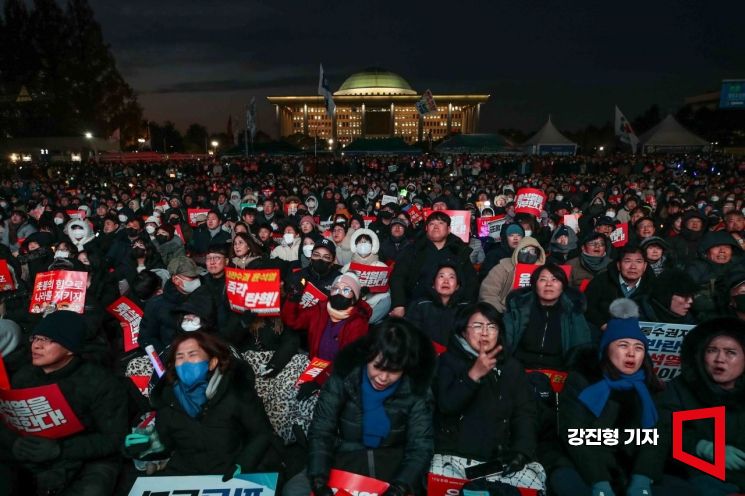 On the 7th, the day of the vote on the impeachment motion against President Yoon Seok-yeol, citizens in front of the National Assembly in Yeouido, Seoul, watched with somber expressions as the People Power Party members left without participating in the vote on the impeachment motion. Photo by Kang Jin-hyeong
The situation is serious. Politically, public opinion has effectively sentenced President Yoon and the ruling party to impeachment since the declaration of martial law. The opposition party, which controls the National Assembly with a minority ruling party and majority opposition, will launch a massive offensive using public opinion as a foothold. The opposition will use all the powers of the parliamentary committees and national investigations to uncover the full details of the martial law. As a result, not only the military but also government organizations are at risk of being shaken.
The government has no choice but to respond to such an offensive from the opposition.
For now, it appears that Leader Han and others will present a roadmap for President Yoon's "orderly resignation." Accordingly, the key question is whether the ruling party can regain political capability to manage the situation. However, the opposition plans to resume impeachment efforts against President Yoon after the regular National Assembly session. Impeachment discussions are expected to restart as early as next week. The opposition is determined, saying, "We will continue until impeachment is achieved."
The budget situation is also serious. There is currently no discussion regarding the budget bill, which has been pointed out as the trigger for the martial law. Normally, this would be the time for behind-the-scenes negotiations between the ruling and opposition parties on the budget, but dialogue between the two sides has effectively broken down. The opposition points out, "Can we discuss the budget in such a situation?" Moreover, with the ruling party's floor leadership resigning en masse to take responsibility for the current crisis, there is no partner for negotiations between the ruling and opposition parties. The opposition has suggested at least processing the reduced budget that passed through the Budget and Accounts Special Committee.
If the impeachment political situation prolongs, there are forecasts that market economic instability will worsen due to increased uncertainty. Immediately after President Yoon's declaration of martial law on the 3rd, the exchange rate fluctuated wildly and has been unable to find a clear direction. As of the previous day, the dollar exchange rate rose by 4.1 won to 1,419.2 won. At one point, it approached 1,430 won, taking a direct hit from the shock of the impeachment motion.
While a rising exchange rate has the advantage of increasing export prices domestically, sectors such as the automobile industry, which operate based on a stable exchange rate over the long term, may suffer significant damage. Political instability is also bad news for the aviation industry.
This is because major countries have designated South Korea as a "travel risk country" following President Yoon's declaration of martial law. Immediately after the announcement of the lifting of martial law, the U.S. Department of State stated, "Potential unrest should be anticipated," and the Japanese Embassy in Korea also sent an email saying, "We do not know specific measures, but please pay attention to future announcements." If political instability in South Korea continues for a long time, it is highly likely that overseas countries will delay lifting travel advisories for South Korea.
© The Asia Business Daily(www.asiae.co.kr). All rights reserved.

















