Rising Awareness Among Japanese Citizens on Korean Martial Law Crisis
"Can We Run to Nagatacho?"
Debate Over Emergency Clause Introduction Spreads... Conflicts Over Pros and Cons
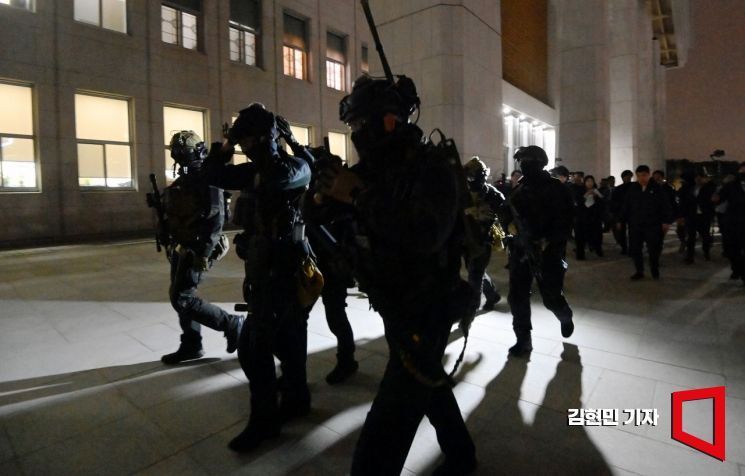 Asahi Shimbun reported on the 6th that there are citizens in Japan who, upon learning of the emergency martial law situation in neighboring Korea, are reflecting deeply on the meaning and reality of democracy and feeling a sense of vigilance. The photo shows martial law troops attempting to enter the National Assembly main building in the early morning of the 4th. Photo by Kim Hyun-min
Following President Yoon Suk-yeol's declaration of martial law, the world is closely watching the political situation in South Korea, and according to the Asahi Shimbun on the 6th, there are citizens in Japan who have become alert after learning about the incident.
According to the media, a woman in her 50s living in Yokohama, Kanagawa Prefecture, wrote on the social networking service X (formerly Twitter), "I cannot forget the late night when I kept watching the live broadcast." The woman described watching South Korean citizens gather in front of the National Assembly immediately after President Yoon declared martial law late at night on the 3rd, and wrote, "I wondered if we could run to Nagatacho." Nagatacho is the political center of Japan where the Prime Minister's residence and the National Diet are located.
A Japanese person in their 20s said upon hearing the news of the martial law situation in South Korea that they newly realized "democracy can end simply." A Japanese person in their 60s living in Matsumoto, Nagano Prefecture, told the media, "Although South Korea has serious division and cynicism, through the history of oppression and resistance, there is a shared understanding that the era of dictators moving the military must not return." Asahi reported, "Japan's constitution does not have the same martial law provisions as South Korea, and the political system is very different, but there are people who reflect on their own lives by overlapping (the South Korean situation) and asking themselves questions."
According to the Tokyo Shimbun, although the martial law provisions that existed in the Meiji Constitution created during the imperial era disappeared, the South Korean martial law incident has sparked debate in Japan over the introduction of an 'emergency clause' that would concentrate government power and restrict citizens' rights in times of crisis. The ruling Liberal Democratic Party (LDP) defined large-scale disasters, armed attacks, and widespread infectious diseases as 'emergencies' in the constitutional amendment issue summary decided in September, allowing the government to issue emergency ordinances with the same effect as laws without Diet approval during emergencies. In response, Mizuho Fukushima, leader of the Social Democratic Party, wrote on X on the 4th, "Both martial law and the LDP's emergency clause proposal destroy democracy by ignoring and attempting to abolish the Diet." On the other hand, the LDP and the second opposition party, Nippon Ishin no Kai, which support constitutional revision, advocate for the introduction of the emergency clause.
© The Asia Business Daily(www.asiae.co.kr). All rights reserved.

![Clutching a Stolen Dior Bag, Saying "I Hate Being Poor but Real"... The Grotesque Con of a "Human Knockoff" [Slate]](https://cwcontent.asiae.co.kr/asiaresize/183/2026021902243444107_1771435474.jpg)















