Demand for Presidential Impeachment Delivered to Lawmakers
Low Legal Punishment Possibility but Consideration of Mature Approach
Amid mounting calls for the impeachment of President Yoon Suk-yeol, phone and text message pressure continues against People Power Party lawmakers who have adopted an 'anti-impeachment' stance as the party's official position. Experts say that considering the social status of members of the National Assembly, the legal risk is low, but they advise that voters need to express their opinions in a more mature manner.
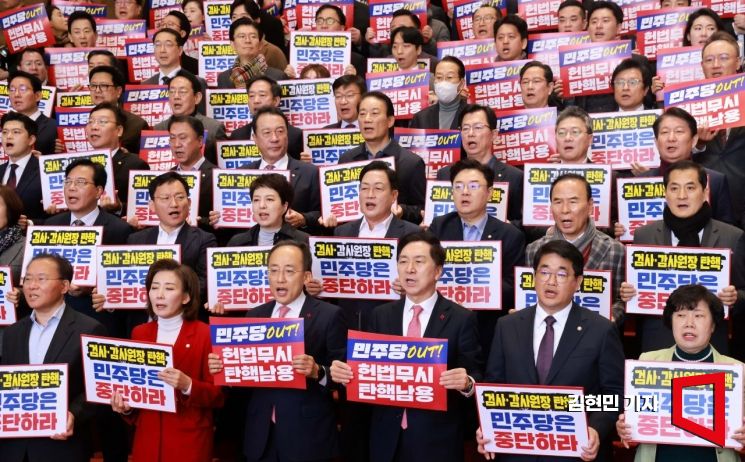 On the 5th, Choo Kyung-ho, floor leader of the People Power Party, and lawmakers held a rally condemning the impeachment drive against the Board of Audit and Inspection chief and prosecutors on the stairs of the National Assembly Rotunda Hall. Photo by Kim Hyun-min
According to online communities on the 6th, an Excel file containing the names, constituencies, and contact information of People Power Party lawmakers is being shared. The author of the post stated, "I have collected the contact information of lawmakers circulating on the internet and confirmed their authenticity," and encouraged, "Please send text messages to the contacts listed in the file." Another post promotes copying and sending five types of text messages to netizens, including phrases like "Please spare the lives of supporters who support impeachment" and "It's embarrassing to others."
Phone and text message pressure also occurred during the impeachment of former President Park Geun-hye in 2016. At that time, former Democratic Party lawmaker Pyo Chang-won stirred controversy by publicly dividing lawmakers' positions on Park's impeachment into three categories?support, hold, and oppose?on his social media account. In fact, a People Power Party official said, "I receive so many calls and texts all day that I do not answer calls from unknown numbers at all," adding, "It would be fortunate if the messages were simply expressing opinions, but many contain threatening content, which is often distressing."
Experts believe that the likelihood of criminal punishment for citizens' phone and text message actions under the Personal Information Protection Act or the Stalking Punishment Act is low. While sending messages containing false information may be subject to criminal penalties, simply sending messages expressing one's political views can be seen as a form of political expression.
Kim Han-gyu, a lawyer at the law firm Gonggan, explained, "Contact information and email addresses of lawmakers are basically widely disclosed to voters, so merely collecting this information cannot be considered a violation of the Personal Information Protection Act," adding, "Similarly, voters sending phone calls or texts expressing their political views to their representatives have a low risk of criminal punishment."
Lee Jun-han, a professor of political science and diplomacy at Incheon National University, advised, "While all citizens have the freedom of political expression, this does not extend to infringing on others' freedoms or using forms of expression that exceed social norms," and added, "Citizens should consider more mature ways of expressing their opinions."
© The Asia Business Daily(www.asiae.co.kr). All rights reserved.
![Clutching a Stolen Dior Bag, Saying "I Hate Being Poor but Real"... The Grotesque Con of a "Human Knockoff" [Slate]](https://cwcontent.asiae.co.kr/asiaresize/183/2026021902243444107_1771435474.jpg)
















