Systematic Preservation and Management of National Heritage 'First Step'... Heritage Conservation and Regional Development 'Simultaneously'
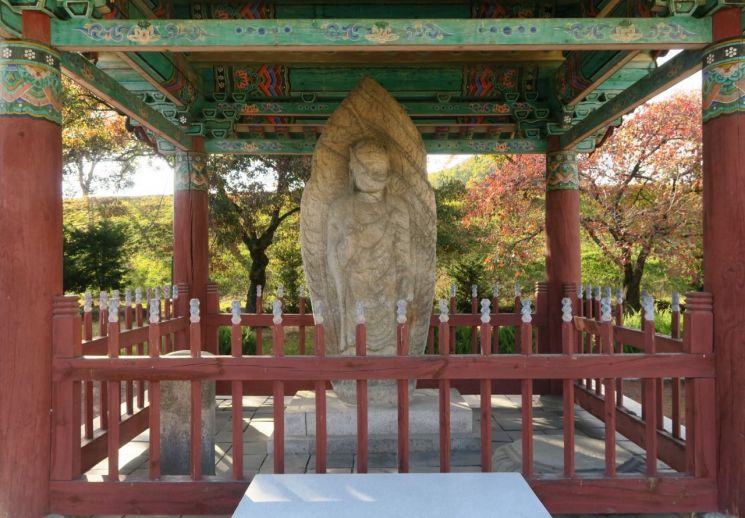
On the 5th, Yeongju City in Gyeongbuk announced that the "Treasure Yeongju-dong Stone Seated Buddha Statue," whose relocation necessity has been continuously raised, has received "conditional approval for relocation" from the National Heritage Agency.
The Yeongju-dong Stone Seated Buddha Statue is a Buddhist statue created during the Unified Silla period and is recorded to have been discovered in 1917 during the Japanese colonial era at the embankment of Namsan Field. It was later moved in front of Yeongju Elementary School and then relocated in 1988 to the current Aishinna Indoor Playground (formerly the Provincial Library) courtyard.
The current location differs from the statue's original site, lacking historical and cultural connectivity with the surrounding environment, and being situated in an urban area has caused continuous inconvenience to residents. Accordingly, Yeongju City has been conducting a "feasibility study for relocation" to explore suitable relocation plans.
After deliberation at the "11th Architectural Cultural Heritage Subcommittee of the National Heritage Agency" held in Jeonju on the 21st, conditional approval was finally decided on the 29th. The main approval condition is relocation to the site around the "Treasure Gahung-dong Rock-carved Seated Buddha Triad and Seated Buddha Statue" in Yeongju.
Based on this, the city plans to closely consult with the National Heritage Agency at every stage related to the relocation of the Yeongju-dong Stone Seated Buddha Statue from next year, including △establishing relocation and preservation plans and △creating a Buddhist heritage park plan, and proceed after obtaining final approval.
Mayor Park Nam-seo said, "This conditional approval is the first step toward systematic preservation of national heritage and development of the old downtown," adding, "We will thoroughly cooperate with related organizations and experts during the relocation process to successfully carry it out."
He also added, "This case will serve as an opportunity to simultaneously achieve the two goals of national heritage preservation and regional development."
According to the city, major urban planning projects that had been delayed due to Buddha statue protection regulations are expected to be actively promoted following the relocation approval. Detailed projects include △the "Gahung New Town to Tax Office Intersection Urban Planning Road Construction" and △the "Guhak Park Treetop Skywalk Construction," with an expected budget saving effect of about 9 billion KRW through plan adjustments such as road alignment changes and utilization of national and city-owned land.
© The Asia Business Daily(www.asiae.co.kr). All rights reserved.
![Clutching a Stolen Dior Bag, Saying "I Hate Being Poor but Real"... The Grotesque Con of a "Human Knockoff" [Slate]](https://cwcontent.asiae.co.kr/asiaresize/183/2026021902243444107_1771435474.jpg)
















