Emergency Macroeconomic and Financial Issues Meeting Held
Corporate Bond and CP Purchase Programs Also Activated
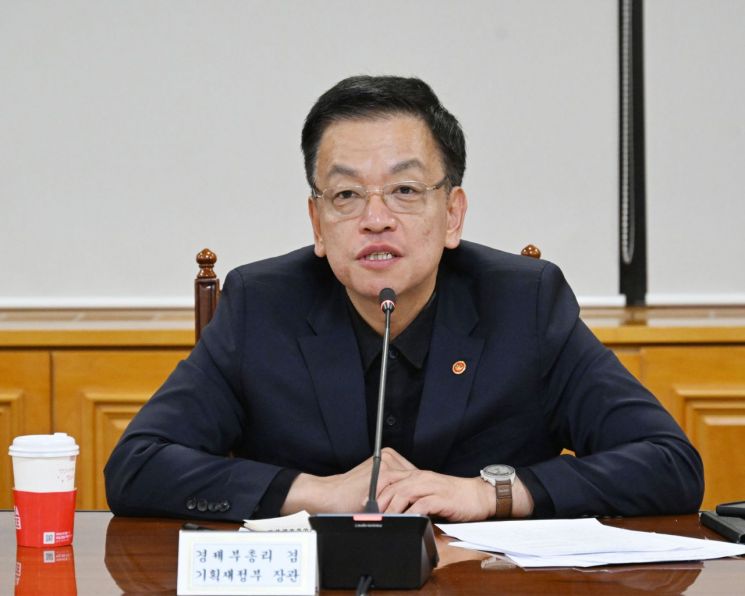 Choi Sang-mok, Deputy Prime Minister for Economic Affairs and Minister of Economy and Finance, is presiding over an emergency macroeconomic and financial issues meeting on the 5th at the Korea Federation of Banks in Jung-gu, Seoul.
To prevent the spread of crisis following the martial law situation, the government will operate a Securities Market Stabilization Fund worth up to 10 trillion won, as well as a Bond Market Stabilization Fund and a Corporate Bond and Commercial Paper (CP) Purchase Program totaling 40 trillion won.
On the 5th, the government announced that it held an "Emergency Macroeconomic and Financial Issues Meeting" chaired by Deputy Prime Minister and Minister of Economy and Finance Choi Sang-mok at the National Federation of Banks building to review the trends in the financial and foreign exchange markets and discuss future response directions. Attendees included Lee Chang-yong, Governor of the Bank of Korea, Kim Byung-hwan, Chairman of the Financial Services Commission, and Lee Bok-hyun, Governor of the Financial Supervisory Service.
On the 4th, when the state of emergency martial law was declared and then lifted, the financial and foreign exchange markets fell into panic, causing increased volatility in the early trading hours. However, as financial authorities quickly announced stabilization measures, the markets generally showed stability. Nonetheless, given the difficulty in early resolution of uncertainties related to political changes such as the start of impeachment proceedings, negative impacts on the stock and bond markets are expected to continue for some time.
The government is preparing to immediately activate market stabilization measures such as the Securities Market Stabilization Fund of up to 10 trillion won at any time, while managing the bond and money markets stably by operating a Bond Market Stabilization Fund and Corporate Bond and CP Purchase Program totaling 40 trillion won.
The Bank of Korea will also immediately begin purchasing repurchase agreements (RP) to supply unlimited liquidity and, if necessary, swiftly implement various market stabilization measures including simple purchases of government bonds and foreign currency liquidity supply through foreign currency RP purchases.
The attendees evaluated that the recent situation's impact on the financial and foreign exchange markets has been limited so far. They agreed that since the government and the Bank of Korea have sufficient capacity to respond to market volatility, and the international credit rating agency Standard & Poor's (S&P) has assessed that there is "no material impact" on South Korea's sovereign credit rating, market participants should respond calmly and rationally rather than with excessive anxiety.
However, as this domestic situation coincides with external uncertainties following the inauguration of the new U.S. administration, there is a possibility of increased volatility. Therefore, related agencies will closely monitor the market situation together and take all possible measures.
Until the market normalizes, the government will establish and operate a task force to monitor economic and financial conditions 24 hours a day, strengthening monitoring of the overall financial and real economy situation, and swiftly implement all measures necessary to stabilize the market according to contingency response plans.
© The Asia Business Daily(www.asiae.co.kr). All rights reserved.
![Clutching a Stolen Dior Bag, Saying "I Hate Being Poor but Real"... The Grotesque Con of a "Human Knockoff" [Slate]](https://cwcontent.asiae.co.kr/asiaresize/183/2026021902243444107_1771435474.jpg)











