The Truth and Reconciliation Commission (TRC) has decided to investigate the truth behind human rights violation cases, including the 'Han Hee-cheol Military Suspicious Death Case.'
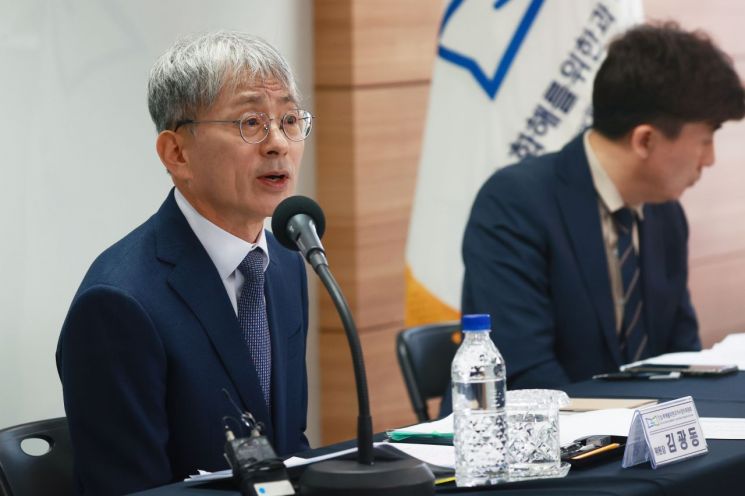 Kim Kwang-dong, Chairman of the Truth and Reconciliation Commission, speaking. Photo by Yonhap News.
On the 4th, the TRC announced at its 92nd meeting that it had determined the 'Han Hee-cheol Military Suspicious Death Case' to be a serious human rights violation and decided to investigate the truth. The military suspicious death case refers to an incident in which, under the supervision of the Defense Security Command, forced conscription and illegal enlistment of soldiers with student activist backgrounds were subjected to ideological reform and coerced into acting as informants against student movements from September 1982. During this process, illegal detention and harsh treatment led to deaths.
The case involves the late Han Hee-cheol, the subject of the truth investigation, who was subjected to 'Nokhwa Operation' interrogation and harsh treatment from December 5 to 9, 1983, and returned to his unit on December 10. He died during guard duty early the next morning on December 11. Han was scheduled for additional investigation by the Defense Security Command on December 12.
At that time, the Defense Security Command's 'Nokhwa Operation' was carried out from September 1982 to December 1984. This operation involved severe human rights violations and violence, causing deaths and social conflicts, and is known as an anti-human rights policy. The TRC stated, "Strict management and supervision were required, but there was negligence and neglect of duty by the Ministry of National Defense and the Defense Security Command," and judged it as "a state-sponsored murder case that drove Han Hee-cheol, who was faithfully fulfilling his military service obligations, to death."
The TRC uncovered new facts different from previous investigations through records related to the case secured from national institutions such as the National Archives and testimonies from applicants and witnesses. While previous investigations did not determine whether the Defense Security Command attempted to use Han as an informant during the 'Nokhwa Operation' interrogation process, the TRC confirmed that the Defense Security Command tried to utilize Han as an informant.
It was also additionally confirmed that from March 1984 to April 1989, for about six years after Han's death, the family was surveilled, infringing on their privacy and freedom. After Han's death, the military and the Defense Security Command tried to conceal traces of harsh treatment by persuading the bereaved family, who insisted on burial, to cremate the body under the pretext of 'military customs,' and instructed them not to open the coffin or verify the body. During the 'Nokhwa Operation' interrogation period, Han was beaten for more than two hours daily, and the tools of assault included a 70-80 cm baton and a stainless steel tape measure.
The TRC recommended that the Ministry of National Defense and the Defense Security Command (now the Defense Counterintelligence Command) apologize to the subject of the truth investigation and the bereaved family for abusing the duty of national defense to commit serious human rights violations. It also stated that appropriate measures should be taken to compensate and restore the honor of the victims and their families who suffered from the illegal 'Nokhwa Operation,' and to prevent the recurrence of unjust human rights violations during the fulfillment of military service obligations for reasons such as regime maintenance.
In addition, the TRC conducted truth investigations into four other human rights violation cases, including the verification of participation in the March 15 Uprising protests and the suspicious death of the late Kim Du-hwang.
© The Asia Business Daily(www.asiae.co.kr). All rights reserved.

















