Emergency Martial Law Declared, Japanese Forces Enter Emergency Mode Immediately
Some Local Governments Close Government Buildings, Restrict Civilians
Oh Se-hoon Demands Immediate Withdrawal... Business Trips Canceled
Confusion at 'Government Building Closures' Sites... Some Local Governments Oppose
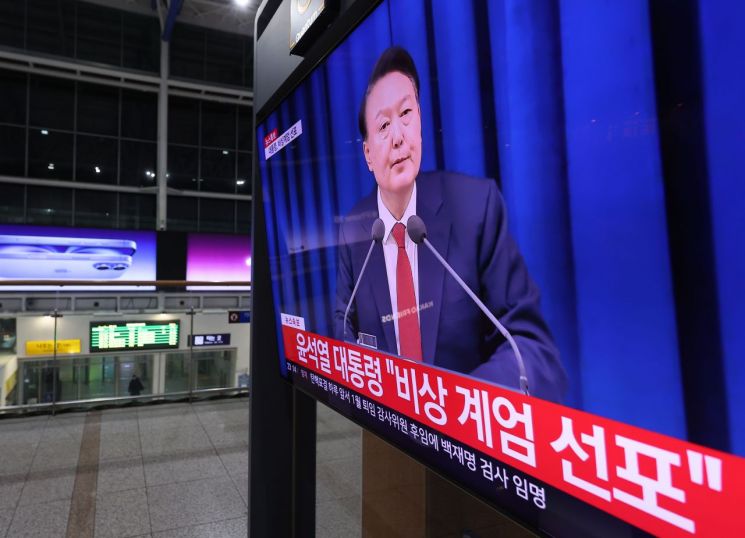
On the night of the 3rd, following President Yoon Suk-yeol's declaration of martial law, local governments nationwide that had entered an emergency system returned to normal operations. Although there was a tense moment when the Ministry of the Interior and Safety reportedly ordered the closure of government offices nationwide, the swift lifting of martial law prevented greater confusion. However, some local governments continue to closely monitor any additional changes in the situation even after the emergency system was lifted.
According to the Ministry of the Interior and Safety and local governments on the 4th, local governments across the country that had been under emergency duty with restricted public access the previous night allowed public entry and resumed normal operations that morning.
Seoul Mayor Oh Se-hoon, who went to his office immediately after the martial law declaration and held an emergency meeting with the mayoral team, only left after the National Assembly declared martial law invalid around 1 a.m. Until then, Mayor Oh continued meetings attended by the mayoral team, the chief of staff, and spokesperson, urging, "Please do your best to ensure that there are no changes to citizens' daily lives, including livelihood, prices, distribution, and transportation."
Notably, just over two hours after the martial law declaration, Mayor Oh officially expressed his opposition, stating, "I oppose martial law. Martial law must be withdrawn." He issued this statement around 12:23 a.m., adding, "As mayor, I will do my utmost to protect the daily lives of citizens." He also canceled his scheduled official overseas business trip to India and Malaysia that day.
Other local governments also showed urgency by convening emergency meetings. Gyeonggi Province Governor Kim Dong-yeon held an emergency executive meeting with department heads and even suspended the review schedule for next year's main budget. Governor Kim called the martial law "an outrage that takes South Korea back 45 years" and urged its lifting. Incheon Mayor Yoo Jeong-bok also convened an emergency meeting immediately after the martial law declaration, conducting situation assessments and countermeasure checks with the Deputy Mayor for Political Affairs, Head of the Citizen Safety Headquarters, Director of Planning and Coordination, and Director of the Administration Bureau.
Local governments outside the metropolitan area had similar responses. About an hour after the martial law declaration, Jeonbuk Province convened an emergency executive meeting chaired by Deputy Governor Choi Byung-kwan. Employees were ordered to be on emergency duty, and measures such as government office security and prohibition of leave were enforced. Gangwon Province called all department heads and section chiefs to work and entered emergency standby.
Jeonnam Province, Gwangju City, and Busan City also held emergency meetings with senior officials. It is reported that these meetings focused more on situation assessment and preparation rather than immediate response measures. In Jeju Province, an initial response team led by Governor Oh Young-hoon held a situation assessment meeting, and emergency video conferences were held with the Marine Corps 9th Brigade and Jeju Police Agency. Some local governments and their respective education authorities discussed whether students should attend school on the morning of the 4th.
However, there was some confusion on the ground regarding the control of local government offices. It was reported that the Ministry of the Interior and Safety had ordered the closure of government offices nationwide. Following this directive, some local governments closed their office doors and restricted public access.
In response, the Ministry of the Interior and Safety stated, "The duty command center instructed all government offices, including local government offices, to strictly manage access in preparation for emergencies, and this was communicated to all offices." They added, "This was an emphasis on the duty officers' responsibilities during emergencies, and a subsequent re-instruction from the duty command center clarified that local government offices are not included, so there is no access restriction." This means that after initially announcing a policy to strengthen management close to closure for ministries and local government offices immediately after the martial law declaration, local government offices were later excluded from the target.
Nevertheless, some local governments experienced confusion due to these directives. Governor Kim Dong-yeon stated at an emergency meeting the previous night, "I firmly reject the Ministry of the Interior and Safety's request to close our provincial office," and Incheon City, although receiving closure instructions, did not implement them. Seoul City also reported, "We have not received any separate notice," and confirmed that "normal duty operations were conducted."
© The Asia Business Daily(www.asiae.co.kr). All rights reserved.

![Clutching a Stolen Dior Bag, Saying "I Hate Being Poor but Real"... The Grotesque Con of a "Human Knockoff" [Slate]](https://cwcontent.asiae.co.kr/asiaresize/183/2026021902243444107_1771435474.jpg)















