KCCI, Report on 'Korean Employment Extension Measures Based on Japan's Employment Extension Cases'
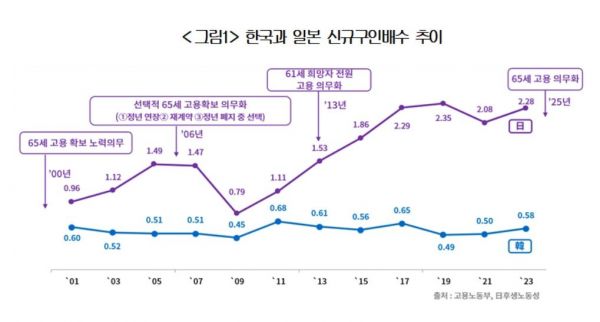
2.28 Jobs per Job Seeker in Japan, 0.58 in Korea
Concerns have been raised that implementing a uniform retirement age extension in South Korea, where the job market is already challenging, could potentially shrink employment opportunities for young people.
In a report titled "Korean Employment Extension Measures Based on Japan's Employment Extension Cases," released on the 4th by the Korea Chamber of Commerce and Industry (KCCI), it was stated, "Japan had a 'new job openings-to-applicants ratio' of 2.28 per job seeker as of last year, indicating a plentiful job market, and plans to mandate retirement age extension to 65 by 2025. In contrast, South Korea's ratio is 0.58, reflecting a tight job market, so a uniform retirement age extension could reduce employment opportunities for youth and should be implemented gradually."
Not only the job openings-to-applicants ratio but also Japan's capacity for quality employment is significantly higher than South Korea's. Comparing the number of unfilled positions (job openings minus hires) by company size, companies with 300 or more employees had 1,000 unfilled positions in South Korea (first half of the year), whereas Japan had 340,000 (2020). Additionally, the total number of unfilled positions across all companies was overwhelmingly higher in Japan at 934,000 compared to South Korea's 119,000.
A KCCI official expressed concern, saying, "Given the current poor economic conditions in South Korea, the prospects for improving youth employment are low. If the retirement of the older generation is delayed during such times, the scale of university graduate job seekers will inevitably shrink, worsening the employment market for young people."
Japan introduced the 65-year employment extension system in 2006, allowing companies autonomy to choose among abolishing the 60-year retirement age, extending the retirement age, or continuing employment (recontracting) based on their circumstances, rather than enforcing a uniform retirement age extension. As a result, 69.2% of Japanese companies maintained the 60-year retirement age while adopting the continued employment method up to 65, with 81.9% of large companies with over 300 employees implementing this continued employment approach.
Japan gradually established employment at age 65 through a three-stage process: 'Efforts to extend employment to 65 (2000) → Mandatory selective employment extension for certain individuals (2006) → Mandatory employment extension for all willing employees (2013?2025).' Implementing this over a long period of 25 years minimized burdens on companies and side effects in the labor market. Alongside mandating employment extension, Japan did not regulate the maintenance of working conditions or wage reductions, allowing companies autonomy to determine wage levels.
In contrast, South Korea mainly focuses on a law amendment (the Act on the Promotion of Employment of Older Persons) that uniformly extends the retirement age to 65, with a system establishment period of 5 to 8 years (2025?2033). The report noted that the uniform extension system and the significantly shorter establishment period would impose burdens on companies.
The report proposed that to establish employment for those aged 60 and above without adverse effects on the labor market, a gradual, phased, and autonomous employment extension system should be introduced.
It argued that employment extension should be implemented after the youth generation born in the 1990s has entered the labor market to minimize job conflicts. The average number of births in the 1990s was 687,000, about 34,000 fewer than the 721,000 average in the 1980s, while the 2000s saw a sharp decline of about 200,000 births.
Looking at the annual birth trends, the average number of births in the 1990s was 687,000, about 34,000 fewer than the 721,000 average in the 1980s, with a sharp decrease of about 200,000 in the 2000s. As the 1990s generation represents the last cohort of population growth, their employment and marriage play a crucial role in addressing low birth rates. However, job competition is intensifying, delaying employment and first marriage ages. If the retirement age is extended next year, the entry of those born in 1995 into the workforce will be delayed, naturally postponing marriage and childbirth, potentially becoming a significant obstacle to overcoming low birth rates.
Furthermore, the report stated that to prevent labor market side effects from employment extension, implementation should proceed in stages: 'Efforts to extend employment → Selective employment extension through labor-management agreements.' This is because the actual benefits of retirement age extension are concentrated in the primary labor market of large company regular workers, raising concerns about job conflicts with the youth generation and widening gaps with the secondary labor market. In fact, a recent forum held by the Low Fertility and Aging Society Committee revealed research showing that extending the retirement age to 60 reduced youth jobs by 11.6% in companies with over 1,000 employees.
Regarding employment extension methods, the report added that since each company’s workforce situation differs, autonomy should be guaranteed to allow companies to choose various employment extension methods suited to their conditions, such as retirement age extension, abolishing retirement age with recontracting, or transferring to affiliated companies, rather than enforcing a uniform retirement age extension. According to a KCCI survey, as of 2024, 29.4% of large companies employ workers aged 60 and above, whereas 78.9% of small and medium-sized enterprises, which suffer from chronic labor shortages, utilize workers aged 60 and above.
Kang Seok-gu, head of the KCCI Research Division, emphasized, "Although voices are growing to extend the retirement age to 60 and above in response to rapid low birth rates and aging, extending the retirement age could actually exacerbate employment insecurity by causing job conflicts with the youth generation and delaying early retirement of the older generation. We must actively pursue lifelong career policies, not just lifelong employment, such as vocational training and developing suitable jobs for older workers, to effectively extend the labor market participation period of workers aged 60 and above."
© The Asia Business Daily(www.asiae.co.kr). All rights reserved.
![Clutching a Stolen Dior Bag, Saying "I Hate Being Poor but Real"... The Grotesque Con of a "Human Knockoff" [Slate]](https://cwcontent.asiae.co.kr/asiaresize/183/2026021902243444107_1771435474.jpg)
















