KMA "Cannot Overlook Even After Martial Law Lifted"
Presidential Candidates "Government's Position on Medical Crisis Revealed"
Resigning Residents "Government Lies Exposed... Must Raise Voices"
President Yoon Suk-yeol's declaration of martial law on the 3rd has further exacerbated the conflict between the government and the medical community. Immediately after the martial law declaration, the martial law command issued a proclamation containing a stern order for resident doctors to return to work and a policy of punishment for violations, which sparked strong backlash from the medical sector.
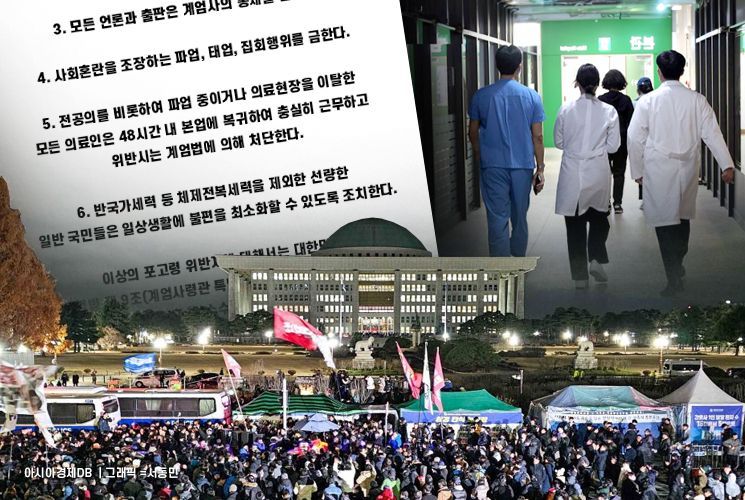
Medical community officials stated on the 4th, "The proclamation issued right after President Yoon's martial law declaration clearly reveals the government's perception of the current medical crisis," adding, "We will firmly uphold our principles and respond strongly."
Clause 5 of Article 1 in the martial law command's first proclamation states, "All medical personnel, including resident doctors who are on strike or have left the medical field, must return to their duties within 48 hours and work diligently; violations will be punished under the Martial Law Act." Among the six clauses that ban political activities such as assemblies and demonstrations and impose controls on the press and publication, the only clause specifically mentioning doctors, particularly resident doctors, reflects the government's hostile attitude toward physicians, according to the medical community.
Choi Anna, spokesperson for the Korea Medical Association (KMA), pointed out, "The term 'punish' is usually used against terrorist groups, isn't it? This is an issue that cannot be simply overlooked as if the martial law situation has been resolved." The Emergency Response Committee of the Catholic University Medical School Professors' Association also expressed in a statement that day, "The shocking fact is that the martial law proclamation explicitly designated doctors, who have been protecting the lives of the people on the front lines, as targets for punishment," lamenting, "Are doctors anti-state forces? Are doctors making wrong claims? Will resident doctors be demonized to the end? We feel deep sorrow beyond anger and despair."
Opinions also diverged on who exactly the "medical personnel on strike or who have left the medical field" mentioned in the proclamation referred to. This is because most resident doctors who collectively resigned in February this year in protest against the policy to increase medical school quotas were officially processed as having resigned as of June.
In response, the KMA issued an official statement that there are currently no resident doctors on strike as resigned personnel. Spokesperson Choi said, "Are they saying they will round up everyone who is away from the field, including those with dormant licenses or those on overseas leave, according to the proclamation?" She added, "No resident doctors are striking, so we suspect this is an attempt to mislead the public."
KMA presidential by-election candidates also uniformly opposed the martial law proclamation. Accordingly, whoever is elected as the next KMA president early next year is expected to take an even tougher stance.
Joo Su-ho, head of the Future Medical Forum, said, "It has been revealed that the president is the main culprit behind the medical disruption and that government policy is political repression against the medical community," adding, "The medical community will uphold its principles, and from our perspective, there is no sign that the current situation will be resolved anytime soon."
Kim Taek-woo, chairman of the Association of Metropolitan and Provincial Medical Associations, said, "Upon seeing the proclamation, I felt the government is treating the medical community like an anti-state force. It confirmed that the government's perception is seriously flawed," adding, "It will also serve as an opportunity for resigned resident doctors to think, 'The government indeed has no intention to resolve the situation.'"
Kang Hee-kyung, chair of the Emergency Response Committee at Seoul National University College of Medicine and Hospital, said, "The proclamation reveals the government's stance on the medical crisis," questioning, "We have tried for over half a year to broaden understanding, but does it make sense to use the term 'punish'?"
The resentment among resigned resident doctors is also deepening. Resident doctor A, who resigned from a training hospital in Gyeonggi Province, said, "Seeing this martial law situation, I think the president's claims will lose momentum, which will help resolve the medical crisis," adding, "Among resident doctors, there is talk that if an impeachment situation arises, the government's medical school quota increase will lose credibility, and the time will come to properly convey our demands."
Another resigned resident doctor B said, "The proclamation confirmed that the government considers resident doctors as enemies. The government's lie that the medical field has been functioning well without resident doctors was exposed by the forced return order," adding, "The time has come to convey the demands of resident doctors, and we will have to discuss again what to demand."
Park Dan, chair of the Korean Intern Resident Association Emergency Response Committee, wrote on social media, "As a member of the public, I feel once again devastated by this anti-democratic behavior," adding, "Dictatorship, please step down."
Meanwhile, the Ministry of Health and Welfare, the government department responsible for the medical crisis, stated immediately after the martial law command's proclamation was issued the previous day that it was "identifying implementation guidelines and response measures," but as of the morning of the 4th, it has not released any separate statements or explanations.
© The Asia Business Daily(www.asiae.co.kr). All rights reserved.

















