President Yoon Declares Emergency Martial Law on the 3rd
National Assembly Adopts Resolution to Lift It After Two and a Half Hours
Some People Power Party Members Oppose Martial Law, Political Situation Rapidly Changes
President Yoon Suk-yeol declared martial law, but the National Assembly resolved to lift it within two and a half hours. As martial law troops entered the main building of the National Assembly, creating a constitutional crisis and escalating the situation into a crisis, the political landscape was swept into a massive storm.
On the 4th, the National Assembly held a plenary session at 1 a.m. and passed a resolution to lift martial law in accordance with Article 77, Paragraph 5 of the Constitution, which states, "When a majority of the total members of the National Assembly request the lifting of martial law, the President shall lift it." A total of 190 lawmakers participated in the resolution.
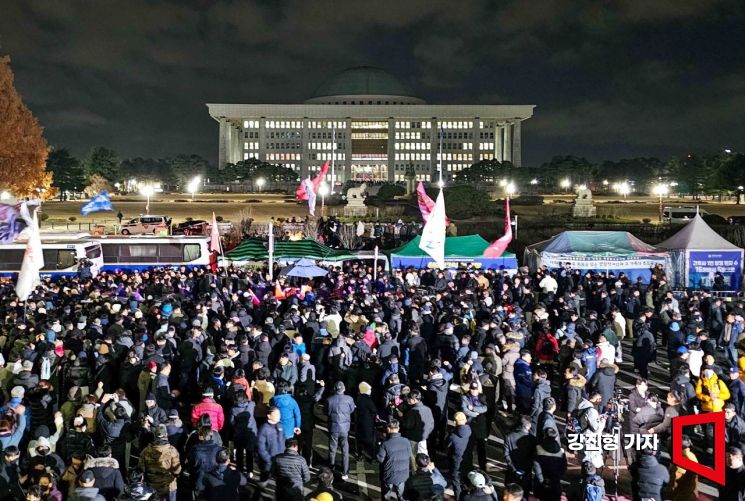 President Yoon Suk-yeol declared martial law, and on the 4th, citizens gathered in front of the National Assembly in Yeouido, Seoul, urging the lifting of martial law. Photo by Kang Jin-hyung
President Yoon held a briefing at 10:30 p.m. the previous night, stating, "I hereby declare martial law to protect the free Republic of Korea from the threat of North Korean communist forces, to eradicate the shameless pro-North anti-state forces who plunder the freedom and happiness of our people at once, and to uphold the free constitutional order." Following this, police blocked lawmakers attempting to enter the National Assembly, and martial law troops attempted to enter the Assembly, continuing the crisis situation.
After the adoption of the resolution to lift martial law, martial law troops began to leave the National Assembly, but since martial law has not yet been officially lifted, the political situation remains precarious.
A Massive Aftershock Approaches.
For now, the political sphere is caught in a storm as the constitutional order faces a crisis. President Yoon's gambit was blocked by the National Assembly, centered around the opposition parties, plunging the political situation into an unpredictable state.
Already, accusations of "rebellion" related to this martial law have emerged within political circles.
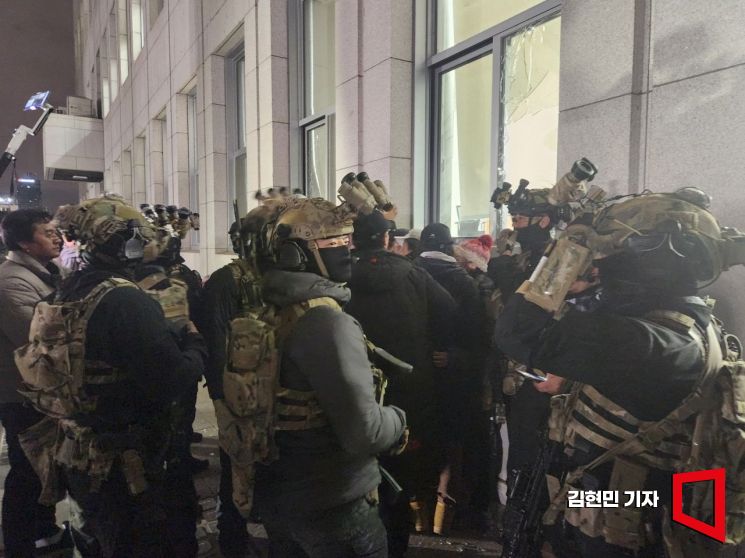 On the 4th, about 20 martial law troops attempted to break the glass windows and enter the main building of the National Assembly. Photo by Kim Hyun-min
Former People Power Party lawmaker Kim Woong stated on social media (SNS), "Martial law cannot be imposed on National Assembly activities by the executive branch or the judiciary," adding, "Martial law commanders or police prohibiting National Assembly activities constitute the crime of rebellion, and those currently blocking lawmakers from entering the Assembly will face severe punishment." Park Gyun-taek, the legal committee chairman of the Democratic Party of Korea, also called it a "practical rebellion," saying, "It is a clear constitutional violation that must be impeached."
Cho Guk, leader of the Innovation Party, said, "Martial law itself is illegal and a military rebellion from the start. It is the same behavior as the new military regimes of Chun Doo-hwan and Roh Tae-woo in the past." He added, "The procedures were not followed, and it does not meet the requirements for martial law," and said, "Defense Minister Kim Yong-hyun, who recommended the declaration of martial law, also attempted a military rebellion." He further stated, "President Yoon should be investigated and punished simply for announcing martial law," and "All conditions for impeachment are met."
The opposition parties are still cautious in their statements while martial law is in effect, but they warn that failure to lift martial law could lead to a serious situation.
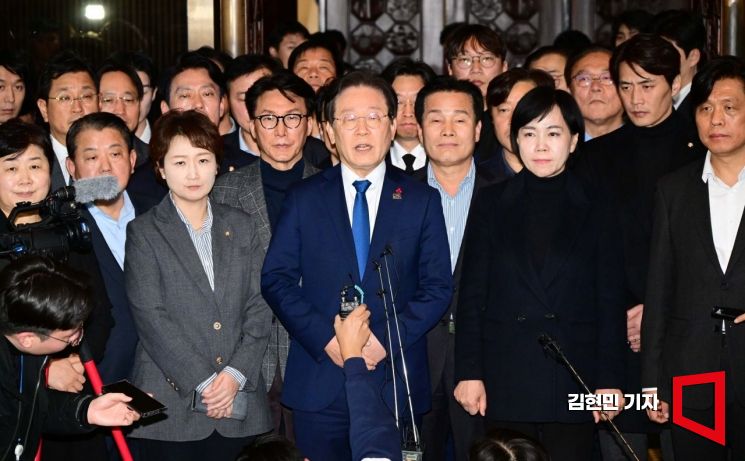 Lee Jae-myung, leader of the Democratic Party of Korea, is giving a statement in the early morning of the 4th at the National Assembly after the resolution demanding the lifting of martial law was passed. President Yoon Seok-yeol declared martial law in an emergency statement on the night of the 3rd. Photo by Kim Hyun-min
Cho Seung-rae, chief spokesperson for the Democratic Party of Korea, told reporters, "First and foremost, it is crucial that martial law is effectively declared null by the President," adding, "What is worrisome is that it might be nullified but not declared as such." He continued, "I hope that does not happen," and "If it does, a truly unfortunate situation will occur." Cho reiterated, "I sternly warn that martial law has been lifted by the National Assembly."
Confirmation of a Practical Split in the Conservative Camp
The resolution to lift martial law was passed unanimously, with participation not only from opposition parties but also some ruling party lawmakers.
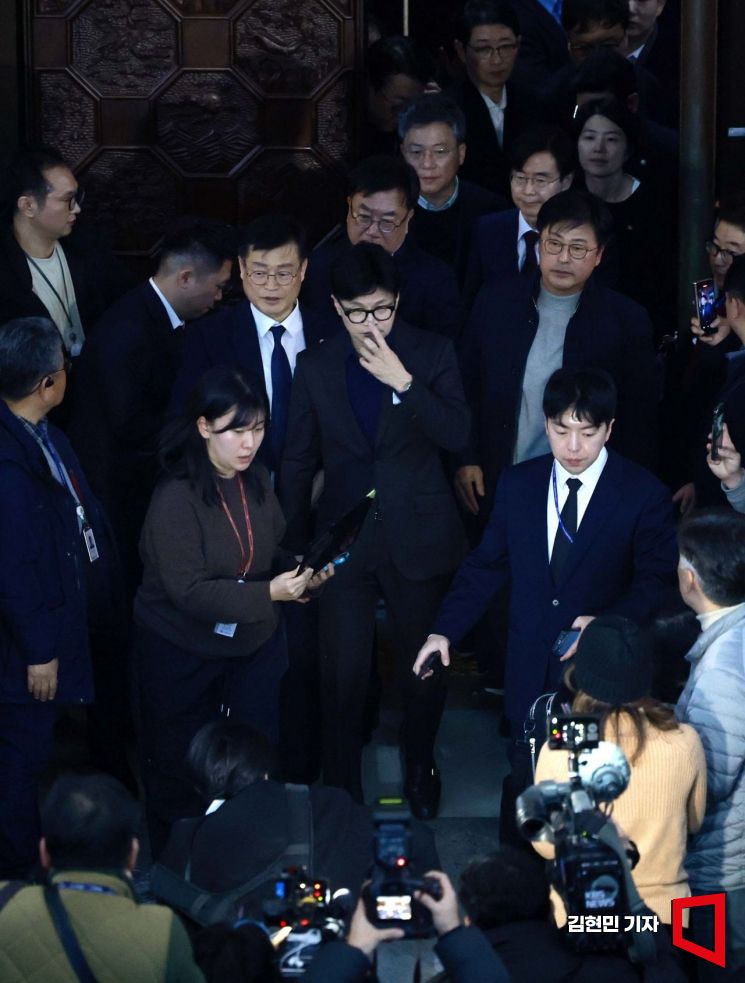 Handonghun, the leader of the People Power Party, is expressing his position after the resolution demanding the lifting of martial law was passed in the National Assembly in the early morning of the 4th. President Yoon Seok-yeol declared martial law in an emergency statement on the night of the 3rd. Photo by Kim Hyun-min
Within the People Power Party, a total of 18 lawmakers participated in the vote, demanding the lifting of martial law. Pro-Han Kangye lawmakers, known to be aligned with People Power Party leader Han Dong-hoon, formed the core group, contrasting with those who did not participate in the vote.
In particular, Leader Han explicitly opposed martial law from the early stages of the crisis, stating, "The President's declaration of martial law is wrong." This was effectively a declaration of rejection of President Yoon within the ruling party.
This shift signals political changes in the future, including the Kim Geon-hee special prosecutor law and the process of holding President Yoon accountable. Until now, the opposition secured 192 seats but fell short by 8 votes, repeatedly yielding to the President's veto power and other measures. However, the minimum conditions for a two-thirds coalition capable of impeaching the President have now been met.
© The Asia Business Daily(www.asiae.co.kr). All rights reserved.



















