Sharp Drop in Korea-Related Stocks Following Emergency Martial Law Declaration
Coupang, POSCO, KT, and Others Fall in Unison
October Job Openings Reach 7.74 Million, Exceeding Market Expectations
The three major indices of the U.S. New York Stock Exchange showed mixed movements near the flat line in early trading on the 3rd (local time). After the S&P 500 and Nasdaq indices hit record highs the previous day, the market appears to be taking a breather. Korean company stocks listed on the New York Stock Exchange plunged sharply following President Yoon Seok-yeol's declaration of martial law.
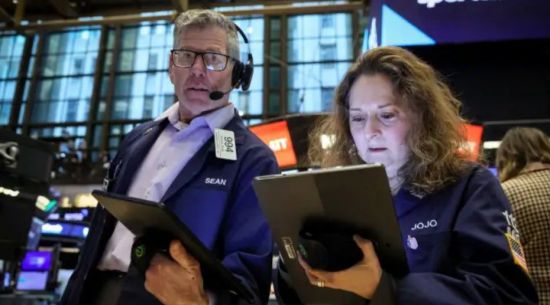
As of 11:45 a.m. in the New York stock market, the Dow Jones Industrial Average (Dow) focused on blue-chip stocks was down 0.43% from the previous trading day, standing at 44,591.44. The large-cap S&P 500 index fell 0.19% to 6,035.4, while the tech-heavy Nasdaq index rose 0.02% to 19,406.88.
By individual stocks, Korean-related shares all plunged sharply. Coupang dropped 4.39%. POSCO Holdings fell 4.4%, KT was down 1.21%, and KB Financial declined 2.37%. Investor sentiment toward Korean companies deteriorated significantly due to President Yoon's declaration of martial law. The MSCI Korea Exchange-listed fund (EWY) ETF tracking Korean companies fell 3.06%, and the Franklin FTSE Korea ETF dropped 2.44%.
Among major stocks, Super Micro Computer, which surged nearly 29% the previous day on news that no wrongdoing was found in an accounting investigation, fell 2.21%. Intel plunged 5.31%. The company announced the resignation of CEO Pat Gelsinger, who was brought in as a savior four years ago, the day before.
The New York Stock Exchange, taking a breather today, has been on an upward trend since Donald Trump, who promised business-friendly policies, won the presidential election on November 5. Since the election, the S&P 500 has risen 4.6%, the Nasdaq has jumped 5.2%, and the Dow average has increased 6%. The market is hopeful for a "Santa Rally" to continue into December.
Ken Mahoney, CEO of Mahoney Asset Management, said, "Since the election of a new president, the market has risen more than 10%, and there has never been a case where stock prices fell in December. This does not necessarily mean stock prices will rise in December, but given the substantial inflow of funds after the election, demand for stocks remains sufficient."
The U.S. job openings data released this morning exceeded market expectations, signaling that the labor market remains robust. According to the Job Openings and Labor Turnover Survey (JOLTs) released by the U.S. Department of Labor, job openings in October reached 7.74 million. This surpassed both the market forecast (7.51 million) and the previous month's figure (7.372 million). Layoffs were at their lowest level since June at 1.6 million, with a layoff rate of 1.0%. The increase in job openings and easing of layoffs indicate stabilization in labor demand.
The most important employment indicator is the November nonfarm payrolls report to be released by the U.S. Department of Labor on the 6th. The market expects an increase of 200,000 nonfarm jobs last month. The unemployment rate is expected to remain steady at 4.1%, the same as the previous month. Other employment indicators will be released consecutively, including ADP's November private nonfarm employment on the 4th and weekly initial jobless claims on the 5th.
These employment indicators are expected to influence the Federal Open Market Committee (FOMC) rate decision at the regular meeting scheduled for December 17-18. According to the Chicago Mercantile Exchange (CME) FedWatch, the federal funds futures market reflects a 68.6% probability that the Fed will cut rates by 0.25 percentage points at the December FOMC meeting and a 31.4% chance of holding rates steady.
Investors are also paying attention to speeches scheduled for this afternoon by Fed Board member Adriana Kugler and Chicago Federal Reserve Bank President Austan Goolsbee.
Government bond yields are mixed. The U.S. 10-year Treasury yield, a global bond yield benchmark, rose 1 basis point (1 bp = 0.01 percentage points) to 4.21%, while the 2-year Treasury yield, sensitive to monetary policy, fell 1 bp to 4.18%.
International oil prices are rising. West Texas Intermediate (WTI) crude oil increased $1.90 (2.79%) from the previous day to $70 per barrel, and Brent crude, the global oil price benchmark, rose $1.86 (2.59%) to $73.69 per barrel.
© The Asia Business Daily(www.asiae.co.kr). All rights reserved.

















