President Yoon Suk-yeol declared martial law on the evening of the 3rd.
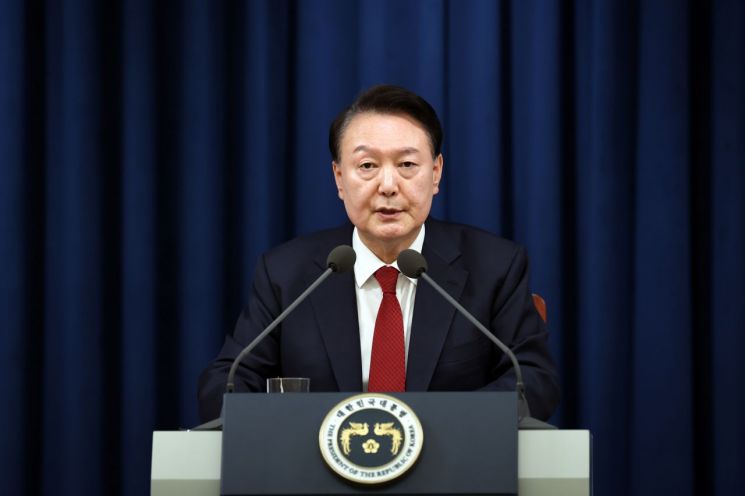 President Yoon Suk-yeol is delivering an urgent special address to the nation on the night of the 3rd at the Yongsan Presidential Office building in Seoul. Photo by the Presidential Office. Yonhap News.
The authority to declare martial law, stipulated in Article 77 of the Constitution, is one of the national emergency powers granted to the President of the Republic of Korea, along with the emergency decree power (Article 76, Paragraph 2) and the emergency financial and economic disposition and order power (Article 76, Paragraph 1).
Article 77, Paragraph 1 of the Constitution states, "The President may declare martial law in accordance with the law when, in times of war, armed rebellion, or a national emergency equivalent thereto, it is necessary to respond to military needs or to maintain public peace and order by means of armed forces."
Thus, the declaration of martial law is a national emergency power system that uses armed forces as a means to respond to military needs or to restore public peace and order.
There are two types of martial law: emergency martial law and security martial law. Article 2, Paragraph 2 of the Martial Law Act states, "Emergency martial law is declared by the President during times of war, armed rebellion, or a national emergency equivalent thereto when the country is in a state of armed conflict with the enemy or when social order is extremely disturbed, making the performance of administrative and judicial functions significantly difficult, in order to respond to military needs or to maintain public peace and order."
Paragraph 3 of the same article states, "Security martial law is declared by the President during times of war, armed rebellion, or a national emergency equivalent thereto when social order is disturbed and general administrative agencies alone cannot secure public safety, in order to maintain public peace and order."
In the case of emergency martial law, which is declared when the performance of administrative and judicial functions is significantly difficult due to a national emergency, special measures regarding the warrant system, freedom of the press, publication, assembly, association, and the authority of the government or courts may be taken as prescribed by law. (Article 77, Paragraph 3 of the Constitution)
Furthermore, Article 9, Paragraph 1 of the Martial Law Act (Special Measures Authority of the Martial Law Commander) states, "In an emergency martial law area, the martial law commander may take special measures regarding arrest, detention, seizure, search, residence, relocation, press, publication, assembly, association, or collective action when militarily necessary. In such cases, the martial law commander must announce the details of such measures in advance."
Paragraph 2 of the same article states, "In an emergency martial law area, the martial law commander may mobilize or requisition as prescribed by law, and if necessary, may order the investigation, registration, and prohibition of removal of goods to be provided as military supplies," and Paragraph 3 states, "In an emergency martial law area, the martial law commander may destroy or burn the property of citizens if operationally unavoidable."
On the day, the martial law command issued Proclamation No. 1 under the name of General Park An-su, appointed as the martial law commander, announcing six measures effective from 11 p.m., including ▲ banning all political activities such as the activities of the National Assembly, local councils, political parties, political associations, assemblies, and demonstrations ▲ prohibiting any acts denying the liberal democratic system or attempting to overthrow it, fake news, public opinion manipulation, and false agitation ▲ martial law control over all media and publications ▲ banning strikes, work stoppages, and assemblies that incite social disorder ▲ requiring all medical personnel, including interns on strike or who have left medical sites, to return to their duties within 48 hours and work diligently (violators will be punished under the Martial Law Act) ▲ and measures to minimize inconvenience to ordinary citizens, excluding anti-state forces and regime-overthrowing groups.
It also stated that violators of the above proclamation may be arrested, detained, and searched without a warrant under Article 9 of the Republic of Korea Martial Law Act (Special Measures Authority of the Martial Law Commander) and punished under Article 14 (Penalties) of the Martial Law Act.
Under emergency martial law, all administrative affairs and judicial administrative affairs, except for judicial trials, fall under military jurisdiction. Regarding military court jurisdiction under emergency martial law, Article 10, Paragraph 1 of the Martial Law Act stipulates that military courts shall try persons who commit any of 13 crimes, including crimes of rebellion, crimes against foreign relations, crimes related to national security, crimes disturbing public order, crimes involving explosives, obstruction of official duties, arson, currency-related crimes, murder, robbery, crimes stipulated in the National Security Act, crimes related to the safety management of firearms, knives, and explosives, and crimes prescribed by laws enacted for military necessity. However, the martial law commander may allow trials in the competent court if necessary.
Paragraph 2 of the same article states, "If there is no court in the emergency martial law area or if communication with the competent court is cut off, all criminal cases shall be tried by military courts notwithstanding Paragraph 1."
Meanwhile, Article 77, Paragraph 4 of the Constitution states, "When martial law is declared, the President shall immediately notify the National Assembly." Paragraph 5 of the same article states, "If the National Assembly requests the lifting of martial law by a majority vote of the total members, the President shall lift it."
© The Asia Business Daily(www.asiae.co.kr). All rights reserved.

![Clutching a Stolen Dior Bag, Saying "I Hate Being Poor but Real"... The Grotesque Con of a "Human Knockoff" [Slate]](https://cwcontent.asiae.co.kr/asiaresize/183/2026021902243444107_1771435474.jpg)















