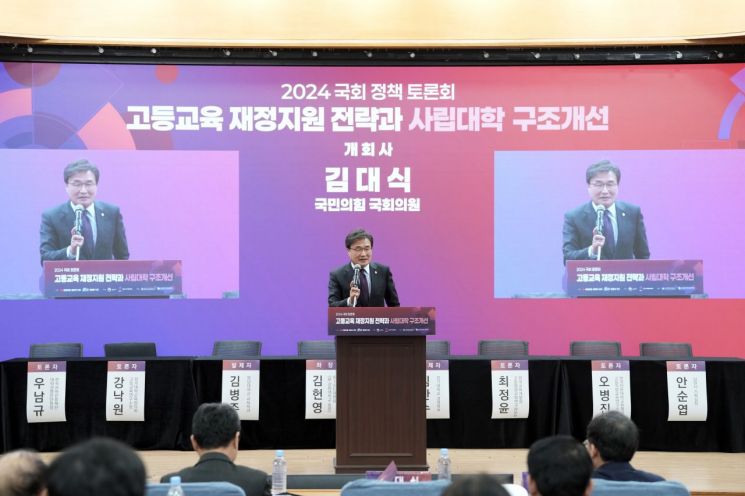
Kim Dae-sik, a member of the National Assembly's Education Committee representing Sasang District, Busan, held a forum on the theme of "Higher Education Financial Support Strategies and Structural Improvement of Private Universities" at the National Assembly Members' Office Building on the 3rd.
This forum was organized to address the fundamental issues of the higher education ecosystem, such as the decline in the school-age population and the crisis facing regional universities. At the event, Choo Kyung-ho, floor leader of the People Power Party, and Lee Ju-ho, Deputy Prime Minister for Social Affairs and Minister of Education, gave congratulatory remarks, and Kim Heon-young, former president of Kangwon National University, served as the chairperson.
Several education experts and officials also attended, including Lee Ha-woon, chairman of the Korea Private School Promotion Foundation, Kim Byung-joo, professor at Yeungnam University, and Kim Han-soo, professor at Kyonggi University.
In his opening remarks, Assemblyman Kim Dae-sik pointed out the seriousness of the crisis facing regional universities due to the declining school-age population and emphasized the need to enact the Private University Structural Improvement Act.
Kim said, "I hope today's discussion will become a turning point in resolving the crisis of private universities."
In his congratulatory speech, Lee Ju-ho, Deputy Prime Minister for Social Affairs and Minister of Education, stated, "Assemblyman Kim Dae-sik is leading a warm atmosphere in the Education Committee through smooth legislative activities. To solve the difficult issue of the declining school-age population in the higher education sector, we need to strengthen region-based policies such as RISE and Glocal University 30, and provide exit strategies for universities facing critical situations. I strongly agree with the topics discussed today."
Choo Kyung-ho, floor leader of the People Power Party, emphasized, "Assemblyman Kim Dae-sik has stepped up to solve the difficult issues in the higher education sector that someone must address. Since higher education and private universities are the sectors most affected by population decline, Minister Lee Ju-ho will support education, and members of the People Power Party, including myself, will assist in the National Assembly amid the changing environment."
Kim Jun-hyuk, a member of the Democratic Party representing Suwon City, Gyeonggi Province, said, "Assemblyman Kim Dae-sik is engaged in legislative activities that plant significant policies, just as his name means 'big' and 'plant.' If university financial issues go wrong, the entire region could suffer." He continued his congratulatory remarks by stating, "Structural improvement of private universities is necessary for the mutual growth of universities and regions, and the policies planted by Assemblyman Kim today are meaningful."
Cho Jung-hoon, secretary of the People Power Party representing Mapo District A, Seoul, said, "The topic addressed today is both very meaningful and challenging," adding, "What the higher education sector needs in this era is decentralization based on 'autonomy and responsibility.' I hope that with Assemblyman Kim Dae-sik's help, the National Assembly will gradually remove cumbersome obstacles so that universities can freely advance toward the world."
Kim Young-do, president of the Korea Council for College Education, expressed gratitude, saying, "I appreciate Assemblyman Kim Dae-sik's efforts to resolve the two major challenges facing universities?higher education finance and structural improvement of private universities?through legislation. Although these are difficult tasks to solve immediately, they must be addressed one by one as a historical responsibility."
Lee Ha-woon, chairman of the Korea Private School Promotion Foundation, emphasized, "I felt Assemblyman Kim Dae-sik's positive influence during the national audit. For the sake of local residents, the public, and the nation as a whole, difficult universities should be provided with exit strategies, and existing universities should develop regional specialization strengths."
Professor Kim Byung-joo of Yeungnam University, who delivered a presentation, said, "The financial difficulties of private universities are at the core of the crisis in the higher education ecosystem," and stressed the need for systematic support for universities in financial distress through financial diagnosis. He added, "Financial support strategies are the key solution to overcoming the crisis of private universities."
Professor Kim Han-soo of Kyonggi University emphasized the urgency of enacting the Private University Structural Improvement Act, arguing, "The orderly resolution of failing universities and linkage with local communities are necessary to solve the problems of private universities."
In the discussion, Choi Jung-yoon, head of the Higher and Lifelong Education Research Division at the Korea Educational Development Institute, said, "With the decline in the school-age population, universities must reinvent themselves as regional innovation hubs," emphasizing the need for structural reform centered on adult learners.
Kang Nak-won, director of the Higher Education Research Institute at the Korea Council for University Education, mentioned, "Financial support should back universities' autonomous innovation," suggesting the importance of efficient budget allocation.
Oh Byung-jin, director of the Higher Vocational Education Research Institute at the Korea Council for College Education, stated, "Junior colleges should seek new development directions through specialization strategies," while Woo Nam-gyu, university management diagnostician at the Korea Private School Promotion Foundation, said, "Systematic liquidation of failing universities and recovery plans for universities in financial crisis are necessary."
An Soon-yeop, planning officer of Namwon City, argued, "The closure of Seonam University starkly illustrates the financial crisis of regional private universities and the resulting economic and social damage to the region," and insisted, "Enacting the Private University Structural Improvement Act is necessary to secure the financial soundness of regional private universities and revitalize the local economy."
Concluding the forum, Assemblyman Kim said, "I hope the various opinions presented today will lead to practical and effective policies." He promised to do his best to achieve sustainable development of the higher education ecosystem through cooperation among the government, the National Assembly, and universities.
© The Asia Business Daily(www.asiae.co.kr). All rights reserved.

















