Struggling Due to Preference for Domestic Cars and Hybrids
Similar Performance Expected Domestically
"Brand Image Marketing Determines Success or Failure"
BYD, the world's largest electric vehicle manufacturer, struggled in the Japanese market this year. Although it grew compared to the previous year, it faced obstacles from domestic manufacturers, a preference for internal combustion engine vehicles, and revisions to the electric vehicle subsidy system. Similar difficulties are expected in the domestic market as well.
The Korea Automobile Mobility Industry Association (KAMA) released a report titled 'BYD's Status in the Japanese Market and Implications for the Domestic Industry' on the 3rd, detailing these findings.
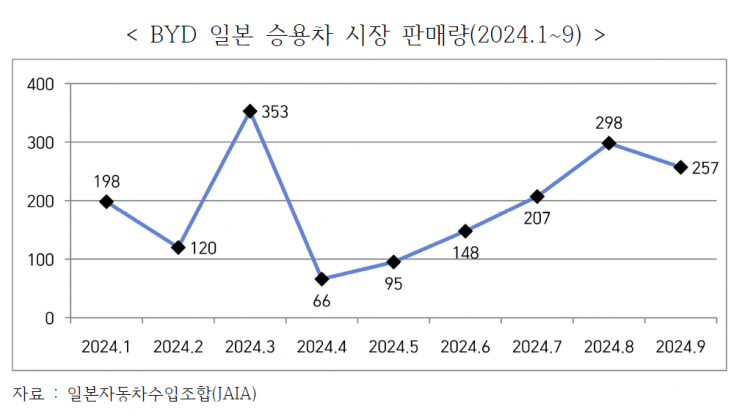
According to the report, BYD sold 1,742 passenger cars in the Japanese market from January to September this year, marking a 96.6% increase compared to the same period last year. BYD is known to have set an annual sales target of 10,000 units in Japan since it began full-scale deliveries in January 2023. Although it nearly doubled its sales compared to the previous year, it fell significantly short of its initial target.
BYD launched three models in Japan, starting with the compact electric sport utility vehicle (SUV) ATTO3, followed by the Dolphin and Seal. However, sales declined after the Japanese government revised its electric vehicle subsidy system. Since April, the clean energy vehicle subsidy in Japan added evaluation criteria such as charging and maintenance infrastructure and cybersecurity measures, reducing the purchase subsidy from 650,000 to 850,000 yen down to 350,000 yen.
Additionally, the domestic market's preference for local brands proved to be a formidable barrier. Last year, foreign brands accounted for only 6% of the Japanese passenger car market. The electric vehicle's status as a less preferred vehicle also worked against BYD. In Japan's eco-friendly vehicle market, hybrid electric vehicles (HEVs) dominated due to strategies by Toyota, Honda, and Nissan, while battery electric vehicles (BEVs) and fuel cell electric vehicles (FCEVs) accounted for only 2.2% of sales. The domestic electric vehicle market in Japan has shown a continuous decline, with sales shrinking year-over-year for ten consecutive months since December last year.
To change consumer perceptions of 'Chinese-made' and 'electric vehicles,' BYD adopted a localization strategy focused on offline channels. As of October, BYD had 33 official stores, with plans to increase to 90 by the end of this year. It is also conducting electric vehicle maintenance personnel training in cooperation with local parts suppliers. In response to subsidy cuts, BYD decided to provide its own support funds of up to 400,000 yen by the end of the year. Furthermore, it plans to install fast chargers at more than 100 locations by next year. Through these efforts, BYD aims to secure over 100 sales outlets nationwide and achieve annual sales of 30,000 units in Japan by 2025.
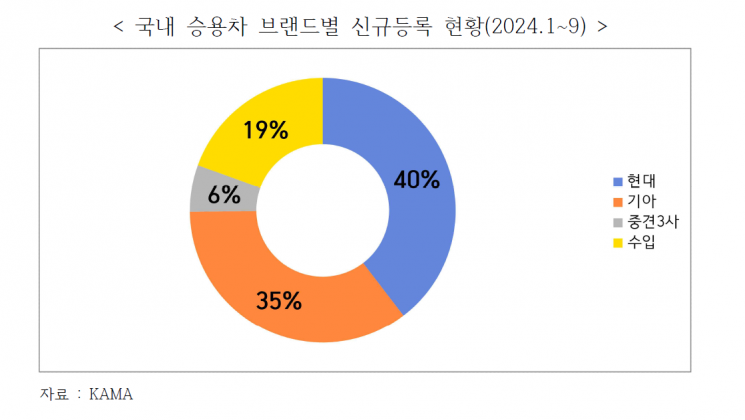
Since the domestic market shares similarities with Japan, BYD is expected to adopt a similar market entry strategy. The domestic passenger car market recorded an 81% share for domestic brands from January to September this year. Imported car sales also tend to be concentrated among a few brands. Overcoming the perception of being 'Chinese-made' and securing brand loyalty are essential.
Electric vehicle sales are also sluggish, similar to Japan. From January to September this year, newly registered electric vehicles in Korea totaled about 108,000 units, a 7.9% decrease compared to the previous year. Imported electric vehicles numbered 2,753 units as of September, marking a decline for three consecutive months.
The report analyzed, "BYD is expected to achieve limited results initially in the domestic market, similar to Japan. Domestic consumers place great importance on price and brand image when purchasing new cars, so marketing effectiveness after launch will directly impact mid- to long-term sales."
It also suggested the need for increased support and investment to protect the domestic electric vehicle industry and strengthen market competitiveness. A KAMA official stated, "The full-scale entry of Chinese electric vehicle manufacturers into the domestic market will pose new challenges to the sluggish new car market. It is time for the government and industry to cooperate in revitalizing the domestic market and securing competitiveness in the electric vehicle industry through long-term research and development (R&D) investment."
© The Asia Business Daily(www.asiae.co.kr). All rights reserved.

![Clutching a Stolen Dior Bag, Saying "I Hate Being Poor but Real"... The Grotesque Con of a "Human Knockoff" [Slate]](https://cwcontent.asiae.co.kr/asiaresize/183/2026021902243444107_1771435474.jpg)

















